
Oct 10, 2026B2B & Sourcing
Epoxy Flooring Alternatives: A Product Selection Guide for Wholesalers
Explore epoxy flooring alternatives from a wholesaler’s perspective. Compare customer needs, renovation conditions and supply requirements before expanding your flooring range.
Epoxy Flooring Alternatives: A Product Selection Guide for Wholesalers
Epoxy flooring alternatives include vinyl flooring, ceramic or porcelain tiles, polished concrete and other resin flooring systems. The right choice depends on why the customer wants an alternative: appearance, installation method, substrate suitability or a specific service requirement.
For wholesalers and distributors, this question can reveal opportunities to expand a product range. However, a request for an “epoxy alternative” does not always mean the buyer needs a different material. They may simply want a different finish or installation system.
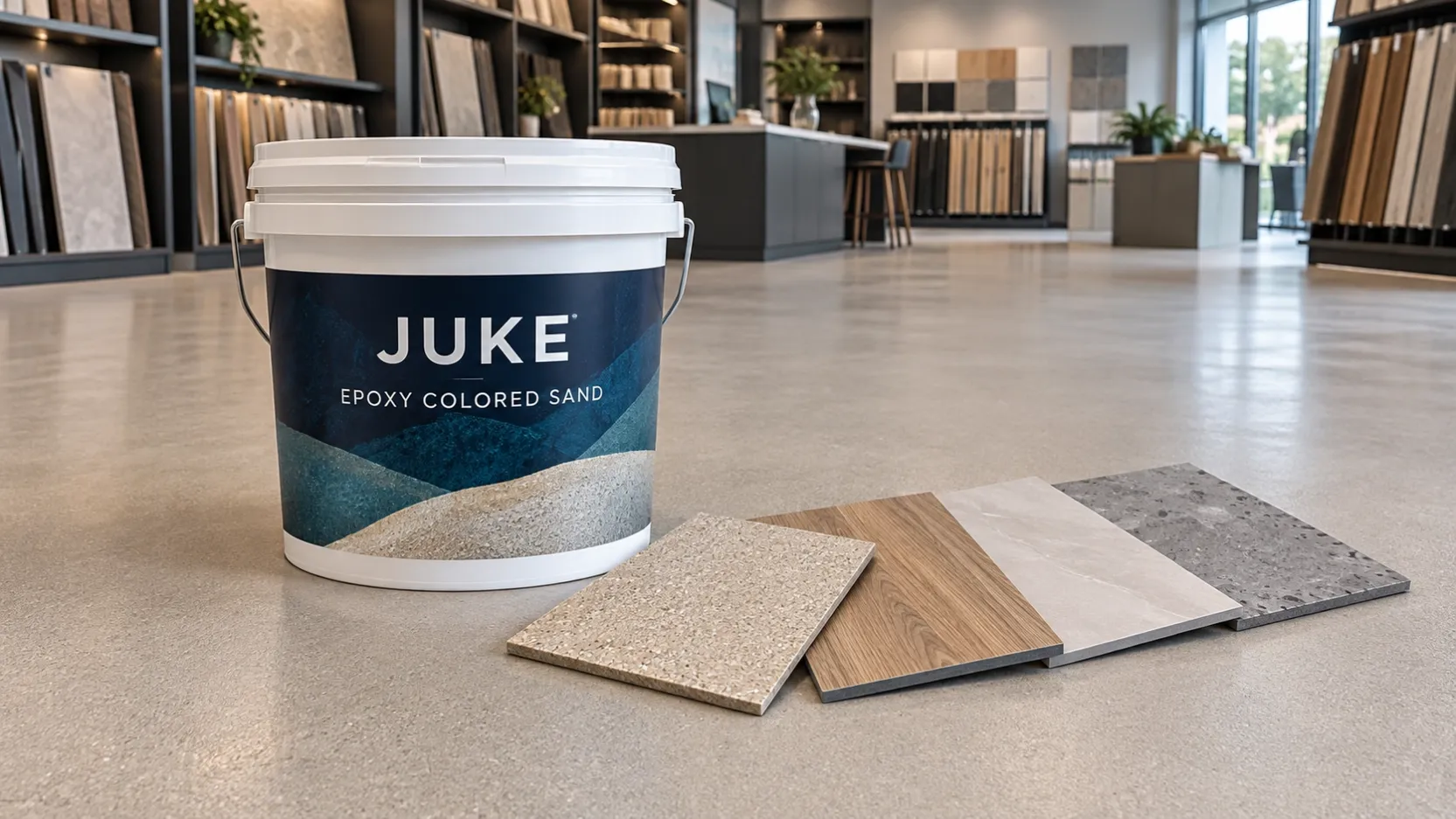
JUKE Epoxy Colored Sand Self-Leveling remains an epoxy product. It offers a decorative option within the epoxy category, particularly for renovation over suitable existing tiles.
Find Out Why Customers Want an Alternative
Before recommending products, identify the problem with the current proposal.
A customer may want wood-look planks rather than a continuous floor. Another may want to retain an existing tiled base. A third may need performance that requires a different, specifically documented system.
Ask:
What needs to change: the appearance, installation process or service performance?
This helps sales staff narrow the options and prevents unsuitable recommendations based only on a product name.
For wholesalers, recurring answers can guide purchasing decisions. If customers repeatedly request a continuous mineral finish, that creates a different opportunity from demand for wood-look flooring.
Separate Different Flooring Categories From Different Epoxy Systems
Two routes deserve consideration.
The first is choosing another flooring category, such as vinyl, tile or polished concrete.
The second is choosing another system within the epoxy category, such as decorative colored sand instead of a standard coating.
Resin flooring also includes different chemistries and construction methods. FeRFA distinguishes coatings, multilayer floors, flow-applied systems and screeds, showing why the complete system matters when comparing products.
Customer request | Category or system to evaluate | Purchasing question |
|---|---|---|
Wood-look plank appearance | Vinyl plank flooring | Which format and installation method fit the project? |
Individual tile layout | Ceramic or porcelain tile | What preparation and complete installation materials are required? |
Exposed concrete appearance | Polished concrete | Is the existing slab suitable for the specified finish? |
Continuous decorative mineral surface | Epoxy colored sand | What substrates, coverage and preparation does the system support? |
Specific traffic or exposure requirement | Documented flooring system | Does the complete system meet the project specification? |
Vinyl Flooring as an Epoxy Alternative
Vinyl is worth evaluating when customers want manufactured plank or tile designs.
It is available in several installation formats, including gluedown, loose lay and rigid-core systems. These formats have different requirements, so a wholesaler should specify the actual product rather than offer generic installation advice.
Some products permit installation over existing tiles. Preparation requirements still apply, including product-specific treatment of grout lines and uneven surfaces.
For wholesalers, check pack coverage, accessories, installation instructions and continuity of supply for each design.
Tile as an Epoxy Alternative
Tile deserves consideration when the customer specifically wants a tiled layout or individual units.
A tile quotation should identify the complete installation scope, including substrate preparation, fixing materials, grout and any required floor removal.
For tile wholesalers, the sales opportunity may also include customers who want to renovate their existing tiles without replacing them. These customers could be candidates for an overlay system, subject to assessment of the existing floor.
The decision should follow the desired finish and installation conditions. Replacing suitable tiles is not automatically necessary, while damaged or unstable tiles cannot simply be ignored.
Polished Concrete as an Epoxy Alternative
Polished concrete suits customers seeking a finish based on the concrete slab itself.
Its appearance depends partly on the slab, aggregate and processing depth. The Concrete Polishing Council recommends an approved mock-up on the actual slab to establish expectations.
Wholesalers serving polishing contractors can evaluate the associated equipment, tooling and treatment products as a separate supply opportunity.
When tiles cover the concrete, access to the slab becomes part of the project scope. That should be considered before comparing polishing with an overlay.
When Another Epoxy System May Be the Better Fit
Sometimes the customer wants an alternative to the appearance of a standard epoxy coating.
JUKE Epoxy Colored Sand Self-Leveling creates a continuous decorative surface with a fine mineral appearance and a generally matte-to-satin finish.
It can be applied directly over suitable existing tiles. When tiles are firmly bonded, stable, clean and dry, the system does not require demolition, grinding or primer.
Concrete follows a different route: mechanical grinding, repairs where required and a compatible epoxy primer.
The factory-matched two-component system incorporates colored sand, fillers and pigments into Part A. Installers mix Part A with Part B before pouring and spreading the material.
This gives wholesalers a specific product proposition: a decorative epoxy renovation system with a direct-to-tile application route.
Compare Complete Project Costs
Avoid ranking flooring categories by material price alone.
Compare:
- Preparation and repair work.
- Complete flooring materials and accessories.
- Installation labor.
- Material losses.
- Curing or access requirements.
- Delivery costs.
JUKE’s current standard 20 kg set covers approximately 10 m² at a typical consumption of 2 kg/m². Actual coverage varies with substrate flatness and application conditions.
Vinyl and tile estimates need their own cutting allowances and accessory quantities. Polishing quotations need a clearly defined finish and work scope.
Use equivalent project assumptions before deciding which option offers better value.
Choose Products Your Channel Can Support
A useful addition to a wholesale range needs more than an attractive sample.
Confirm whether your customers have suitable installation resources. Check what training, documentation and sales materials the supplier provides.
For each candidate product, request:
- Representative samples.
- Current technical and safety documentation.
- Installation instructions.
- Packaging and storage information.
- Minimum order and delivery terms.
- Branding and marketing support.
JUKE offers factory-direct supply, a minimum order of 36 sets, mixed-color trial orders, OEM labels and marketing support.
Start with a focused trial range and collect feedback from customers and installers before increasing stock.
Frequently Asked Questions
What is the best alternative to epoxy flooring?
There is no single best option. Identify the desired appearance, substrate and service requirements, then compare specific products.
Is epoxy colored sand an epoxy alternative?
It is an alternative to some epoxy finishes or systems, but it remains epoxy flooring.
Can wholesalers stock epoxy and non-epoxy flooring?
Yes. A broader range can address different customer requests, provided sales staff understand each product’s installation requirements.
Can JUKE go over existing vinyl?
Direct application over vinyl should not be assumed. JUKE’s standard guidance covers suitable tiles and correctly prepared concrete. Other substrates require technical assessment.
Explore a Decorative Flooring Range With JUKE
JUKE supplies epoxy colored sand self-leveling flooring for distributors, building material wholesalers, tile suppliers and retail channels.
Share your existing product range and typical renovation projects to discuss a 36-set trial order, OEM labels and marketing support.