
Oct 10, 2026B2B & Sourcing
Epoxy Flooring vs Terrazzo: A Selection Guide for Flooring Distributors
Compare decorative epoxy flooring and terrazzo by composition, appearance, installation and purchasing requirements. Understand where epoxy colored sand fits before selecting products for your distrib
Epoxy Flooring vs Terrazzo: A Selection Guide for Flooring Distributors
Epoxy flooring and terrazzo are not completely separate categories. Terrazzo can use either a cement or epoxy binder, while epoxy flooring includes many systems that are not terrazzo.
For distributors comparing “epoxy flooring vs terrazzo,” the first step is to identify the actual products. A decorative epoxy colored sand system, an epoxy terrazzo floor and a cement-based terrazzo installation have different construction methods and purchasing requirements.
This guide explains those differences and helps wholesalers decide which systems fit their customers and sales channels.
What Is Terrazzo Flooring?
Terrazzo combines decorative aggregates with a binder and is processed to expose the aggregate at the finished surface. The National Terrazzo & Mosaic Association describes aggregates including marble, quartz, granite and glass, used with cement or epoxy and polished to produce the finish.
The binder matters. A quotation for “terrazzo” should identify whether the system is cement-based or epoxy-based, together with its build-up and installation requirements.
Distributors should also distinguish poured-in-place systems from manufactured terrazzo products. Confirm which format the customer needs before requesting prices.
Is Epoxy Colored Sand the Same as Epoxy Terrazzo?
No. Sharing epoxy resin and decorative mineral materials does not make two systems identical.
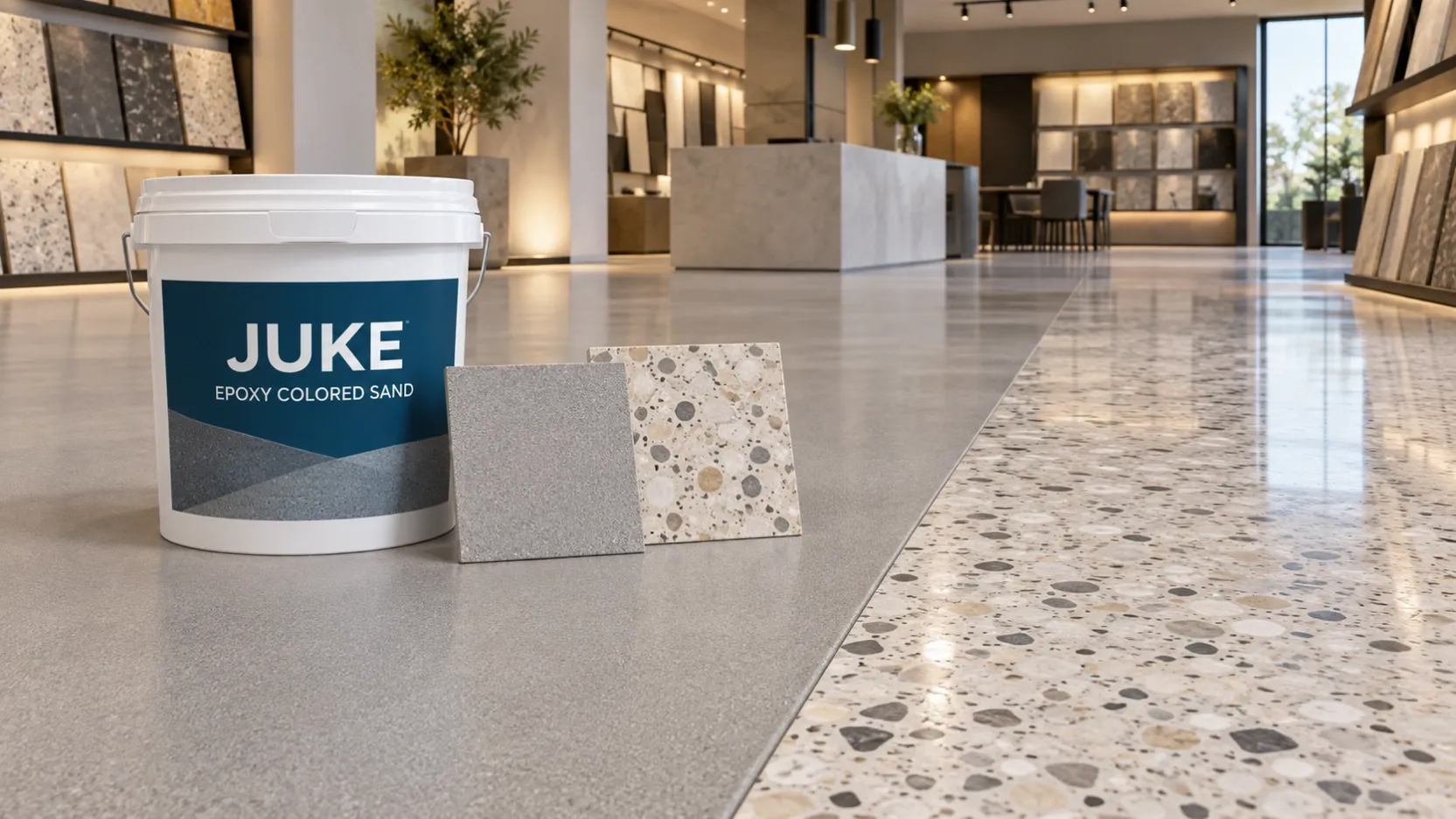
JUKE Epoxy Colored Sand Self-Leveling uses a factory-prepared Part A containing colored sand, fillers and pigments, mixed with Part B hardener before application. It creates a fine mineral finish through its application process.
Epoxy terrazzo is a different system, with its own aggregate selection, installation and finishing requirements. NTMA describes conventional epoxy terrazzo toppings at nominal thicknesses of 1/4 inch or 3/8 inch. Those specifications should not be transferred to JUKE’s colored sand system.
JUKE should therefore be sold as epoxy colored sand self-leveling flooring, rather than described as equivalent to epoxy terrazzo.
Selection factor | JUKE epoxy colored sand | Terrazzo |
|---|---|---|
Product identity | Decorative epoxy self-leveling system | Aggregate flooring with a cement or epoxy binder |
Appearance | Fine, closely textured mineral finish | Exposed decorative aggregate |
Material supply | Factory-matched two-component set | System-specific binder, aggregate and accessories |
Application | Mix, pour, spread and allow to cure | Installation and finishing according to the selected terrazzo system |
Finishing process | No terrazzo grinding-and-polishing stage in the standard application | Aggregate exposure achieved through finishing |
Purchasing focus | Complete sets, coverage and substrate preparation | Complete specification, material selection and installation scope |
Compare the Appearance Customers Want
Both systems can offer decorative mineral character, but samples should make their differences clear.
JUKE produces a fine colored sand appearance with a generally matte-to-satin finish. It suits buyers seeking a continuous surface with a relatively subtle mineral texture.
Terrazzo offers exposed aggregate as a defining visual feature. Aggregate size, color, binder and finishing affect the result. Divider strips can also form part of the design, although their use depends on the system and project.
Ask whether the customer wants visibly exposed aggregate or a finer decorative surface. Use representative samples to establish expectations rather than relying on the word “stone-like.”
Do not promise that colored sand flooring will reproduce a particular terrazzo design.
Compare Installation Requirements
Installation capability is an important consideration for distributors.
Terrazzo projects require the materials, equipment and workmanship appropriate to the specified system. Wholesalers serving this market may supply aggregates, binders, divider strips and grinding products. NTMA identifies these among the materials and equipment supplied to the terrazzo industry.
JUKE uses a different application sequence. Installers mix the factory-matched components at an 8:1 ratio by weight, pour the material, spread it with a notched tool and use a spiked roller according to the instructions.
Accurate mixing, organized application and protection during curing remain essential. A packaged system does not remove the need for installation training.
Assess the Existing Floor Before Comparing Options
A renovation quotation should begin with the substrate.
JUKE supports direct application over suitable existing tiles. The tiles must be firmly bonded, stable, clean and dry. Under those conditions, demolition, grinding and primer are not required.
Concrete requires mechanical grinding, repairs where needed and a compatible epoxy primer. Self-leveling behavior does not replace repairs or resolve active movement.
For terrazzo, obtain preparation requirements for the exact proposed system. Do not assume that all terrazzo installations require demolition, or that every existing surface can remain.
The substrate, floor build-up and project details determine the available installation routes.
Compare Complete Project Costs
Neither category should be judged by a single material price.
For terrazzo, request a quotation covering the selected binder and aggregate, substrate preparation, accessories, installation and finishing.
For JUKE, account for complete sets, preparation, primer where required, application labor and material losses.
JUKE’s current standard 20 kg set covers approximately 10 m² at a typical consumption of 2 kg/m². Actual coverage varies with substrate flatness and application conditions.
Also compare the specified appearance and work scope. A fine colored sand floor and a polished exposed-aggregate terrazzo floor are different deliverables, even when both are proposed for the same room.
Distributors should explain the cost components without promising a universal percentage saving.
Match the Product to Your Distribution Business
A supplier of terrazzo installation materials may prioritize specialist contractors and project specifications.
A tile or building material wholesaler may find a packaged decorative renovation system easier to introduce to its existing customers—provided suitable installation support is available.
For JUKE, the product proposition includes:
- Direct application over suitable tiles.
- A continuous decorative colored sand finish.
- Factory-matched components.
- Factory-direct supply.
- A minimum order of 36 sets.
- OEM labels and marketing support.
Evaluate the opportunity through samples and a trial installation. Confirm that sales staff can explain the finish, substrate requirements and quantity calculation before expanding stock.
Frequently Asked Questions
Is terrazzo always cement-based?
No. Terrazzo can use cement or epoxy binders. Confirm the specific system when comparing suppliers.
Is JUKE epoxy colored sand a terrazzo system?
JUKE is a decorative epoxy colored sand self-leveling system. It should not be presented as equivalent to conventional epoxy terrazzo.
Which is cheaper: epoxy colored sand or terrazzo?
Compare project-specific quotations with complete installation scopes. Preparation, materials, finishing and labor influence the result.
Can JUKE be applied over existing terrazzo?
An existing terrazzo floor needs technical assessment, including its condition, surface treatments and compatibility. Do not automatically apply the tile preparation instructions to terrazzo.
Can distributors order JUKE with custom labels?
JUKE offers OEM labels, subject to agreement on artwork and packaging. The minimum order is 36 sets.
Discuss Decorative Flooring Supply With JUKE
JUKE supplies epoxy colored sand self-leveling flooring for distributors, wholesalers, tile suppliers and retail channels.
Share your customer profile and typical renovation projects to discuss samples, a trial order, OEM labels and marketing support.