
Oct 12, 2026B2B & Sourcing
Epoxy Flooring vs Microcement: A Buying Guide for Distributors
Compare epoxy colored sand flooring and microcement by appearance, substrate preparation, application stages and wholesale supply requirements before adding a decorative system to your range.
Epoxy Flooring vs Microcement: A Buying Guide for Distributors
Epoxy flooring and microcement can both provide continuous decorative surfaces, but their formulations, application methods and complete installation requirements differ.
For distributors comparing epoxy flooring vs microcement, the most useful questions concern the specific products: What finish do customers want? Which substrates are supported? What materials and installation skills are required?
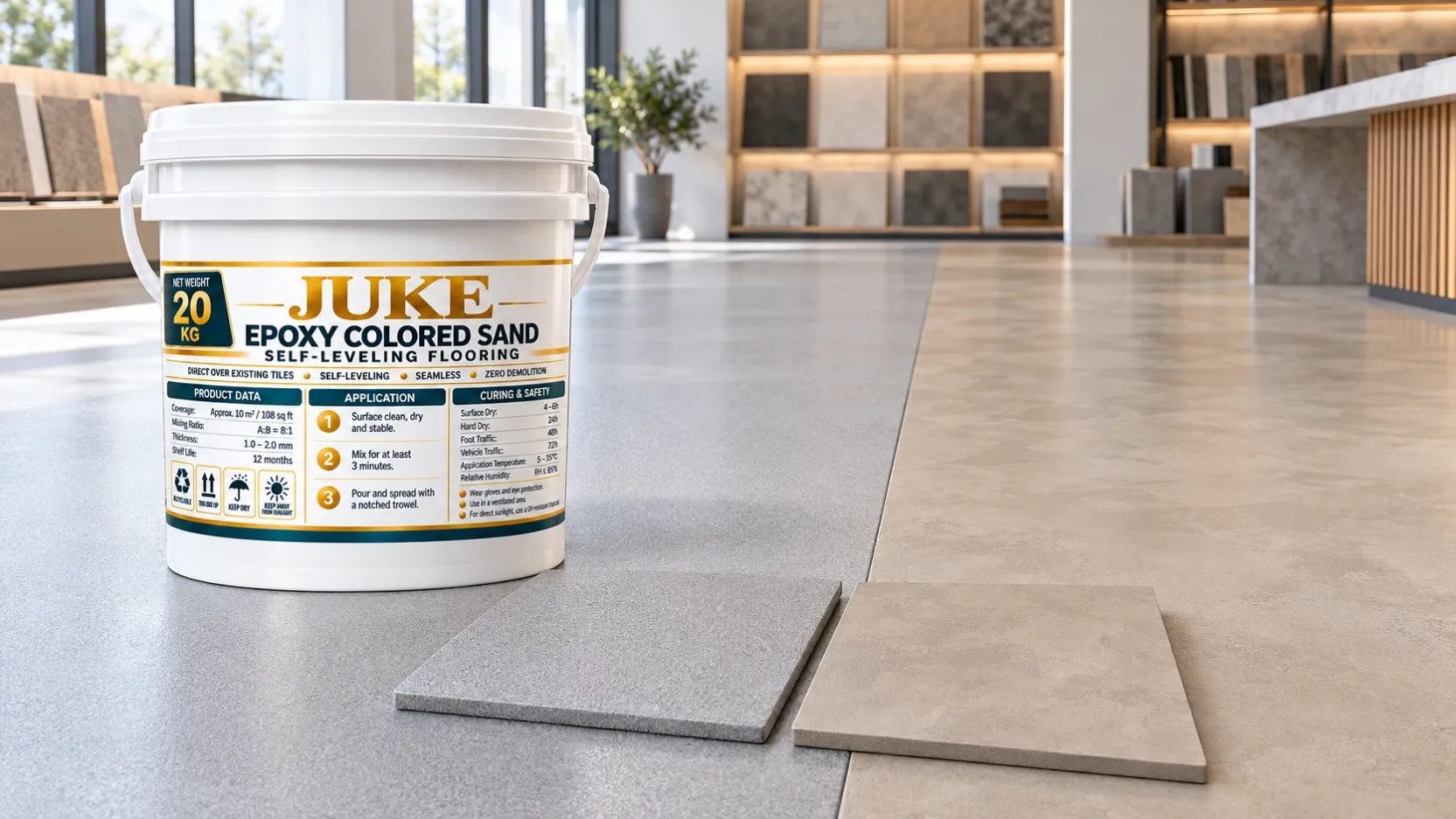
JUKE Epoxy Colored Sand Self-Leveling offers a fine mineral finish through a factory-matched two-component system. Microcement suppliers offer different formulations and layered application systems, so buyers should assess each manufacturer’s instructions individually.
Compare Specific Systems, Not Just Product Categories
“Epoxy flooring” includes thin coatings, decorative systems and self-leveling products. These should not be treated as interchangeable.
Microcement also covers different product ranges. For example, Topciment supplies ready-to-use decorative systems with their own primers, application layers and protective sealers. Its instructions demonstrate why the complete system must be identified before purchasing.
This guide compares JUKE’s epoxy colored sand system with decorative microcement flooring. It does not assume that every product in either category has the same performance.
Selection factor | JUKE epoxy colored sand | Microcement |
|---|---|---|
Product format | Factory-matched Part A and Part B | Depends on the selected formulation |
Appearance | Fine decorative mineral texture | Product-specific decorative finish |
Application | Mix, pour, spread and allow to cure | Manufacturer-specific layers and finishing |
Suitable existing tiles | No demolition, grinding or primer required | Overlay possible for selected systems, with specified preparation |
Concrete preparation | Grinding, repairs and compatible epoxy primer | Follow the selected system’s requirements |
Additional surface protection | Normally unnecessary for standard indoor JUKE applications | Check specified sealer or protective coats |
Wholesale comparison | Complete sets and consumption | Complete system materials and consumption |
Start With the Desired Appearance
Customers may consider both products when they want a continuous surface rather than a plank or tile layout.
JUKE produces a fine colored sand appearance with a generally matte-to-satin finish. Its decorative character comes from the colored mineral materials incorporated into the system.
For microcement, establish the expected texture and finish using the supplier’s samples and application guidance. Review how the selected product is applied and what appearance the installer is expected to achieve.
Distributors should display representative samples rather than describe both options simply as “concrete-look flooring.”
A practical sample presentation includes a close-up of the texture, a larger installed area and the finish under natural light. This helps customers understand what they are purchasing.
Can Both Systems Be Applied Over Existing Tiles?
Selected products in both categories can support tile renovation.
JUKE can be applied directly over tiles that are firmly bonded, stable, clean and dry. Under those conditions, tile demolition, grinding and primer are not required.
Loose tiles, contamination and damaged areas must still be addressed. The coating does not make an unstable substrate suitable.
Microcement overlay requirements vary. Topciment’s Efectto Quartz instructions, for example, include preparation of tile joints and use of a suitable primer. This is a requirement of that particular system, rather than a rule for every microcement product.
For wholesalers, the comparison should identify the complete preparation route. Avoid presenting tile overlay as exclusive to JUKE, or assuming that every overlay product requires the same work.
Compare the Application Stages
Installation stages affect training, material planning and scheduling.
JUKE’s factory-prepared Part A incorporates colored sand, fillers and pigments. Installers mix it thoroughly with Part B hardener at an 8:1 ratio by weight.
The mixed material is poured onto the prepared floor, spread with a notched tool and treated with a spiked roller according to the instructions.
Self-leveling behavior helps form the surface, but it does not replace repairs to cracks, holes or significant unevenness.
For microcement, request the exact layer sequence, drying intervals and finishing requirements. Topciment’s Efectto PU technical instructions include thin-layer application, drying between layers and protective sealer coats.
Do not promise that either system is universally faster. Compare preparation, application and reopening requirements for the actual project.
Does Either System Require a Sealer or Topcoat?
Check the complete specification.
JUKE normally requires no additional topcoat for standard indoor applications. Project-specific exposure and performance requirements should still be assessed.
For microcement, confirm whether the quotation includes all specified protective materials. The selected finish may depend on the supplier’s sealer system.
Distributors should know which components are essential and which are optional. This prevents customers from buying only part of an installation system.
The same principle applies to primer: JUKE’s suitable tile route does not require primer, while its concrete route requires mechanical preparation and a compatible epoxy primer.
Compare Complete Installed Costs
A bucket price alone does not provide a useful comparison.
For JUKE, calculate the required sets, preparation materials, primer where necessary, application labor and losses.
For microcement, calculate every required layer and accessory, along with preparation, labor and finishing.
Include:
- Substrate assessment and repairs.
- Complete flooring materials.
- Required primers and protective coats.
- Application labor and equipment.
- Material losses.
- Access restrictions and reopening arrangements.
JUKE’s current standard 20 kg set covers approximately 10 m² at a typical consumption of 2 kg/m². Actual coverage varies with substrate flatness and application conditions.
Use the specified consumption for each product in a microcement system. Do not compare the coverage of one finishing layer with the coverage of a complete epoxy installation.
Check Product Suitability and Support
A continuous decorative appearance does not establish suitability for every use.
Define the customer’s traffic, cleaning regime, sunlight exposure and other service requirements. Request relevant technical documentation and confirm the proposed application with the supplier.
Also consider the support your channel needs. Sales staff should be able to explain preparation, estimate quantities and recognize when technical assessment is necessary.
Retailers and e-commerce sellers need clear instructions available before purchase. Distributors supplying installers may also need demonstrations and troubleshooting guidance.
Choose products your customers can install successfully and your team can support accurately.
Evaluate the Wholesale Opportunity
Microcement and epoxy colored sand may serve overlapping design interests while offering different installation systems.
For tile suppliers and building material wholesalers, JUKE provides a decorative renovation option with a defined direct-to-tile route.
Its channel offer includes factory-direct supply, a minimum order of 36 sets, mixed-color trial orders, OEM labels and marketing support.
Before expanding stock, evaluate samples and complete a representative installation. Use feedback to refine product listings and customer guidance.
Frequently Asked Questions
Is epoxy colored sand the same as microcement?
No. JUKE is a two-component decorative epoxy system. Microcement products have their own formulations and installation requirements.
Can both be used over existing tiles?
Selected systems can. Confirm substrate suitability and the preparation specified by each manufacturer.
Which is cheaper?
Compare complete project quotations. Preparation, layer requirements, labor and finishing influence the result.
Can JUKE also be applied to walls?
JUKE Epoxy Colored Sand Self-Leveling is a flooring system and should not be promoted for wall application.
Can wholesalers order JUKE with custom branding?
JUKE offers OEM labels, subject to agreement on artwork and packaging. The minimum order is 36 sets.
Discuss Decorative Flooring Supply With JUKE
JUKE supplies epoxy colored sand self-leveling flooring for distributors, wholesalers, tile suppliers and retail channels.
Share your sales channel and typical renovation projects to discuss samples, a trial order, OEM labels and marketing support.