
Sep 23, 2026Technical & Installation
Do You Need a Primer for Epoxy Color Sand Flooring?
Learn when epoxy color sand flooring needs a primer, why suitable tile can often be coated directly, and when porous concrete may require sealing or priming.
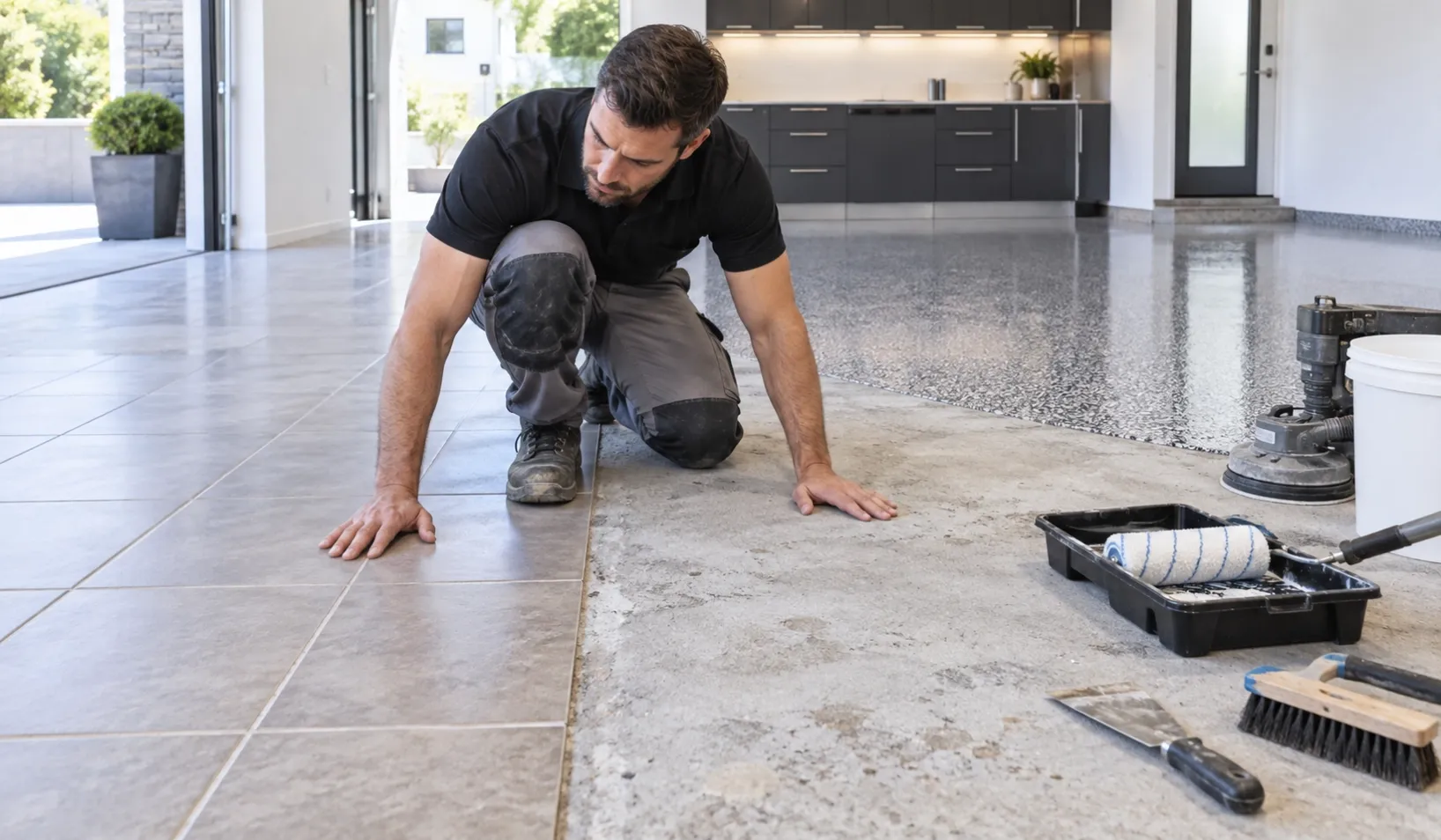
Do You Need a Primer for Epoxy Color Sand Flooring?
Primer is one of the most common questions contractors and distributors ask about epoxy flooring.
Some flooring systems require a separate primer before every application. Others can be installed directly over certain substrates after proper preparation.
JUKE Epoxy Color Sand Self-Leveling is designed to simplify renovation, especially over suitable dense surfaces such as existing tile and terrazzo.
The key point is:
Primer requirements depend on the substrate.
A sound, dense tile floor may not need a separate primer, while porous concrete may require additional sealing or priming before the self-leveling layer is applied.
Understanding this difference can save installation time without compromising substrate preparation.
What Does a Flooring Primer Do?
A primer is applied between the substrate and the main flooring layer.
Depending on the substrate, it can help:
- Seal pores
- Reduce substrate absorption
- Improve surface consistency
- Reduce air release from porous concrete
- Support bonding of the flooring system
Primer can be particularly useful when the substrate is porous or has irregular absorption.
However, adding a primer where it is not needed also adds another material, another application step, and additional drying time.
That is why substrate evaluation should come first.
Does Epoxy Color Sand Need Primer Over Existing Tiles?
For suitable dense tile surfaces, a separate primer is normally not required.
Existing tiles are typically much less porous than concrete.
If the tiles are:
- Structurally sound
- Firmly bonded
- Dry
- Clean
- Free from oil and wax
- Properly prepared
This is one of the main advantages of zero-demolition flooring.
Instead of following:
Demolition → Substrate repair → Primer → New floor
a suitable tile renovation can often be simplified to:
Inspect → Prepare → Mix → Pour → Spread
The original tile remains in place and becomes the substrate for the new seamless floor.
No Primer Does Not Mean No Preparation
This distinction is important.
Customers sometimes hear “no primer” and assume the product can simply be poured over any existing tile floor.
That is not correct.
The existing surface still needs to be inspected and prepared.
Before application, check for:
- Loose tiles
- Hollow areas
- Broken sections
- Oil contamination
- Wax or surface treatments
- Dirt and dust
- Deep or damaged joints
- Uneven areas
Loose or unstable sections should be repaired before coating.
The floor should also be clean and dry before the epoxy color sand system is applied.
What About Terrazzo Floors?
Terrazzo is another dense substrate that can be suitable for zero-demolition renovation.
If the existing terrazzo remains solid and stable, it may not need to be removed.
The surface should first be inspected for cracks, chips, contamination, and damaged areas.
After proper preparation, epoxy color sand can create a completely new seamless decorative finish over the original terrazzo.
As with tile, the objective is not to add unnecessary layers.
The objective is to create the correct bonding surface before application.
Does Concrete Need Primer?
Unlike tile or terrazzo, concrete can be highly porous.
A porous concrete surface can absorb resin unevenly and may release air from its pores during application.
This can contribute to problems such as:
- Pinholes
- Air bubbles
- Uneven absorption
- Inconsistent surface appearance
- Higher material consumption
For this reason, porous concrete may require an epoxy primer or sealing treatment before the main self-leveling layer.
The decision should be based on the actual condition of the floor.
Dense Concrete vs. Porous Concrete
Not all concrete behaves the same way.
A dense, well-finished concrete slab may have relatively low absorption.
An older, rough, or highly porous slab can behave very differently.
Before installation, contractors should evaluate:
- Surface porosity
- Moisture
- Dusting
- Surface strength
- Cracks
- Pitting
- Previous coatings
- Oil or chemical contamination
The more porous and irregular the concrete is, the more likely additional substrate treatment will be required.
This is why a universal “primer always required” or “primer never required” rule is not appropriate for every concrete floor.
A Simple Water Absorption Check
One practical way to understand a concrete surface is to observe how quickly it absorbs moisture.
If a small amount of water placed on the floor is absorbed rapidly, the substrate is likely relatively porous.
If it remains on the surface for much longer, the concrete may be denser.
This type of simple observation does not replace professional substrate testing, but it can help identify floors that need closer evaluation before application.
For commercial projects, substrate moisture and condition should be assessed properly before installation.
Why Porous Concrete Can Create Bubbles
Concrete contains pores.
When a resin flooring material covers a porous substrate, air inside those pores may move upward while the material is still fluid.
If the substrate has not been properly sealed, this air can become trapped in the coating.
The result may be:
- Small bubbles
- Pinholes
- Surface defects
A suitable primer or sealing layer can help reduce this problem by closing the pores before the main flooring layer is applied.
This is one reason substrate treatment is particularly important for porous concrete.
Can Epoxy Color Sand Be Used as a Sealing Layer?
Depending on the project and substrate condition, an additional thin treatment layer may sometimes be used to help control substrate absorption before the main application.
However, the correct method should be selected based on the floor condition rather than applying the same process to every project.
For distributors and contractors, asking for photos or videos of the existing floor before recommending the installation method is often a good first step.
What If the Concrete Is Damaged?
Primer does not repair a damaged substrate.
Before deciding whether primer is required, cracks, pits, holes, and loose areas should be repaired.
The correct sequence is generally:
Inspect → Repair → Grind → Clean → Prime if required → Apply epoxy color sand
Trying to use primer to compensate for unstable concrete will not solve the underlying problem.
The substrate itself must first be sound.
What If There Is Moisture?
Moisture is another important factor.
A primer should not be treated as an automatic solution for excessive substrate moisture.
If the concrete is damp or has an unresolved moisture problem, the cause should be investigated before applying the flooring system.
The substrate should be sufficiently dry and free from condensation during application.
Moisture problems can affect adhesion and final surface quality regardless of whether a primer is used.
Does Primer Increase Installation Time?
Yes.
A separate primer normally means:
- Mixing another material
- Applying another layer
- Waiting for that layer to reach the required condition
- Returning to apply the main flooring system
Removing an unnecessary primer step can therefore simplify installation.
This is particularly useful for tile renovation projects where the substrate is already dense and stable.
For contractors, fewer steps can mean:
- Faster installation
- Less labor
- Fewer materials
- Simpler project management
That is one reason direct-to-tile applications are an important part of the JUKE zero-demolition system.
How Is the Main Epoxy Color Sand Layer Applied?
Once the substrate is ready, the application process is straightforward.
1. Mix
Combine Part A and Part B thoroughly until the material is uniform.
2. Pour
Pour the mixed material onto the prepared substrate.
3. Spread
Use a notched trowel to distribute the material evenly.
4. Self-Level
Allow the material to flow and form a continuous surface.
The recommended self-leveling layer is approximately 1.8–2.0 mm, depending on the substrate and project requirements.
JUKE's current export specification is 20 kg per set, covering approximately 10 m² under typical application conditions.
Actual coverage will vary with floor flatness and substrate condition.
Which Substrates Usually Need the Most Evaluation?
A useful general approach is:
Existing tile:
Often suitable for direct application after proper preparation.
Terrazzo:
Often suitable for resurfacing after inspection and preparation.
Dense concrete:
Evaluate the surface before deciding whether primer is required.
Porous concrete:
More likely to require primer or sealing treatment.
Damaged substrate:
Repair first, regardless of primer.
This approach is more reliable than treating every floor exactly the same way.
Why This Matters to Flooring Distributors
“No primer” is an attractive sales message, but it should be explained correctly.
The strongest product message is not:
“Primer is never required.”
It is:
“No separate primer is normally required on suitable dense substrates such as properly prepared tile.”
That distinction helps distributors sell the product accurately while reducing installation problems.
JUKE supports distributors, flooring suppliers, contractors, and online sellers with:
- Factory-direct supply
- OEM and private label options
- Application guidance
- Marketing photos and videos
- Technical support
- Low MOQ starting from 36 sets
This allows partners to offer a simplified renovation system while still recommending the correct installation process for each substrate.
Final Thoughts
Whether epoxy color sand flooring needs primer depends primarily on the substrate.
For suitable existing tiles and other dense surfaces, JUKE Epoxy Color Sand Self-Leveling can often be applied without a separate primer after proper preparation.
For porous concrete, additional sealing or primer may be required.
The easiest rule to remember is:
Dense substrate: prepare carefully and evaluate.
Porous substrate: consider sealing or primer.
Damaged substrate: repair first.
The goal is not to eliminate primer at all costs.
The goal is to use the simplest flooring system that is technically appropriate for the existing floor.
Not sure whether your project needs primer? Contact JUKE and send us photos of the existing floor. We can help evaluate the substrate and recommend the appropriate application method.