
Oct 29, 2026Epoxy Color Sand
Concrete Moisture Testing Before Epoxy: What to Check
Test concrete moisture before epoxy: how to measure, the 8% limit, why test methods are not interchangeable, and what to do when readings are high.
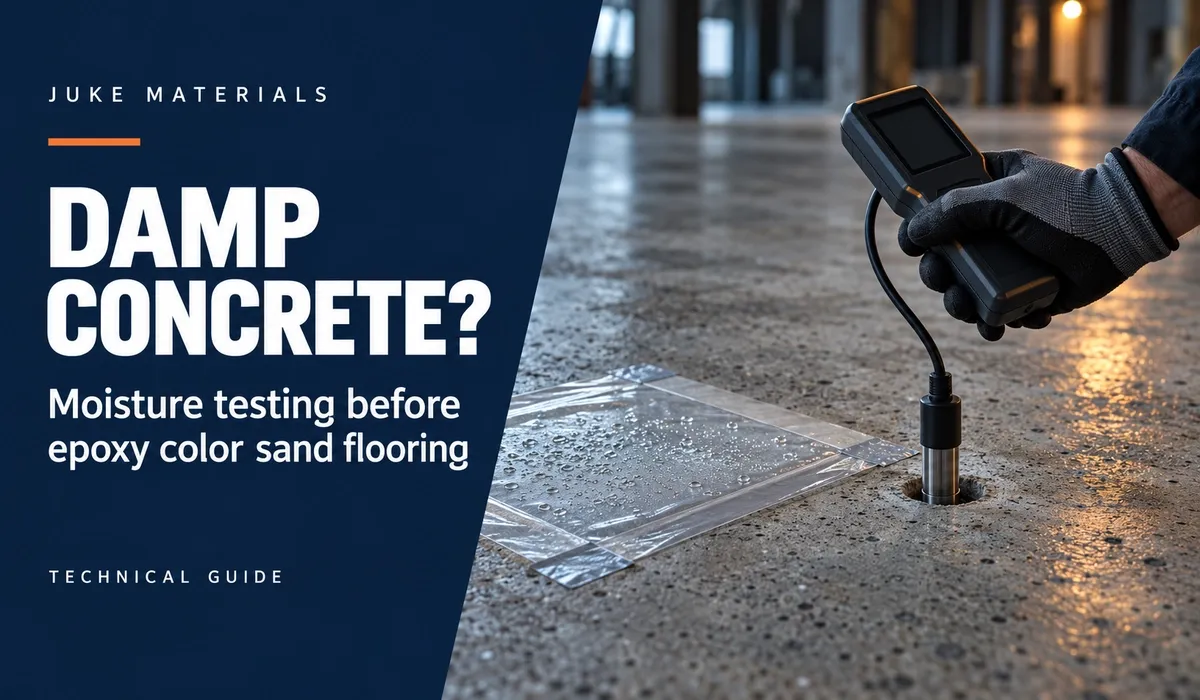
Quick answer: Test the slab before you coat it. For critical projects, use ASTM F2170 (in-situ relative humidity) or ASTM F1869 (calcium chloride); compare the result with the system's limit in the same units; fix the moisture source before priming. A primer is not a moisture barrier.
Why test before you coat
Epoxy color sand is a low-permeance film. Moisture vapor that reaches the underside has nowhere to go. It lifts the coating, forms blisters, and can leave soft or uncured patches. A slab can look dry at the surface and still hold moisture deeper. Testing gives you a record before the floor is covered, and it helps you avoid coating a slab that is not ready.
When to test
Test before any primer or coating. A primer can interfere with surface meters and can trap moisture, so it should not be used to “seal” a slab that has not been tested.
Test in these situations:
- New concrete, after the slab has cured and dried enough for the system
- Existing concrete before grinding or coating
- Ground-floor slabs, especially without a vapor barrier
- Slabs with visible dampness, efflorescence, or a history of coating failures
- Areas near drainage, plumbing, or exterior walls
- Any project where the specification or client requires a moisture report
Measure under the same temperature and ventilation conditions as the installation. A slab that reads dry in an open, hot building may read differently after the HVAC is running or the building is closed.
Three ways to test
1. In-situ relative humidity (ASTM F2170)
This is a reliable method for a critical project. The tester drills holes to the depth required by the standard, inserts probes, lets them equilibrate, and reads the relative humidity inside the slab. It measures the moisture condition deeper than a surface meter can reach.
Follow ASTM F2170 for the number and spacing of test locations. Do not rely on one spot near the door. Record the readings, locations, and conditions.
2. Calcium chloride (ASTM F1869)
This test reports the moisture vapor emission rate in pounds per 1,000 sq ft per 24 hours. It is widely used and easy to compare across projects, provided the specification states the limit in the same units. Follow the standard for site conditions, test dish placement, and timing.
3. Handheld meters and the plastic sheet test
These are screening tools, not pass/fail tests.
A pin or pad meter gives a quick reading, but the result depends on the meter, the substrate, and the contact. It can tell you where to look; it cannot sign off a floor.
A plastic sheet taped to the slab can show condensation underneath. That is a warning sign, not a measurement. It does not replace ASTM F2170 or F1869.
Run the test properly
- Clean the slab and remove curing compounds, coatings, dust, and standing water.
- Mark locations across the whole area, not just one corner.
- Use calibrated equipment and follow the standard's depth, equilibration, and timing requirements.
- If the slab was washed, let it return to normal conditions before testing.
- Record the test method, date, locations, readings, slab and air temperature, and relative humidity.
- Photograph the test locations and the meter or probe readings.
Read the result correctly
The units matter. A handheld meter may report % moisture content, an in-situ probe reports % relative humidity, and a calcium chloride test reports a moisture vapor emission rate. These are different measurements. Do not compare 8% moisture content with 8% relative humidity; they are not the same scale.
JUKE's published application guidance caps substrate moisture at 8% moisture content for the current system. The TDS for the specific kit and project prevails. If you use ASTM F2170 or F1869, compare the result with the limit stated for that method, not with 8% by default.
A single high reading is a warning, not a verdict. Moisture can vary across a slab because of grade, drainage, cracks, thickness, and the absence of a vapor barrier. Test more locations and look for the pattern.
Check these at the same time
Moisture is only one input. While you are on the slab, also check:
- pH and contamination (oil, curing compounds, dust)
- hollow tiles or delaminated areas
- cracks and movement
- surface profile and flatness
- slab and air temperature, and the dew point
Record these with the moisture readings. A dry slab with poor preparation can still fail.
If the moisture is too high
- Find the source: ground moisture, a plumbing leak, drainage, wet curing, or a slab that has not dried.
- Allow drying with ventilation and dehumidification, then test again. Do not guess a drying time; thick slabs, mixes, and site conditions vary.
- Use a dedicated moisture mitigation system or vapor barrier. A standard primer is not a moisture barrier, and adding more primer is not a fix.
- Consider a different floor build or delay the project.
- Do not coat a slab that is damp or at risk of condensation — for example, a cold slab in warm, humid air, or a slab near the dew point. Condensation during application and cure can cause the same failures.
Document the result
Keep a short moisture report with the method, locations, readings, date, conditions, photos, and the product/TDS version. Give a copy to the client and keep one for your files. If a floor fails later, the report tells you whether moisture was the cause or whether to look at mixing, temperature, or application.
FAQ
Can I apply epoxy color sand over damp concrete?
No. Damp concrete is one of the main causes of blisters, delamination, and soft spots. Test the slab, correct the moisture, and test again before coating.
Does primer stop moisture?
No. A standard primer seals pores and improves adhesion; it is not a moisture barrier. If the slab exceeds the system limit, use a dedicated mitigation system or a different build.
What moisture limit should I use?
Use the limit in the current TDS for the specific system. JUKE's published guidance caps substrate moisture at 8% moisture content. If you use a different test method, use the limit stated for that method. Do not compare different units.
How long should concrete dry before coating?
It depends on slab thickness, mix, curing method, and site conditions. There is no safe fixed number. Measure the slab and compare the result with the system limit.
Is a plastic sheet test enough?
No. It can show a moisture condition, but it is not quantitative. Use ASTM F2170 or F1869 when the result affects the specification or warranty.
Need help with a slab?
Send the slab type and age, the test method and readings, the project location, and photos through Contact Us or email sales@jukematerials.com. We can help you decide whether to dry, mitigate, or change the build.
Sources
- ASTM F2170 — Standard Test Method for Determining Relative Humidity in Concrete Floor Slabs Using in situ Probes
- ASTM F1869 — Standard Test Method for Measuring Moisture Vapor Emission Rate of Concrete Subfloor Using Anhydrous Calcium Chloride
- JUKE application guidance — published substrate moisture content of no more than 8%
- JUKE primer guide — primer is not a moisture barrier