
Aug 25, 2026Epoxy Color Sand
What Is Epoxy Color Sand Self-Leveling Flooring?
Learn what epoxy color sand self-leveling flooring is, how its two-component system works, where it can be used, and how it differs from other epoxy floors.
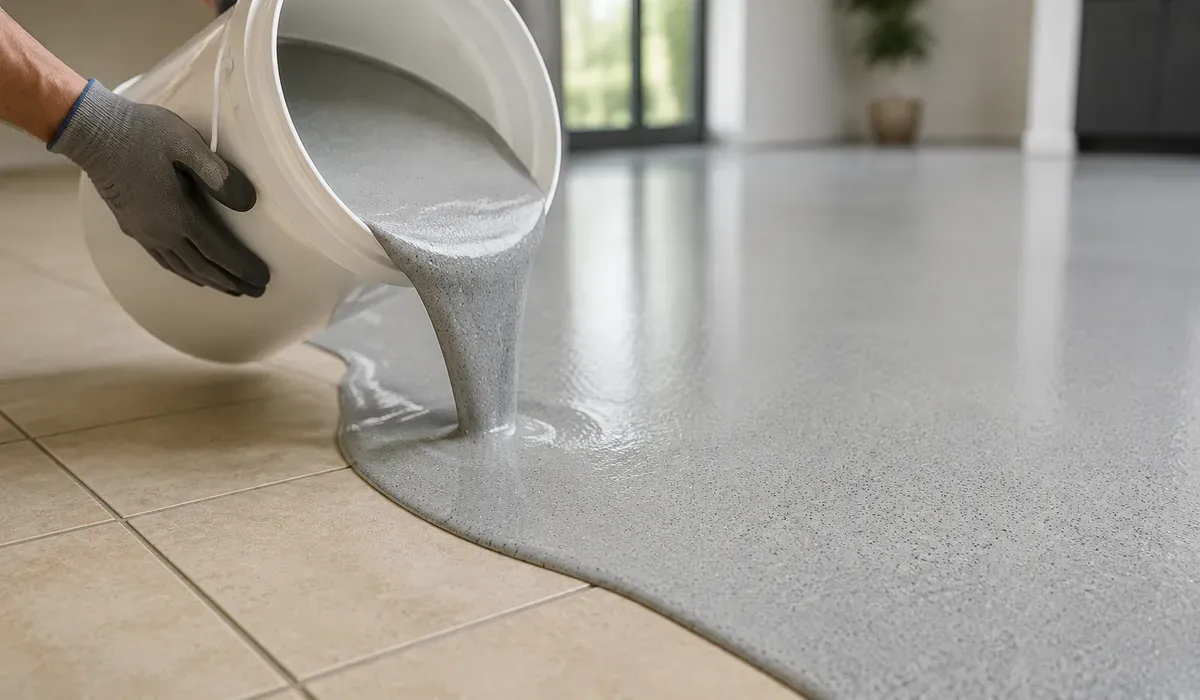
What Is Epoxy Color Sand Self-Leveling Flooring?
Epoxy color sand self-leveling flooring is a two-component resin flooring system made with epoxy resin, mineral fillers, silica, and decorative colored sand.
After Part A and Part B are thoroughly mixed, the material is poured and spread over a prepared floor. It then flows and levels to form a continuous decorative surface without the repeated joints found between tiles or flooring planks.
JUKE Epoxy Color Sand Self-Leveling Flooring can be applied directly over suitable existing tiles, terrazzo, and concrete. When the original floor is stable and properly prepared, complete floor demolition is not required.
A Simple Definition
Epoxy color sand self-leveling flooring has three main characteristics:
- Epoxy-based: A two-component epoxy system forms the cured flooring layer.
- Decorative colored sand: Fine colored sand and mineral materials create color, texture, and a marble-like appearance.
- Self-leveling: After the material is mixed, poured, and spread, it continues to flow and settle into a smooth surface.
The system covers the complete floor. It should not be confused with epoxy tile grout, which fills only the joints between tiles.
What Are Part A and Part B?
JUKE Epoxy Color Sand Self-Leveling is supplied as a two-component system.
Part A is the pre-mixed color sand material. It contains epoxy resin, silica, special colored sand, mineral fillers, and formulation additives.
Part B is the specialized curing component. When it is mixed with Part A, a chemical reaction begins and transforms the fluid material into a hard flooring layer.
The specified Part A to Part B ratio is 8:1 by weight. However, each complete JUKE set contains Part A and Part B in the correct factory-matched quantities.
When using a complete set, the installer combines all of Part A with all of Part B and mixes them thoroughly. Separate weighing on the job site is not required.
The supplied ratio should not be changed. Incorrect proportioning or incomplete mixing may affect curing, hardness, color, and surface quality.
How Does Self-Leveling Work?
“Self-leveling” describes the material’s ability to flow and settle after it has been mixed and distributed across the floor.
It does not mean that the product can simply be poured onto the substrate without using an application tool.
The basic process is:
- Inspect and prepare the existing floor.
- Mix the complete Part A and Part B components.
- Pour the mixed material onto the substrate.
- Spread it evenly with a notched trowel or suitable long-handled spreading tool.
- Allow the material to flow and level.
- Protect the floor while it cures.
The installer controls the initial material distribution and layer thickness. The self-leveling action then helps the surface become smooth and continuous.
What Does “Seamless Flooring” Mean?
A seamless floor is installed as a continuous surface instead of being assembled from separate tiles, planks, or sheets.
After curing, the main flooring area does not have repeated tile grout lines or plank joints.
This creates:
- A more continuous appearance
- Fewer visible joint lines
- Easier routine cleaning
- A consistent decorative finish
- A marble-like or finely speckled surface
Necessary structural and movement joints must still be respected. “Seamless” does not mean that required building joints should be permanently covered.
Can It Be Applied Directly Over Existing Tiles?
Yes. JUKE Epoxy Color Sand can be applied directly over suitable existing tiles without removing the complete tiled floor.
The tiles must be:
- Firmly bonded
- Structurally stable
- Clean and dry
- Free from oil, wax, dust, and contaminants
- Properly mechanically prepared
- Free from unresolved movement or moisture problems
Loose, hollow, cracked, or moving tiles must be repaired before application. Deep tile joints or significant unevenness may also require preparation.
Direct-to-tile therefore means that complete demolition may be avoided when the existing floor is suitable. It does not mean that every old tiled floor can be coated without inspection or preparation.
Does It Require a Primer?
The standard JUKE system does not require a separate primer when applied to a suitable and correctly prepared substrate.
This removes one application step, but it does not eliminate surface preparation.
Depending on the existing floor, preparation may include:
- Mechanical grinding
- Dust removal
- Oil and wax removal
- Crack repair
- Repairing loose tiles
- Correcting major unevenness
- Checking substrate moisture
“No primer” should not be interpreted as “no preparation.”
Can It Be Applied Over Concrete and Terrazzo?
Yes. The system can be installed over suitable concrete and terrazzo.
Concrete must be stable, sufficiently strong, clean, dry, and free from weak surface material. Cracks and damaged areas must be repaired before installation.
Existing terrazzo must be securely bonded and mechanically prepared. Polish, wax, oil, and contaminants that could reduce adhesion must be removed.
When the condition of an existing surface is uncertain, a small on-site adhesion test is recommended.
The flooring system should not be used to hide active structural cracks, loose substrates, or continuing moisture problems.
What Is the Recommended Thickness?
The recommended application thickness is approximately 1.0–2.0 mm.
The installer uses a notched trowel or suitable long-handled spreading tool to distribute the material and control the layer before it self-levels.
Actual material consumption depends on:
- Application thickness
- Surface roughness
- Existing tile joints
- Floor flatness
- Local repairs
- Normal installation loss
A rough or uneven floor will normally consume more material than a smooth and flat substrate.
How Is It Different from Other Epoxy Products?
Epoxy color sand flooring belongs to the wider epoxy flooring category, but it has a specific decorative formulation and purpose.
Product | Main characteristic | Typical use |
|---|---|---|
Epoxy color sand self-leveling | Epoxy resin combined with fine decorative colored sand | Seamless decorative floor renovation |
Conventional self-leveling epoxy | Usually creates a smooth, uniform resin surface | Commercial and industrial floors |
Epoxy terrazzo | Uses larger decorative aggregates and may require grinding and polishing | Premium terrazzo-style surfaces |
Epoxy tile grout | Fills individual tile joints | Tile-joint filling and renovation |
Some traditional epoxy systems are also seamless and self-leveling. The main difference is that JUKE Epoxy Color Sand incorporates fine decorative colored sand to produce a marble-like or finely speckled appearance.
Epoxy terrazzo often uses larger aggregates and a more complex grinding and polishing process.
Epoxy tile grout does not cover the entire floor. It preserves the visible tile pattern.
What Does the Finished Floor Look Like?
Colored sand creates fine visual variation within the cured surface.
Depending on the selected color and finish, the floor may appear:
- Marble-like
- Finely speckled
- Smooth and continuous
- Glossy, satin, or matte
- Neutral or strongly colored
Available color directions may include marble gray, simple white, green, blue, red, pink, and yellow tones.
Digital images and printed color charts should be treated as initial references. A cured physical sample provides a more reliable basis for final approval because lighting, application conditions, and screen settings can affect how the color appears.
Selected color customization and private-label color ranges are available for qualified OEM buyers.
How Strong Is the Cured Material?
The JUKE 2026 Technical Data Sheet records the following performance results:
- Mohs hardness: Level 8
- Compressive strength: ≥80 MPa
- Solid content: approximately 98%
- VOC content: 16 g/L
- Surface dry time: 4–6 hours
- Hard dry time: 24 hours
These are documented material results, not guarantees that every finished floor is impossible to scratch, crack, stain, or damage.
Actual project performance also depends on the substrate, surface preparation, mixing, application thickness, curing conditions, traffic, chemical exposure, and maintenance.
Where Can Epoxy Color Sand Flooring Be Used?
Potential applications include:
- Residential floor renovation
- Garages
- Retail stores
- Showrooms
- Hotels
- Offices
- Workshops
- Warehouses
- Schools
- Hospital circulation areas
- Commercial and suitable industrial spaces
Each project should be evaluated according to substrate condition, traffic, moisture, chemicals, slip-resistance requirements, and expected maintenance.
The standard self-leveling system is intended for floor application and should not be promoted as a wall coating.
It is primarily positioned for indoor use. Long-term outdoor UV exposure may cause color change or yellowing, so outdoor projects require separate evaluation.
Why Use It for Floor Renovation?
When the existing substrate is suitable, epoxy color sand flooring can create a new surface without removing all the original tiles.
This may reduce:
- Demolition work
- Dust and noise
- Construction waste
- Tile disposal
- Renovation steps
- Disruption to surrounding spaces
The finished result is a new continuous floor rather than another layer of visible tiles and grout joints.
Zero-demolition installation is conditional on substrate suitability. Loose, unstable, wet, or severely damaged floors must be repaired before overlay.
Frequently Asked Questions
Is epoxy color sand a type of paint?
It is more accurately described as a two-component resin flooring system. It forms a continuous flooring layer rather than behaving like ordinary decorative paint.
Does self-leveling mean no tool is required?
No. The mixed material must still be poured and evenly spread. Self-leveling helps the distributed material settle into a smooth surface.
Can it cover old tile joints?
Yes, provided the tiled floor is properly prepared and the material is applied at the correct thickness. Deep or uneven joints may require repair first.
Must all old tiles be removed?
No. Stable, firmly bonded, dry, and correctly prepared tiles can remain in place. Loose or damaged areas must be repaired.
Does it require a primer?
No separate primer is required for the standard JUKE system on a suitable and correctly prepared substrate.
Do installers need to weigh the 8:1 ratio?
A complete JUKE set contains Part A and Part B in factory-matched quantities. Combine both complete components and mix thoroughly.
Is an additional topcoat required?
The standard system forms the finished surface without requiring an additional topcoat. Special outdoor or project-specific requirements should be evaluated separately.
Learn More About Epoxy Color Sand Flooring
For more information about installation, technical performance, applications, comparisons, and sourcing, read the complete product guide.
Request the TDS and a Product Sample
Distributors, contractors, wholesalers, tile suppliers, and private-label sellers can request product samples, technical documents, available colors, factory-direct pricing, OEM options, application videos, and marketing materials.
Request the JUKE TDS, Sample & Factory-Direct Pricing