
Oct 6, 2026Epoxy Color Sand
Premixed Epoxy Color Sand Flooring: Why an A+B System Matters
Learn how a premixed A+B epoxy color sand system simplifies on-site material preparation and what distributors and contractors should confirm before buying.
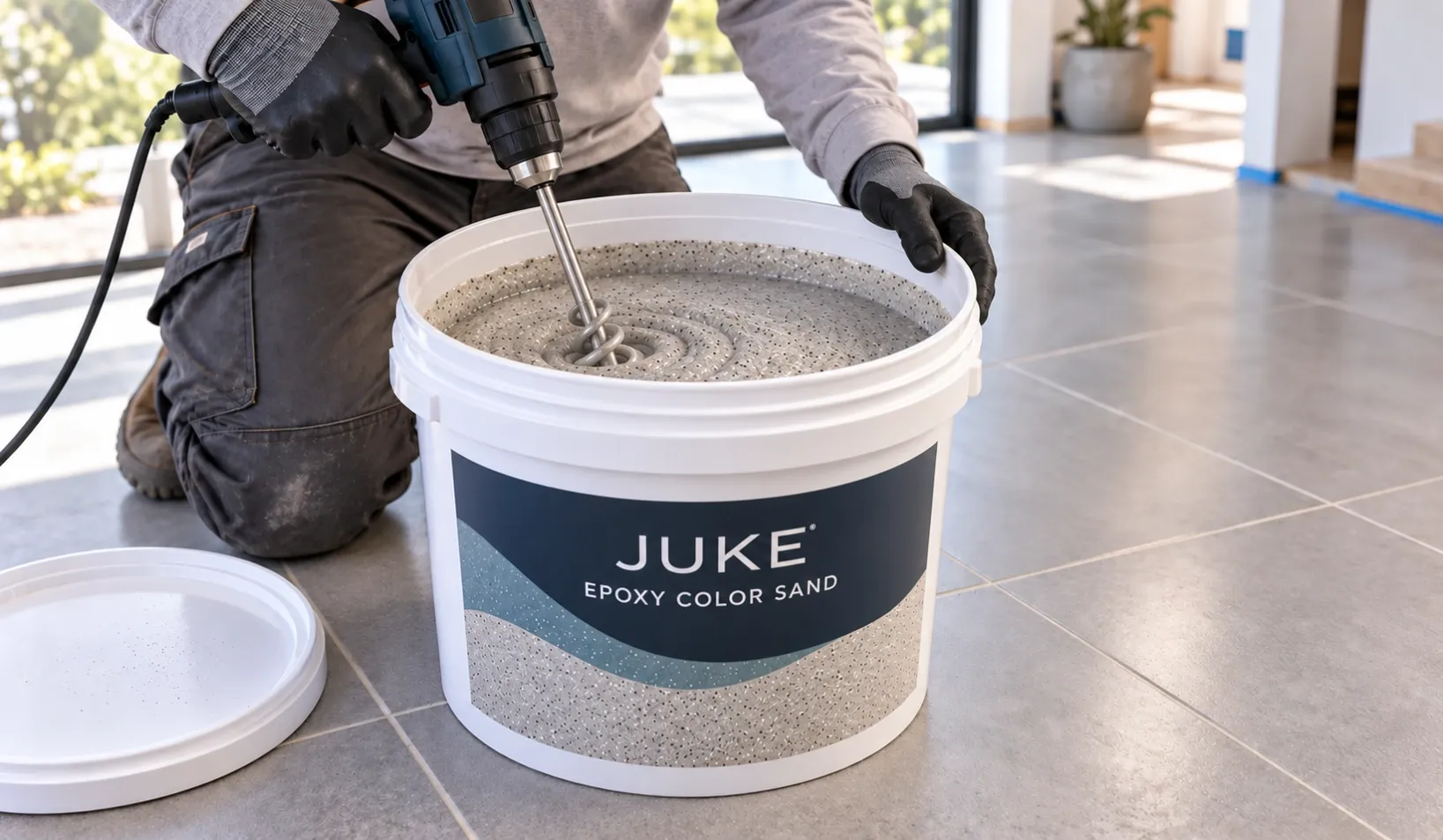
Premixed Epoxy Color Sand Flooring: Why an A+B System Matters
A premixed epoxy color sand flooring system incorporates the decorative sand and fillers into a supplied component before delivery. The installer combines Part A and Part B according to the manufacturer’s instructions, without adding separate colored sand on site. For distributors and contractors, this simplifies material preparation and makes the application process easier to explain.
JUKE Epoxy Colored Sand Self-Leveling Flooring uses a two-component system with factory-proportioned quantities. It is designed for decorative floor renovation, including direct application over suitable existing tiles without demolition.
What Does “Premixed” Mean?
In this context, premixed describes how the decorative materials are supplied. The colored sand and fillers are included in the system before the installer begins work.
It does not mean that the resin and curing agent have already been combined. Part A and Part B remain separate until application because mixing them starts the curing process.
This distinction matters when comparing products. A flooring package may contain resin, hardener, and a separate bag of aggregate. Another may contain two supplied components with the decorative materials already incorporated.
Trade buyers should ask the supplier to identify every item the installer must combine before application. The number of packages alone does not fully explain the installation process.
Why Does This Matter to Contractors?
Contractors need to prepare and place material within its working time. Reducing the number of separate materials handled on site can make that sequence more straightforward.
With JUKE’s complete factory-proportioned set, the installer combines the supplied Part A and Part B according to the instructions. There is no separate colored-sand addition during application.
This helps the team organize the work around a clear sequence: prepare the floor, prepare the tools, mix, pour, spread, and protect the surface during curing.
However, complete mixing remains essential. Decorative material supplied within a component still needs to be distributed uniformly when the system is mixed.
Simpler preparation does not remove the need for trained application, suitable conditions, or a sound substrate.
Compare the Actual Application Requirements
When evaluating flooring systems, compare the steps required rather than relying only on product names.
Question | What the buyer should confirm |
|---|---|
Is the colored sand included? | Whether it is incorporated into a component or supplied separately |
What must be mixed on site? | Every component and any additional material |
Are complete sets proportioned? | Whether supplied quantities are intended to be combined together |
Can a set be divided? | Accurate weighing requirements for partial quantities |
What tools are needed? | Mixing equipment and suitable spreading tools |
What is the working time? | The available placement period and temperature effects |
Different formulations can have different preparation and application requirements. Use the supplier’s current instructions for the specific product being evaluated.
Factory-Proportioned Sets Help Clarify Mixing
JUKE supplies matched Part A and Part B quantities for a complete set. This allows the installer to combine the supplied components without calculating a new ratio for the full package.
The instructions should still explain how to mix thoroughly, including material around the container sides and bottom. Incomplete mixing can leave areas with inconsistent appearance or curing.
Do not divide a set by estimating quantities visually. Partial batches require accurate weighing and the correct component ratio.
Prepare the installation area and tools before combining the components. Once mixing begins, the working-time limit becomes part of the application plan.
An A+B System Still Needs the Right Base
The packaging format does not determine whether an existing floor is suitable.
For JUKE tile applications, the base must be firmly bonded, stable, clean, and dry. Suitable existing tiles generally require neither grinding nor primer.
Remove contamination and address loose tiles, cracks, recessed joints, and other defects before coating. Repair and level irregularities that could affect the finished surface.
Concrete requires its own preparation route and a compatible primer. Uneven or damaged concrete should be repaired before the decorative system is applied.
These requirements should appear alongside the mixing instructions. Customers need to understand both how to combine the material and where it can be installed.
Self-Leveling Requires Controlled Application
After mixing, the installer pours the material onto the prepared surface, spreads it evenly with a suitable notched trowel, and allows it to self-level.
Self-leveling describes the material’s behavior during placement. The installer still controls distribution, maintains a continuous work sequence, and avoids stretching the material beyond the intended consumption.
JUKE’s standard 20 kg set covers approximately 10 m² under normal application conditions. Actual coverage varies with floor flatness, technique, and material loss.
A representative trial helps contractors evaluate spreading behavior and consumption before a larger project. Protect the fresh surface from dust, water, and early traffic while it cures.
What Should Distributors Ask Before Ordering?
Distributors need to confirm that the product they stock matches the process they demonstrate.
Request the current technical data sheet, safety documentation, and application instructions. Review whether the documents clearly identify the supplied components and any materials required separately.
Also confirm:
- The contents and net weight of a complete set.
- Color selection and sample approval.
- Packaging and labeling requirements.
- Available application videos and marketing materials.
- OEM options and minimum order quantity.
JUKE offers factory-direct supply, OEM support, marketing support, and a low MOQ of 36 sets.
A clear product package helps retailers, contractors, and online sellers communicate the same preparation and mixing requirements to their customers.
Frequently Asked Questions
Does the installer add separate colored sand to JUKE?
No separate colored-sand addition is required on site. The installer combines the supplied Part A and Part B according to the application instructions.
Are Part A and Part B already mixed together?
No. They remain separate until application. Factory-proportioned means the supplied quantities are matched for mixing a complete set.
Can I add water to improve flow?
Do not add water, solvents, or unapproved materials. Follow the product’s mixing and application instructions.
Does premixed material eliminate preparation?
No. Substrate inspection, cleaning, necessary repairs, and the appropriate preparation route remain essential.
Evaluate the Complete System With JUKE
A premixed A+B system gives buyers a clear material-preparation process, while successful installation still depends on thorough mixing, suitable substrates, and controlled application.
Before ordering, review the documents and evaluate the product on a representative surface.