
Aug 25, 2026Epoxy Color Sand
What Is Epoxy Color Sand Made Of?
Learn what epoxy color sand is made of and how epoxy resin, colored sand, mineral fillers, and a specialized curing agent form a seamless flooring system.
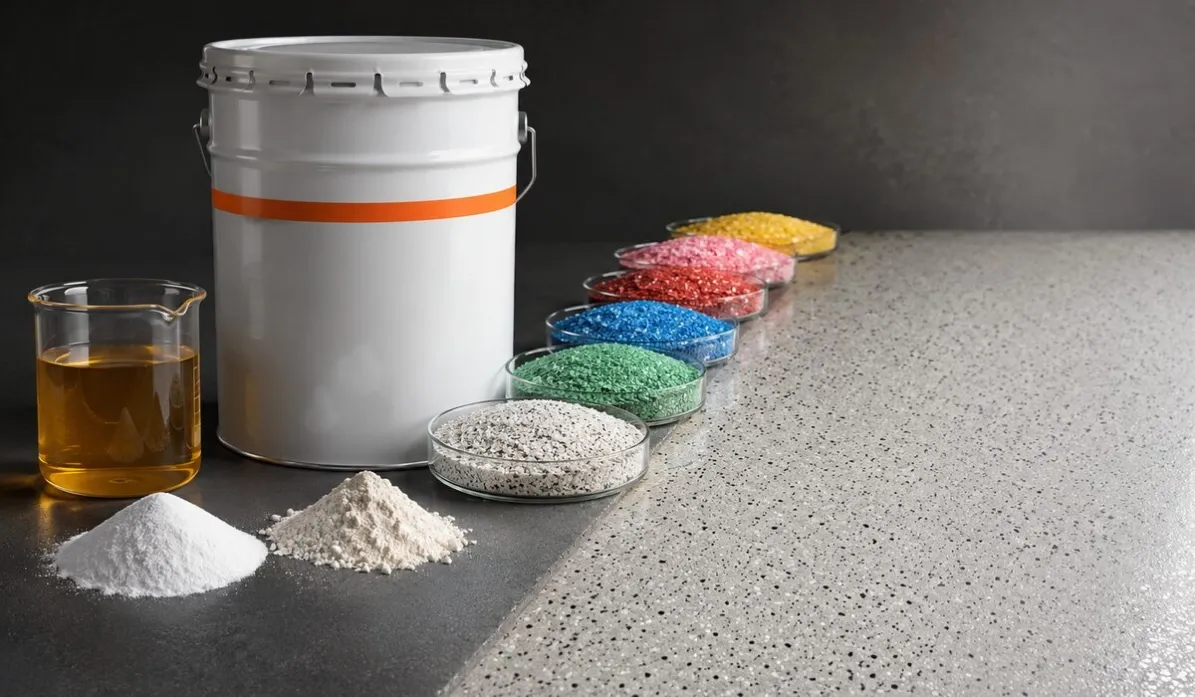
What Is Epoxy Color Sand Made Of?
Epoxy color sand is a two-component flooring material made from epoxy resin, specially selected colored sand, mineral fillers, a reactive diluent, and a specialized curing agent. These ingredients are engineered to work together as a complete system rather than being mixed randomly at the jobsite.
JUKE Epoxy Color Sand Self-Leveling is supplied as two factory-matched components:
- Part A: A premixed epoxy color sand compound containing the resin, colored sand, silica, calcium-based mineral filler, and other formulation components.
- Part B: A specialized curing agent that reacts with Part A and converts the liquid mixture into a hard, continuous flooring surface.
After the two components are thoroughly mixed, a chemical curing reaction begins. The material can then be spread over a properly prepared substrate, where it flows, levels, and cures into a seamless decorative floor.
This composition is what distinguishes epoxy color sand flooring from ordinary epoxy paint, dry sand broadcast systems, and cement-based decorative coatings.
Main Components of Epoxy Color Sand
According to the JUKE technical data sheet, the principal ingredients are represented by the following reference ranges.
Component | Reference Content | Primary Function |
|---|---|---|
Epoxy resin | 60%–68% | Forms the main binding and protective matrix |
Special color sand | 10%–15% | Provides color, texture, and decorative mineral character |
Calcium powder | 7%–12% | Adds mineral body and helps control consistency |
Silica | Approx. 5% | Reinforces the mineral structure and contributes to surface durability |
Benzyl glycidyl ether | Approx. 5% | Helps adjust viscosity and application workability |
Specialized curing agent | Supplied separately as Part B | Initiates curing and crosslinking |
These figures are technical reference ranges rather than a complete manufacturing formula. Actual proportions may be adjusted within controlled limits according to color, finish, raw-material characteristics, and production requirements. The ranges should therefore not be added together as if they represented a single fixed batch recipe.
1. Epoxy Resin: The Main Binder
Epoxy resin is the largest component in the system and forms the continuous matrix of the finished floor.
Before curing, the resin helps wet and carry the colored sand and mineral fillers. After Part A and Part B are mixed, the resin reacts with the curing agent and forms a crosslinked three-dimensional structure.
This cured matrix binds the mineral components together and adheres the flooring system to a suitable prepared substrate. It is also responsible for many of the characteristics commonly associated with epoxy flooring, including:
- Strong adhesion
- Surface hardness
- Resistance to water penetration
- A continuous, joint-free finish
- Resistance to ordinary cleaning and service conditions
- Long-term dimensional stability
Epoxy resin is therefore not simply a transparent liquid surrounding loose sand. It becomes the structural binder that holds the entire composition together.
For a broader explanation of the finished flooring system, see What Is Epoxy Color Sand Self-Leveling Flooring?.
2. Special Color Sand: Color and Mineral Appearance
Special color sand gives the flooring its visible mineral character. Unlike a conventional solid-color epoxy coating, an epoxy color sand system uses distributed mineral particles to create a more natural and visually textured finish.
Depending on the selected color combination, the finished surface may appear:
- Light and uniform
- Speckled
- Stone-like
- Marble-inspired
- Softly contrasted
- Custom-colored for a project or brand identity
The sand is incorporated into Part A during controlled factory production. This is important because factory premixing helps distribute the decorative particles more consistently than adding uncontrolled quantities of loose sand at the construction site.
The color sand is not merely decorative. It also becomes part of the cured mineral-resin structure. Its particle distribution affects appearance, application behavior, surface consistency, and the visual uniformity of the completed floor.
Color cards are useful for initial selection, but actual cured samples should be reviewed before a large project. Lighting, application thickness, substrate color, batch conditions, and the selected gloss level can influence the final appearance.
3. Silica: Mineral Reinforcement
Silica is included as a mineral component that contributes to the body and mechanical structure of the flooring material.
In a properly balanced formulation, silica works with the epoxy resin and other mineral fillers to produce a dense cured layer. It can contribute to hardness, wear performance, and dimensional stability without turning the material into a dry or unworkable mortar.
Particle size and dispersion are important. Too much coarse filler could reduce flow, while an incorrectly balanced fine filler package could increase viscosity. The formulation must therefore maintain a practical balance between mineral reinforcement and self-leveling behavior.
JUKE’s technical data lists a Mohs hardness of Level 8 and compressive strength of at least 80 MPa for the cured system. These performance values come from the complete formulation and curing process, not from silica alone.
4. Calcium Powder: Body and Consistency Control
Calcium powder is another mineral filler used in the Part A compound. Its main role is to provide body, improve filling efficiency, and help establish the designed consistency of the material.
A flooring system cannot consist entirely of resin. A carefully designed mineral filler package helps create a stable, high-solids compound that can be spread at a controlled thickness.
The calcium-based filler works together with silica and color sand to influence:
- Material density
- Viscosity
- Spreading behavior
- Filling capability
- Cured layer structure
- Cost-to-performance balance
The JUKE system has a listed density of approximately 1.64–1.72 g/cm³, which is typical of a highly filled resin flooring material.
Mineral fillers must remain correctly suspended and uniformly dispersed. Poor dispersion could cause inconsistent flow, color differences, or uneven mechanical properties. This is one reason industrial mixing and factory quality control are essential.
5. Benzyl Glycidyl Ether: Flow and Workability
Benzyl glycidyl ether is a reactive formulation component used to help adjust viscosity and application characteristics.
Unlike a conventional volatile solvent that mainly evaporates, a reactive diluent is designed to participate in the curing process. Its controlled use can help the filled epoxy compound remain workable enough for mixing, spreading, and self-leveling.
This is especially important because epoxy color sand contains a relatively high mineral load. Without effective viscosity control, the material could become too thick to mix or distribute uniformly.
However, workability does not depend on one ingredient alone. Resin selection, filler particle size, temperature, mixing quality, and the Part A-to-Part B ratio all affect how the material behaves during application.
Installers should never add unapproved diluents or modify the formulation without technical confirmation. Uncontrolled additions may affect curing, color, strength, gloss, or final surface quality.
6. Part B: The Specialized Curing Agent
Part B is the component that activates the curing reaction.
When the curing agent is mixed with the epoxy-containing Part A, reactive groups begin linking together. The liquid mixture gradually changes into a solid thermoset material. Once properly cured, it cannot be returned to its original liquid state by reheating.
The specified Part A-to-Part B ratio is 8:1 by weight. For complete JUKE factory-matched sets, the two packages are proportioned for use together, so the customer does not need to divide and weigh a new 8:1 batch when the entire set is mixed.
If a package is divided for partial use, both components must be measured accurately by weight. Estimating the ratio by volume or appearance may result in:
- Soft or sticky areas
- Incomplete curing
- Uneven gloss
- Reduced mechanical performance
- Color variation
- Shortened service life
Complete mixing is just as important as the correct ratio. Material from the sides and bottom of the container must be incorporated until the mixture is visually uniform.
To understand the reaction and self-leveling process in more detail, read How Does Epoxy Color Sand Self-Leveling Flooring Work?.
How the Components Become a Finished Floor
Each ingredient performs a different function, but the final performance comes from the entire system working together.
The basic transformation can be summarized in five stages:
- Part A holds the resin, color sand, silica, mineral fillers, and flow-control components in a uniform premixed compound.
- Part B is added to start the epoxy curing reaction.
- Mechanical mixing distributes the curing agent throughout the filled resin system.
- The material is spread over a suitable prepared substrate at a designed floor thickness of 1.0–2.0 mm, with an allowable deviation of ±0.2 mm.
- The resin crosslinks around the mineral particles and forms a hard, continuous surface.
The material’s self-leveling behavior helps minor application marks settle while the mixture remains workable. However, “self-leveling” does not mean that it can repair major substrate defects automatically. Cracks, loose areas, contamination, excessive moisture, and severe unevenness must still be addressed before application.
Is Epoxy Color Sand the Same as Epoxy Paint Mixed With Sand?
No. A professionally formulated epoxy color sand system is not equivalent to adding construction sand to ordinary epoxy paint.
A complete system requires controlled compatibility among:
- Resin chemistry
- Curing-agent chemistry
- Colored mineral particles
- Filler particle sizes
- Viscosity
- Density
- Working time
- Flow behavior
- Curing speed
- Final appearance
Randomly adding sand to an epoxy coating can make the mixture too thick, cause sedimentation, trap air, create weak dry areas, or prevent consistent leveling.
Factory production allows the raw materials to be weighed, dispersed, and checked under controlled conditions. This improves batch consistency and reduces the number of variables that installers must manage on site.
High Solids and Low VOC Content
The JUKE technical data sheet lists an approximate solid content of 98% and a VOC content of 16 g/L.
High solid content means that most of the applied material remains in the cured flooring layer rather than being lost through evaporation. This supports the formation of a dense, continuous film at the specified application thickness.
Low VOC content can help reduce solvent emissions during application, but it does not eliminate the need for responsible handling. The work area should still be ventilated, and installers should use appropriate gloves, eye protection, work clothing, and other personal protective equipment specified by the project’s safety procedures and the current Safety Data Sheet.
“Low VOC” should not be interpreted as “safe to touch before curing.” Uncured epoxy components may irritate the skin or eyes, and repeated skin exposure should be avoided.
Why Composition Matters to Buyers and Contractors
Understanding the material composition helps buyers compare systems more accurately.
A product should not be evaluated only by its color or price per kilogram. Important questions include:
- Is it supplied as a complete Part A and Part B system?
- Is the colored sand factory premixed?
- What is the solid content?
- What is the specified mixing ratio?
- What application thickness is approved?
- Are the density and curing data documented?
- Is batch color consistency controlled?
- Are TDS and SDS documents available?
- Can cured samples be supplied before an order?
For distributors and private-label customers, composition control also affects storage stability, packaging selection, batch repeatability, color development, and application training.
Frequently Asked Questions
Is the visible texture created by loose sand on the surface?
No. The decorative sand is incorporated into the epoxy compound and becomes embedded in the cured resin matrix. The finished floor is a unified layer rather than a loose aggregate surface.
Does epoxy color sand contain cement?
The JUKE epoxy color sand system is based on epoxy resin and a specialized curing agent. Mineral fillers are included, but it is not a conventional cement-based self-leveling compound.
Does the sand settle during storage?
A filled material may require proper mixing before use to restore complete uniformity. Always follow the current product instructions and mix Part A thoroughly before combining it with Part B when required.
Can installers add more color sand at the jobsite?
Unapproved additions are not recommended. Extra sand can change viscosity, coverage, flow, color distribution, curing behavior, and mechanical performance.
Is the 8:1 ratio still important if the packages are factory matched?
Yes. The chemistry still uses an 8:1 Part A-to-Part B ratio by weight. The advantage of a complete factory-matched set is that both containers are already supplied in the required proportion when the full set is used.
What is the standard flooring thickness?
The current recommended floor application thickness is 1.0–2.0 mm, with an allowable deviation of ±0.2 mm, subject to substrate condition and project requirements.
A Controlled Two-Component Mineral–Resin System
Epoxy color sand is best understood as an engineered mineral–resin flooring system.
The epoxy resin provides the binding matrix. Special color sand creates the decorative mineral appearance. Silica and calcium-based fillers contribute body and structural density. The reactive diluent helps maintain practical workability. Finally, the specialized Part B curing agent converts the mixed compound into a hard, seamless floor.
Its performance depends not only on the individual ingredients but also on their compatibility, proportioning, factory dispersion, correct mixing, substrate preparation, application thickness, and curing conditions.
For system selection, preparation requirements, installation planning, and maintenance guidance, continue with the Complete Guide to Epoxy Color Sand Self-Leveling Flooring.
For product samples, technical documents, OEM packaging, or project-specific recommendations, contact JUKE Materials.