
Aug 25, 2026Zero-Demolition Flooring
Can You Apply Epoxy Flooring Directly Over Existing Tile?
Learn when epoxy color sand flooring can be applied over existing tile and what substrate preparation is required for a durable, seamless renovation.
Can You Apply Epoxy Flooring Directly Over Existing Tile?
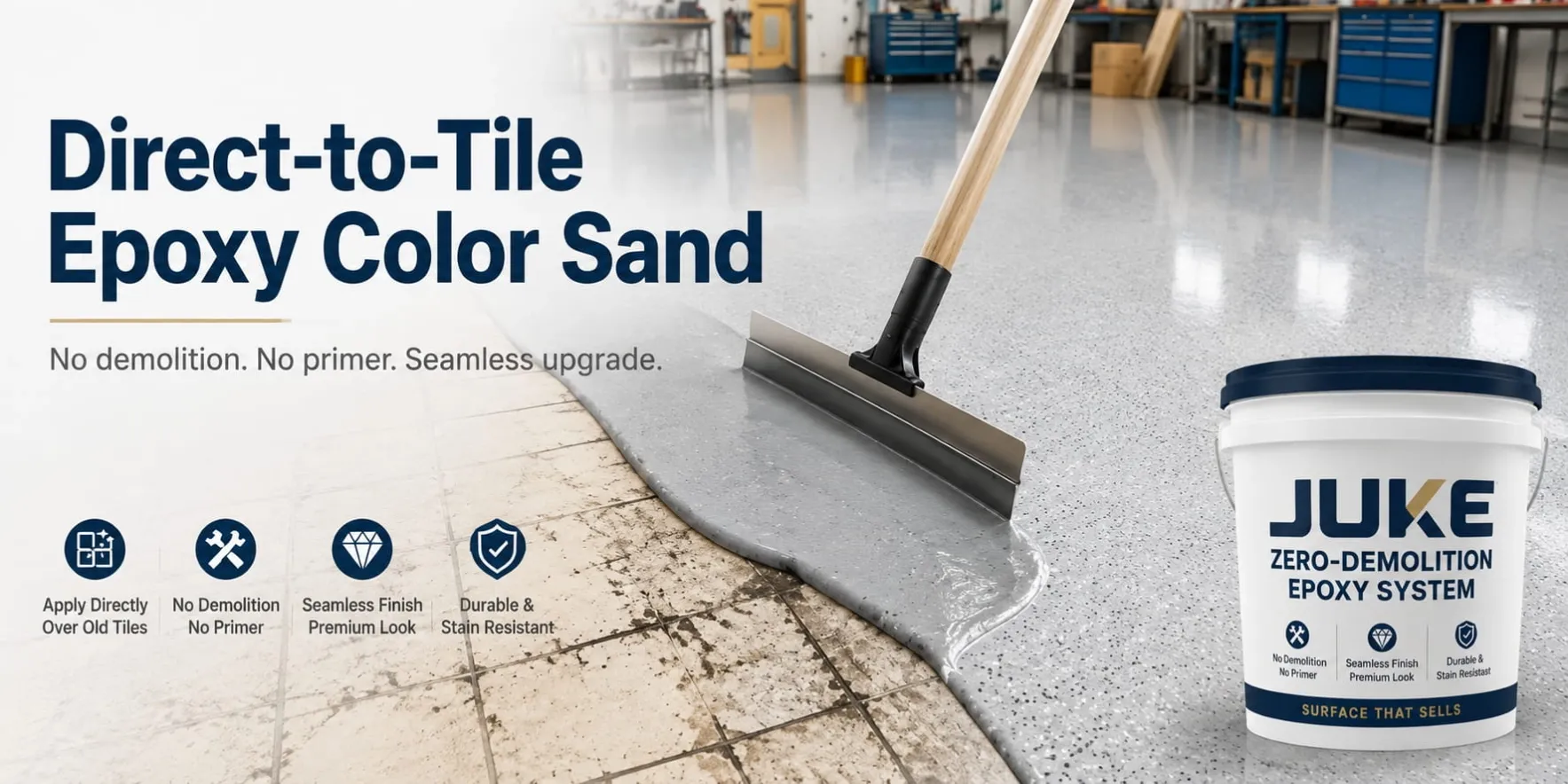
Yes. Epoxy color sand flooring can be applied over sound, stable, and properly prepared existing tile surfaces without removing the entire tile floor first.
JUKE Epoxy Color Sand Self-Leveling is designed for rapid renovation over suitable dense substrates such as existing ceramic tile and terrazzo. The key requirement is not simply that tile is present, but that the existing floor is structurally sound, clean, dry, and properly prepared before application.
This approach can reduce demolition work, construction waste, labor, and renovation downtime while creating a new seamless floor surface.
Can Epoxy Really Go Directly Over Tile?
Yes, but the condition of the existing tile matters.
A tile floor can provide a suitable substrate when it is:
- Firmly bonded
- Structurally stable
- Clean
- Dry
- Free from oil, dust, wax, and contaminants
- Free from loose or hollow sections
- Properly prepared for adhesion
If the old tile floor contains loose tiles, severe cracks, hollow areas, unstable sections, or significant substrate movement, those problems should be repaired before the epoxy flooring system is installed.
The goal is simple:
The new flooring system is only as reliable as the substrate underneath it.
Why Renovate Over Existing Tile Instead of Removing It?
Traditional tile replacement usually begins with demolition.
That can involve:
- Breaking and removing the existing tiles
- Transporting demolition waste
- Repairing the exposed substrate
- Additional cleaning
- More labor
- More project downtime
For commercial spaces, stores, garages, hotels, and renovation projects, these extra steps can increase both project time and disruption.
A direct-over-tile flooring system provides another option when the existing tile is still structurally suitable.
Instead of completely removing the old floor, the contractor prepares the existing surface and installs a new continuous flooring layer over it.
This is the basic idea behind zero-demolition floor renovation.
What Is JUKE Epoxy Color Sand Self-Leveling Flooring?
JUKE Epoxy Color Sand Self-Leveling is a two-component flooring material consisting of a pre-mixed epoxy color sand component and a dedicated curing agent.
After the two components are mixed, the material is spread across the prepared substrate and allowed to self-level.
The result is a continuous flooring surface with:
- Seamless appearance
- Decorative stone-like texture
- High mechanical strength
- Wear resistance
- Water resistance
- Easy-to-clean surface
According to the JUKE Technical Data Sheet, the system has a Mohs hardness of Level 8 and a compressive strength of at least 80 MPa.
What Type of Existing Tile Is Suitable?
The most important factor is substrate stability rather than the decorative style of the tile.
Suitable surfaces may include sound existing ceramic tile and other stable, dense flooring substrates.
Before installation, check whether the existing tile floor has:
Loose Tiles
Any loose or poorly bonded tile should be removed or repaired before the new flooring system is installed.
Hollow Areas
Hollow-sounding or unstable sections may indicate poor bonding underneath the tile. These areas should be repaired first.
Cracks
Existing cracks should be evaluated and repaired before coating. If the substrate continues to move, the movement may affect the new surface.
Oil or Contamination
Grease, wax, dust, cleaning residues, or other contaminants can reduce adhesion and must be removed.
Moisture
The substrate should remain dry. JUKE's current Technical Data Sheet specifies substrate moisture content of ≤8%.
How Should Existing Tile Be Prepared?
Proper surface preparation is one of the most important steps in any epoxy flooring installation.
For a tile renovation project, the surface should be:
Sound → Clean → Dry → Stable → Properly prepared
The general preparation process includes checking the floor for damage, removing contamination, repairing unstable sections, and preparing the surface to promote adhesion.
A contractor should not simply pour epoxy over an untreated dirty tile floor.
Even with a direct-over-tile system, correct preparation determines long-term performance.
How Is JUKE Epoxy Color Sand Applied?
The current JUKE Technical Data Sheet specifies a Part A to Part B mixing ratio of:
8 : 1 by weight
The components should be mechanically mixed until the color and consistency become uniform.
After mixing, the material is spread over the prepared substrate.
JUKE recommends using a 3 mm notched trowel and controlling the applied coating thickness to approximately 1.0–2.0 mm ±0.2 mm.
The material then self-levels to form the finished surface.
For this system, a defoaming spiked roller is not required.
How Long Does the Floor Take to Cure?
Under recommended application conditions:
Stage | Typical Time |
|---|---|
Surface dry | 4–6 hours |
Hard dry | 24 hours |
Light pedestrian traffic | After 48 hours |
Vehicle traffic | After 72 hours |
The area should remain protected during the initial curing period.
Application conditions also matter. JUKE recommends an installation temperature of 5°C to 35°C and relative humidity of ≤85%.
Does Epoxy Over Tile Create a Seamless Floor?
Yes.
One of the major differences between the original tiled surface and the finished epoxy color sand floor is the visual continuity.
Tiles naturally contain grout joints.
After the prepared tile surface is covered with the self-leveling epoxy color sand system, the finished layer forms a continuous surface rather than repeating the original tile pattern.
This can create a significantly different visual effect without requiring complete tile demolition.
Is Epoxy Color Sand Flooring Waterproof?
The JUKE Technical Data Sheet reports water impermeability performance of:
Watertight at 0.4 MPa for 2 hours.
The seamless surface also reduces the number of joints where dirt and moisture can accumulate.
However, the flooring system should not be used as a substitute for correcting structural water leakage or serious substrate moisture problems.
Those problems should be addressed before installation.
Does the Floor Need an Additional Topcoat?
For standard indoor applications, the JUKE system is designed as a one-piece flooring layer and does not require an additional topcoat.
This simplifies the installation system compared with flooring processes that require several separate finishing layers.
The correct installation specification should still be selected according to the actual environment and project requirements.
What Are the Main Advantages of Installing Epoxy Over Tile?
The main benefit is not simply avoiding tile removal.
The broader advantage is reducing the number of renovation steps.
For suitable floors, this can mean:
Less demolition → Less waste → Less disruption → Faster floor renewal
Other advantages include:
- Seamless finished appearance
- High hardness
- Strong compressive performance
- Decorative stone-like finish
- Water resistance
- Easier cleaning
- Application across residential, commercial, and industrial environments
For contractors, the system can provide an alternative renovation method.
For distributors, it provides a flooring product with an easy-to-understand customer problem:
“How can I upgrade this old tiled floor without removing everything first?”
When Should You NOT Apply Epoxy Directly Over Tile?
Direct-over-tile application is not appropriate for every floor.
Additional repair or substrate work may be needed when:
- Tiles are loose
- Large areas are hollow
- The floor has major structural cracks
- The substrate is moving
- Moisture is excessive
- Oil or chemical contamination cannot be removed
- The existing floor is badly damaged
- The surface cannot provide reliable adhesion
A professional evaluation of the existing substrate should always come before installation.
Zero-demolition does not mean zero preparation.
That distinction is essential.
Is Epoxy Over Tile Suitable for Commercial Renovation?
It can be especially useful in commercial renovation where project downtime matters.
Potential applications include:
- Retail stores
- Showrooms
- Hotels
- Garages
- Workshops
- Warehouses
- Public facilities
- Residential renovation
For a business owner, avoiding unnecessary demolition may help reduce disruption to the renovation schedule.
The actual installation plan should still be based on the condition of the existing floor and the expected service environment.
Why Is Direct-to-Tile Flooring Important for Distributors?
For flooring distributors and wholesalers, direct-to-tile renovation is easier to communicate than many technical product features.
Customers immediately understand the problem:
Old tile is unattractive, but removing it is expensive and disruptive.
That creates a clear product positioning:
Upgrade a suitable existing tile floor without beginning with full demolition.
This can be useful for distributors serving:
- Flooring contractors
- Renovation companies
- Hardware retailers
- Building-material stores
- Online flooring sellers
- Private-label flooring brands
The product therefore combines a technical flooring system with a clear renovation use case.
Frequently Asked Questions
Can epoxy flooring be applied directly over ceramic tile?
Yes, provided the existing tile is sound, stable, clean, dry, and properly prepared before installation.
Do I need to remove all old tiles first?
Not necessarily. If the existing tile floor is structurally suitable, JUKE Epoxy Color Sand can be installed as a renovation system over the prepared surface.
What happens if some tiles are loose?
Loose, hollow, damaged, or unstable sections should be repaired before the epoxy flooring system is applied.
Will the tile joints still be visible?
The self-leveling epoxy color sand system forms a continuous finished surface, so the final appearance is seamless rather than reproducing the original tile joints.
How thick is JUKE Epoxy Color Sand flooring?
The current JUKE Technical Data Sheet recommends an application thickness of approximately 1.8–2.0 mm ±0.2 mm.
How long before I can walk on the floor?
Light pedestrian traffic is permitted after approximately 48 hours under recommended curing conditions.
How long before vehicles can use the floor?
Vehicle traffic is permitted after approximately 72 hours under recommended conditions.
Is a topcoat required?
For standard indoor applications, an additional topcoat is not required.
Evaluate Your Existing Tile Floor
The first question should not be:
“Can epoxy go over tile?”
The better question is:
“Is this existing tile floor suitable for an epoxy overlay?”
If the substrate is sound, stable, dry, and properly prepared, JUKE Epoxy Color Sand Self-Leveling can provide a zero-demolition route to a new seamless flooring surface.
For product information, technical documentation, samples, or wholesale inquiries: