
Aug 12, 2026B2B & Sourcing
Why Zero-Demolition Flooring Is an Opportunity for Distributors
Explore why zero-demolition flooring is creating a new opportunity for distributors seeking practical, differentiated renovation products.
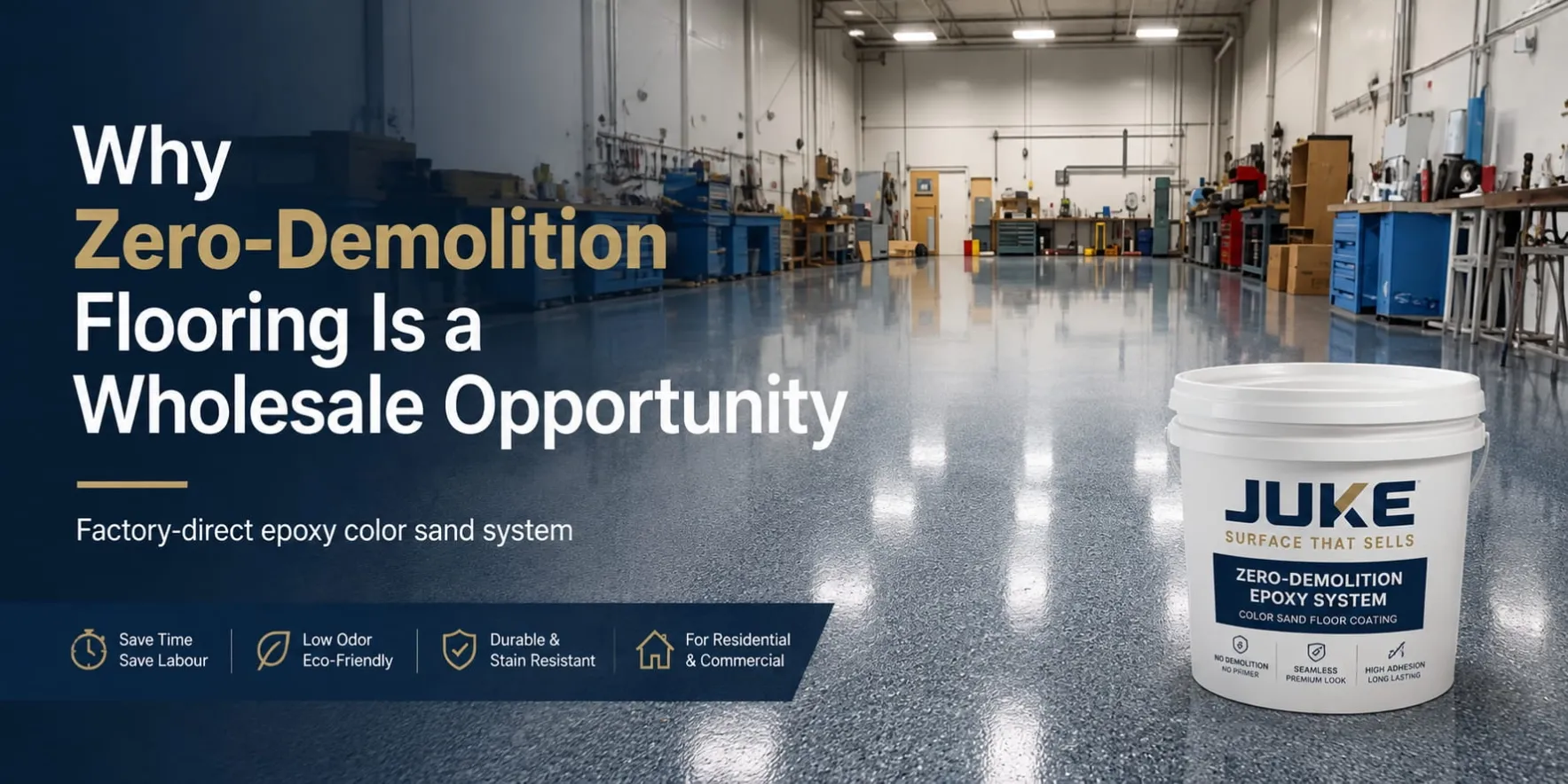
Why Zero-Demolition Flooring Is an Opportunity for Distributors
Floor renovation is changing. Instead of automatically removing an existing floor and rebuilding from the substrate, many renovation projects can now consider systems designed to upgrade suitable existing surfaces with less demolition.
For flooring distributors, wholesalers, contractors, and online sellers, this creates an interesting product opportunity.
JUKE Epoxy Colored Sand Self-Leveling Flooring System is designed for both new floors and renovation projects. On sound and properly prepared existing tile, terrazzo, and other suitable dense substrates, the system can be applied without traditional floor demolition.
The commercial value is simple: less demolition, a shorter renovation process, and a differentiated flooring solution that distributors can offer to customers looking for faster upgrades.
What Is Zero-Demolition Flooring?
Zero-demolition flooring refers to a renovation approach that reduces or eliminates the need to remove the existing floor before installing a new surface.
It does not mean that every old floor can simply be covered.
The existing substrate must still be structurally sound, clean, dry, stable, and suitable for the new flooring system. Loose tiles, cracks, hollow areas, unstable coatings, contamination, and damaged sections should be repaired before application.
When the substrate is suitable, however, avoiding full demolition can reduce several steps in a renovation project:
- Removing the existing flooring
- Handling and disposing of demolition waste
- Rebuilding or repairing the exposed substrate
- Additional labor and construction time
- Downtime for commercial spaces
For distributors, this means the product is not only another decorative epoxy. It addresses a specific renovation problem.
Why Does Zero-Demolition Flooring Matter to Customers?
Most end users do not begin a renovation by asking for a specific chemical formulation.
They usually begin with a problem:
“My existing floor looks old. How can I upgrade it without creating a major construction project?”
Traditional removal and replacement can involve noise, dust, debris, labor, transportation, and longer project schedules.
A flooring system that can be installed over a suitable existing substrate therefore offers a different value proposition.
Instead of selling only:
“a new epoxy floor,”
a distributor can sell:
“a way to renovate an existing floor with less demolition.”
That difference is important because it makes the product easier for customers to understand.
How Does JUKE Epoxy Colored Sand Flooring Fit This Category?
JUKE Epoxy Colored Sand Self-Leveling Flooring is a two-component decorative epoxy flooring system consisting of pre-blended epoxy colored sand and a dedicated curing agent.
After mixing and application, the material self-levels to form a continuous seamless surface with a stone-like decorative appearance.
According to the JUKE Technical Data Sheet, the system can be used on suitable substrates including existing ceramic tiles, terrazzo, sound epoxy floors, concrete, and cement mortar.
For renovation projects over old tile or terrazzo, proper substrate preparation remains essential. The surface must be sound, clean, dry, and free from loose or unstable materials.
This combination of direct-over-suitable-substrate application + self-leveling + seamless finishing is the foundation of the zero-demolition positioning.
What Technical Performance Should Distributors Evaluate?
A new flooring product should not be evaluated only by appearance or marketing claims.
Distributors should review measurable technical performance.
Key JUKE specifications include:
Property | JUKE Specification |
|---|---|
System | Two-component epoxy colored sand |
Mixing Ratio | Part A : Part B = 8 : 1 by weight |
Solid Content | Approx. 98% |
VOC Content | 16 g/L |
Mohs Hardness | Level 8 |
Compressive Strength | ≥80 MPa |
Surface Dry | 4–6 hours |
Hard Dry | 24 hours |
Light Pedestrian Traffic | After 48 hours |
Vehicle Traffic | After 72 hours |
Water Impermeability | Watertight at 0.4 MPa for 2 hours |
Recommended Application Temperature | 5–35°C |
Pot Life | Approx. 50 minutes |
These specifications help distributors evaluate whether the system is appropriate for their target applications rather than relying on general claims such as “strong” or “durable.”
Where Can the Product Be Positioned?
One advantage for distributors is that epoxy colored sand flooring is not limited to a single application.
Potential markets include:
Residential Renovation
Garages, villas, kitchens, balconies, and other interior renovation projects can benefit from a seamless decorative finish.
Commercial Flooring
Retail stores, showrooms, hotels, shopping spaces, and offices often value renovation systems that can reduce disruption and create a clean, modern surface.
Industrial Flooring
Workshops, warehouses, electronics facilities, pharmaceutical facilities, and food-processing areas require flooring systems with mechanical strength and wear resistance.
Public Facilities
Schools, hospitals, corridors, and other public buildings may also require seamless, easy-to-clean flooring systems.
This allows distributors to position one product system across several customer groups while adapting the sales message to each application.
Why Is This Interesting for Flooring Distributors?
The main opportunity is product differentiation.
Many flooring suppliers already compete with similar categories:
- Traditional epoxy coatings
- Tile
- PVC flooring
- Polyurethane flooring
- Terrazzo systems
- Cement-based flooring products
A zero-demolition epoxy colored sand system gives a distributor another category to present when the customer's main concern is renovation rather than new construction.
The selling conversation can therefore begin with a problem:
Existing floor + renovation difficulty
instead of beginning with:
Which epoxy coating would you like?
This problem-solution positioning is especially useful for:
- Flooring distributors
- Building-material wholesalers
- Hardware and renovation retailers
- Contractors
- Online flooring sellers
- Private-label brands
What Should a Distributor Check Before Adding the Product?
A new flooring product should be tested before a distributor commits to larger inventory.
At minimum, evaluate:
- Actual finished appearance Test the surface texture, color, gloss, and decorative effect.
- Application process Confirm mixing, spreading, self-leveling behavior, working time, and substrate preparation requirements.
- Technical documentation Review the current TDS and SDS rather than relying only on sales brochures.
- Substrate compatibility Test the product on the types of floors common in your local market.
- Packaging and supply options Consider whether standard packaging, OEM, or private-label formats fit your sales channel.
- Marketing support Application videos, installation instructions, before-and-after content, samples, and technical guidance can make a new product easier to introduce.
The purpose of a trial is not only to test the material. It is also to determine whether the product fits your customers, sales team, and local renovation market.
Can Epoxy Colored Sand Be Private Labeled?
For distributors and online sellers building their own flooring brand, OEM and private-label packaging can be an important part of the business model.
JUKE offers custom packaging options for OEM and private-label partners.
This allows a distributor to combine the flooring system with its own local brand, sales channels, installation support, and customer relationships rather than competing only as a reseller of a generic product.
Is Zero-Demolition Flooring Right for Every Project?
No.
This is an important point for both distributors and contractors.
Zero-demolition does not mean “no substrate inspection.”
If the existing floor has serious structural problems, loose sections, hollow areas, cracks, moisture problems, contamination, or unstable coatings, these conditions must be repaired before installation.
A reliable flooring supplier should help customers determine when direct renovation is suitable and when additional substrate work is necessary.
That technical honesty is more valuable in the long term than promising that one product can solve every floor condition.
The Opportunity for Distributors
Zero-demolition flooring should not be viewed simply as another epoxy product.
Its commercial value comes from the combination of:
renovation problem + reduced demolition + self-leveling application + seamless decorative finish + measurable technical performance.
For flooring distributors, wholesalers, contractors, and online sellers, that creates a product story that is relatively easy to communicate:
Upgrade suitable existing floors without starting with full demolition.
The next step should be practical rather than theoretical.
Evaluate the material, test it on a representative substrate, review the technical documentation, and determine whether it fits your local customer base.
Interested in Evaluating JUKE Epoxy Colored Sand?
JUKE Materials works with distributors, wholesalers, contractors, and online sellers.
For product evaluation, you can request:
- Product information
- Technical Data Sheet
- Application videos
- Sample information
- Wholesale pricing
- OEM and private-label information
Frequently Asked Questions
What is zero-demolition flooring?
It is a renovation approach that reduces or eliminates removal of the existing flooring when the existing substrate is sound and suitable for direct application of the new system.
Can JUKE Epoxy Colored Sand be applied over existing tiles?
Yes. It can be applied over sound existing ceramic tile and other suitable dense flooring substrates after proper surface preparation.
Is the finished floor seamless?
Yes. The self-leveling material forms a continuous seamless flooring surface after application and curing.
How strong is JUKE Epoxy Colored Sand flooring?
The current technical specification lists Mohs hardness at Level 8 and compressive strength at ≥80 MPa.
How long before the floor can be used?
The system is hard dry after approximately 24 hours under recommended conditions. Light pedestrian traffic is permitted after 48 hours and vehicle traffic after 72 hours.
Does the system require an additional topcoat?
For standard indoor applications, an additional topcoat is not required. Outdoor areas exposed to direct sunlight should use an appropriate UV-resistant protective topcoat.
Can distributors request OEM or private-label packaging?
Yes. Custom packaging options may be available for OEM and private-label partners.