
Aug 25, 2026B2B & Sourcing
Marble-Look Epoxy Flooring: A Product Opportunity for Retailers
Learn how marble-look epoxy colored sand flooring helps distributors and retailers differentiate their ranges with direct-to-tile installation, OEM colors, and a low MOQ.
Marble-Look Epoxy Flooring: A Product Opportunity for Retailers
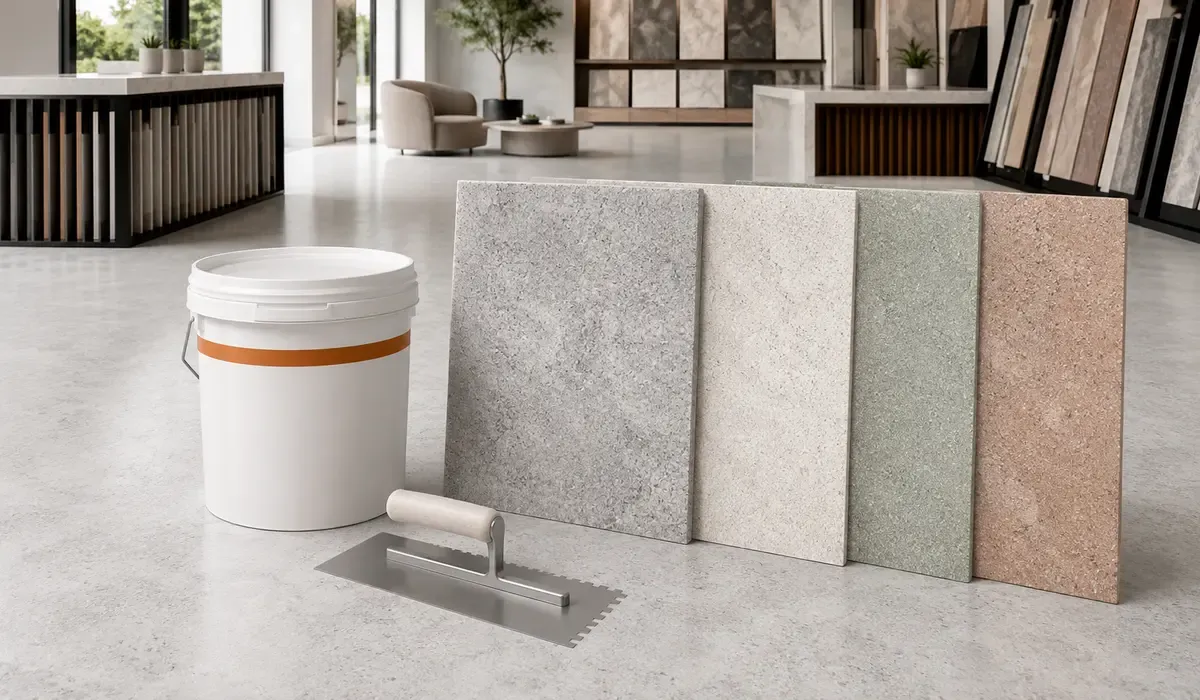
Marble-look epoxy colored sand flooring gives distributors and retailers a way to offer decorative floor renovation without requiring customers to remove suitable existing tiles.
The system combines a seamless marble-like appearance with direct-to-tile application, no separate primer, self-leveling performance, factory-direct supply, and OEM support. This makes it relevant to tile suppliers, decorative concrete distributors, flooring wholesalers, and home-improvement retailers seeking a differentiated product range.
What Is Marble-Look Epoxy Colored Sand Flooring?
Marble-look epoxy colored sand flooring is a two-component decorative flooring system made from Part A colored sand material and Part B curing agent.
After mixing, pouring, and spreading, the material self-levels to create a continuous surface with subtle color and texture variation. The finished appearance resembles decorative stone or fine terrazzo but does not contain the joints found in conventional tiles.
It is not natural marble and should not be marketed as a marble slab replacement. Its advantage is providing a decorative, seamless finish through a liquid-applied renovation system.
Why the Marble-Look Finish Helps Retailers Differentiate
Many flooring sellers compete with similar collections of tiles, vinyl planks, or standard epoxy coatings. A marble-look colored sand system adds a different product category to the range.
Its main commercial advantages include:
- A visible before-and-after transformation
- Direct application over suitable existing tiles
- No separate primer
- Seamless and self-leveling finish
- Multiple decorative color options
- OEM and private-label opportunities
- Suitable content for product demonstrations
- Factory-direct wholesale supply
The product should be positioned as a renovation system rather than only as a bucket of coating material.
Read Why Zero-Demolition Flooring Is an Opportunity for Distributors and Building Material Sellers for a broader overview of the market opportunity.
Zero Demolition Is the Main Selling Point
The decorative finish attracts attention, but the strongest customer benefit is avoiding unnecessary tile removal.
Traditional tile renovation may involve breaking the old floor, removing debris, repairing the substrate, and installing a new finish. JUKE Epoxy Colored Sand can be applied directly over suitable old tiles when they are sound, firmly bonded, dry, clean, and correctly prepared.
This can reduce demolition work, waste, and disruption. It does not eliminate the need for substrate inspection and surface preparation.
Loose tiles, cracks, contamination, excessive moisture, and uneven areas must be repaired before application.
Important Product Facts for Distributors
Retailers should present accurate and consistent information across product pages, catalogs, samples, and sales conversations.
Key product information includes:
- Suitable for properly prepared tiles, concrete, and terrazzo
- No demolition required for suitable existing substrates
- No separate primer required
- Two-component Part A and Part B system
- Components supplied in the correct factory-prepared proportion
- Self-leveling and seamless application
- Recommended thickness of approximately 1.0–2.0 mm
- One 24 kg set covers approximately 12 square meters
- Primarily designed for indoor flooring
- No additional topcoat required under the standard TDS system
Coverage is approximate. Actual consumption depends on substrate flatness, surface condition, application thickness, and material loss.
Performance Behind the Decorative Finish
A decorative floor must also provide suitable physical performance.
According to the JUKE 2026 Technical Data Sheet, the system provides:
- Mohs hardness: Level 8
- Compressive strength: ≥80 MPa
- Solid content: approximately 98%
- VOC content: 16 g/L
- Surface dry time: 4–6 hours
- Hard dry time: 24 hours
- Water impermeability: watertight at 0.4 MPa for 2 hours
- Heat resistance: no flowing or bubbling below 80°C
- Low-temperature flexibility: no cracking at −20°C
These specifications help distributors answer technical questions without relying on exaggerated marketing claims.
How to Build a Practical Color Range
A large number of colors can look attractive in a catalog, but too many stock colors increase inventory complexity.
A better starting strategy is to divide the range into three levels.
Core Neutral Colors
Gray, white, and other neutral marble-look finishes generally work across residential, retail, office, hotel, and showroom applications.
These colors should form the main stocked range because they are easier to demonstrate and combine with different interior styles.
Decorative Accent Colors
Green, blue, pink, red, and yellow options can be presented for customized interiors, branded commercial spaces, schools, showrooms, and special design projects.
These colors may be better offered by sample or project order rather than held in large quantities.
Custom OEM Colors
For distributors developing a private-label range, JUKE can support selected color customization and Pantone-based color development, subject to sample confirmation and production requirements.
Digital colors should always be described as references. Physical samples are necessary because screens, lighting, application thickness, and batch conditions can affect the appearance.
How Retailers Should Display the Product
Physical demonstration is especially important for a new flooring category.
Useful sales tools include:
- Finished sample boards
- Tile-to-finished-floor comparison samples
- Mixing and application videos
- Before-and-after project images
- Coverage information
- Substrate suitability guides
- Color sample cards
- Technical Data Sheets
- Frequently asked questions
A sample board showing the original tile on one side and the completed seamless finish on the other can explain the product faster than a long technical description.
OEM and Private-Label Support
JUKE provides factory-direct support for distributors, wholesalers, and retail brands that want to develop their own product line.
Available support can include:
- Private-label packaging
- Custom logos and labels
- Selected color customization
- Product images and application videos
- Technical documentation
- Sales and marketing materials
- Application guidance
The starting wholesale MOQ is one pallet, equal to 36 sets. This gives new distributors a lower entry point for testing local demand before placing larger orders.
Avoid These Marketing Mistakes
Retailers should not make promises that go beyond the product’s actual application conditions.
Avoid claims such as:
- “No grinding required”
- “Suitable for every old floor”
- “Completely dust-free”
- “Guaranteed high profit margins”
- “Exact coverage on every project”
- “Any color shown on screen will be identical”
- “No professional preparation is required”
The JUKE system avoids demolition on suitable floors, but the substrate still requires inspection, repair where necessary, grinding, cleaning, and correct preparation.
Accurate product education improves customer confidence and reduces installation disputes.
How to Introduce the Product to Your Market
A practical distributor launch can follow these steps:
- Request a product sample and technical documents.
- Test the material on a suitable tile or concrete surface.
- Produce physical sample boards.
- Select a small core color range.
- Calculate local import, storage, and delivery costs.
- Prepare installation and substrate guidance.
- Begin with the 36-set wholesale MOQ.
- Use customer feedback to expand the range.
Distributors selling through websites or online marketplaces can also read How to Sell Zero-Demolition Epoxy Flooring Online for product-page and fulfillment guidance.
Retailer and Distributor FAQ
Is the marble-look pattern printed?
No. The decorative appearance comes from the colored sand formulation and the way the liquid material flows and self-levels during application.
Can the system cover existing tiles?
Yes, when the tiles are stable, firmly bonded, dry, clean, and properly prepared. Loose or hollow tiles must be repaired first.
Does it require a primer?
No separate primer is required when the substrate meets the required conditions and is prepared correctly.
How much area does one set cover?
One 24 kg set covers approximately 12 square meters at the recommended thickness. Actual consumption can vary.
Can distributors select their own colors?
JUKE supports selected OEM color development and Pantone-based customization, subject to sample approval and production requirements.
What is the minimum wholesale order?
The starting MOQ is one pallet, containing 36 sets.
Request Samples and Wholesale Information
JUKE Materials manufactures epoxy colored sand flooring systems for distributors, decorative concrete suppliers, tile suppliers, building material wholesalers, and retail brands.
Partners can request:
- Product samples
- Wholesale pricing
- OEM packaging options
- Available color information
- Technical documents
- Marketing images and videos
- Application guidance
Want to Add This Product to Your Range?
Request color samples, factory-direct wholesale pricing, and OEM packaging options. Low MOQ starting from 36 sets.