
Oct 5, 2026B2B & Sourcing
How to Sell Epoxy Color Sand Flooring: A Distributor’s Sales Toolkit
Build a practical sales toolkit for epoxy color sand flooring with samples, application videos, technical documents, coverage guidance, and customer qualification questions.
How to Sell Epoxy Color Sand Flooring: A Distributor’s Sales Toolkit
To sell epoxy color sand flooring effectively, distributors need materials that explain the product, demonstrate its appearance, and help customers assess their floors. A practical sales toolkit includes cured samples, application videos, current technical documents, coverage guidance, and a clear enquiry process.
JUKE Epoxy Colored Sand Self-Leveling Flooring offers a specific renovation benefit: direct application over suitable existing tiles without demolition, generally without grinding or primer. Supporting that message with useful information helps customers move from initial interest to a purchase decision.
1. Start With One Clear Product Explanation
Customers should understand the product before encountering a long list of specifications.
A useful opening is:
“JUKE Epoxy Colored Sand is a two-component, self-leveling flooring system for renovating suitable existing floors. It can be applied directly over firmly bonded, clean, dry tiles without removing them.”
Then explain the appearance and application. The system creates a continuous decorative colored-sand surface. Installers mix the supplied components, pour the material, spread it evenly, and allow it to self-level.
Keep the substrate distinction clear. Suitable tiles generally need no primer. Concrete requires a compatible primer, and damaged or uneven areas need repair before application.
2. Use Samples to Establish Appearance Expectations
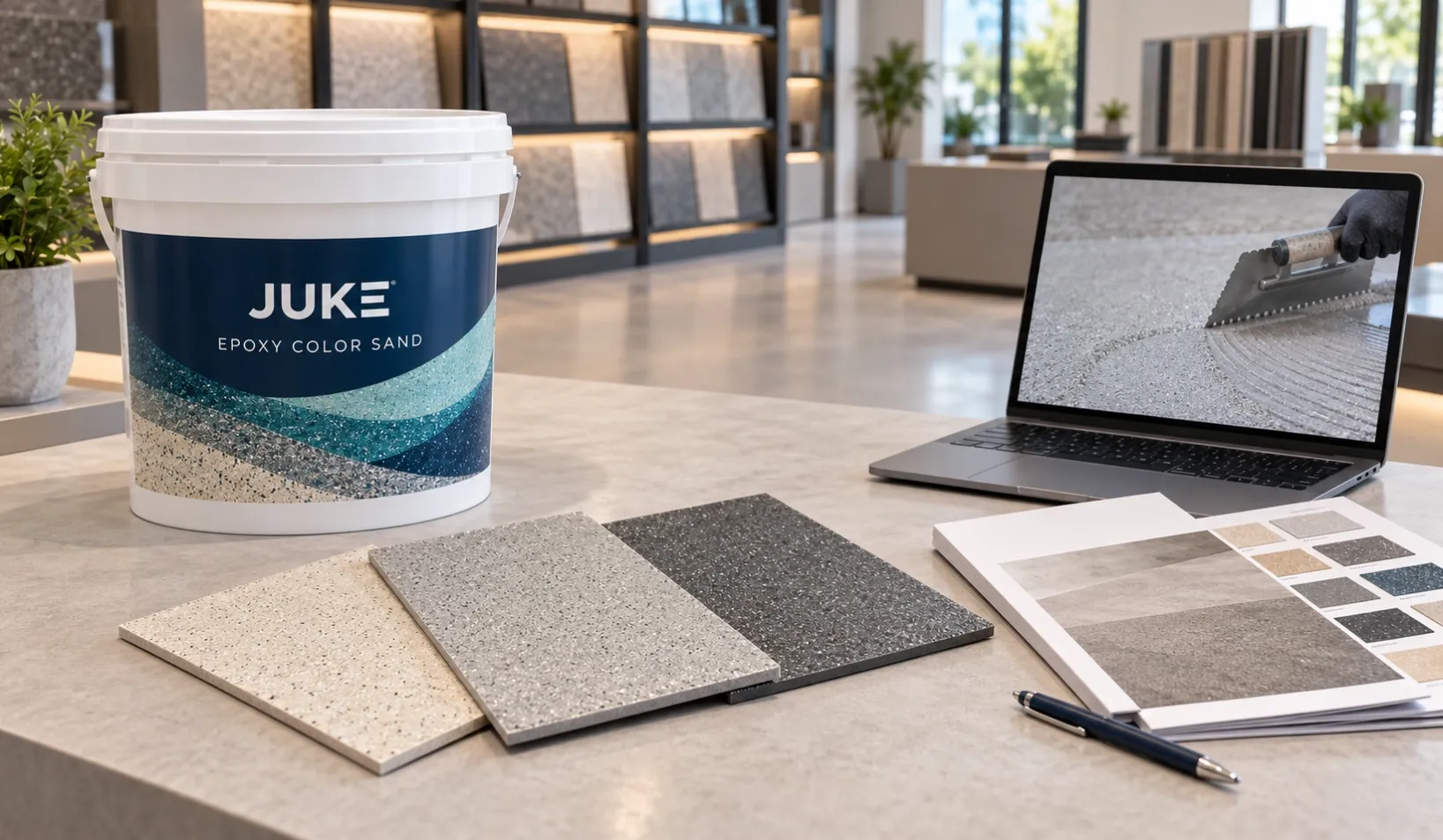
Physical samples help customers judge color, texture, and sheen more accurately than screen images alone.
Prepare a focused selection that represents the colors you intend to stock. Label each sample clearly so staff and customers can identify it when discussing an order.
Let customers inspect the samples under different lighting. Take listing photographs that show both the overall appearance and a close-up of the mineral texture.
Explain what the sample demonstrates. A cured board is useful for reviewing appearance. An application trial provides additional information about preparation, spreading, consumption, and curing.
Keep an approved reference sample for stocked colors. It gives your sales team a consistent point of reference when answering enquiries.
3. Show the Complete Application Sequence
A short pouring video can attract attention, but customers need more information before buying.
Your demonstration should show enough of the process to establish realistic expectations:
- Inspection and preparation of the existing floor.
- Mixing of the supplied Part A and Part B.
- Pouring and spreading with suitable tools.
- Self-leveling and protection during curing.
- The finished surface after adequate curing.
JUKE supplies factory-proportioned components. For a complete set, the installer combines the supplied quantities according to the instructions.
Avoid presenting self-leveling as a substitute for floor repairs. The base must already be suitable, and the installer still needs to distribute the material evenly.
A complete demonstration also helps contractors identify the tools and work sequence they will need.
4. Keep Technical Documents Easy to Access
Customers evaluating a new flooring system may need more than marketing content.
Maintain the current technical data sheet, safety data sheet, and application instructions in an accessible location. Staff should know which document answers each type of question.
Material | Main purpose |
|---|---|
Product overview | Explain the system and its intended applications |
Technical data sheet | Review preparation, application, and declared product data |
Safety data sheet | Understand handling, storage, and safety requirements |
Application instructions | Follow the installation process |
Color samples | Assess appearance |
Commercial quotation | Confirm quantities, packaging, and delivery basis |
Keep versions consistent. When instructions change, update the files your team sends and the information displayed online.
If a customer requests a test result, provide the available report or ask the manufacturer to confirm availability. A demonstration video should not be presented as a standardized laboratory test.
5. Provide Coverage Guidance Customers Can Use
JUKE’s standard 20 kg set covers approximately 10 m² under normal application conditions.
Give customers a simple starting estimate based on floor area, then discuss conditions that may affect consumption. Uneven surfaces, application technique, and material loss can change the quantity required.
Do not promise exact coverage for every floor. Contractors should assess the substrate and use a representative trial when necessary.
Your product page or quotation should make the unit clear: one complete 20 kg set, with approximate coverage of 10 m².
6. Ask Questions in a Useful Order
A clear enquiry process helps staff give relevant answers without overwhelming customers.
Start by identifying the buying purpose. A customer purchasing for resale needs different information from someone planning an installation.
Then establish the substrate and approximate area or quantity. Ask one question at a time when communicating through WhatsApp or another messaging channel.
Useful questions include:
- Are you buying for resale or an installation project?
- Is the existing floor tile or concrete?
- What area do you plan to cover?
- Do you have an installer or application team?
For wholesale enquiries, confirm the company’s sales channel before preparing an order proposal. For shipping calculations, collect the destination details needed for the quotation.
Each answer should determine the next useful step.
7. Match the Offer to the Buyer’s Business
The sales toolkit should support the buyer’s intended use.
A tile retailer may need display samples and staff guidance. A contractor may prioritize a site trial and installation instructions. An online seller may need product photographs, videos, packaging information, and customer support content.
JUKE offers factory-direct supply, OEM options, marketing support, and a low MOQ of 36 sets. Discuss which materials are available and how they fit the buyer’s launch plan.
For private-label supply, confirm branding, artwork, instructions, and approval requirements before production.
Frequently Asked Questions
What should I send after a customer expresses interest?
Start with a concise product explanation and a relevant demonstration. Ask about the buying purpose or existing floor before sending a large document package.
Is a sample board enough to approve an installation?
It establishes appearance expectations. A representative application trial helps assess the process on the intended substrate.
Should every sales message include all technical specifications?
Provide the information needed for the customer’s current decision. Keep the full technical documents available for review.
Can JUKE support an own-brand product launch?
JUKE offers OEM and marketing support. Confirm the scope and requirements before ordering.
Build Your Toolkit With JUKE
A useful sales toolkit connects the product’s renovation benefits with clear application guidance and a practical buying process. Give customers the information they need to assess suitability, estimate quantities, and request an appropriate offer.
Contact JUKE to discuss wholesale supply, OEM options, and marketing materials for your sales channel.