
Sep 6, 2026Epoxy Color Sand
How Much Epoxy Color Sand Do You Need?
Calculate how many 20 kg epoxy color sand sets your floor needs, with coverage examples in square metres and square feet and practical ordering considerations.
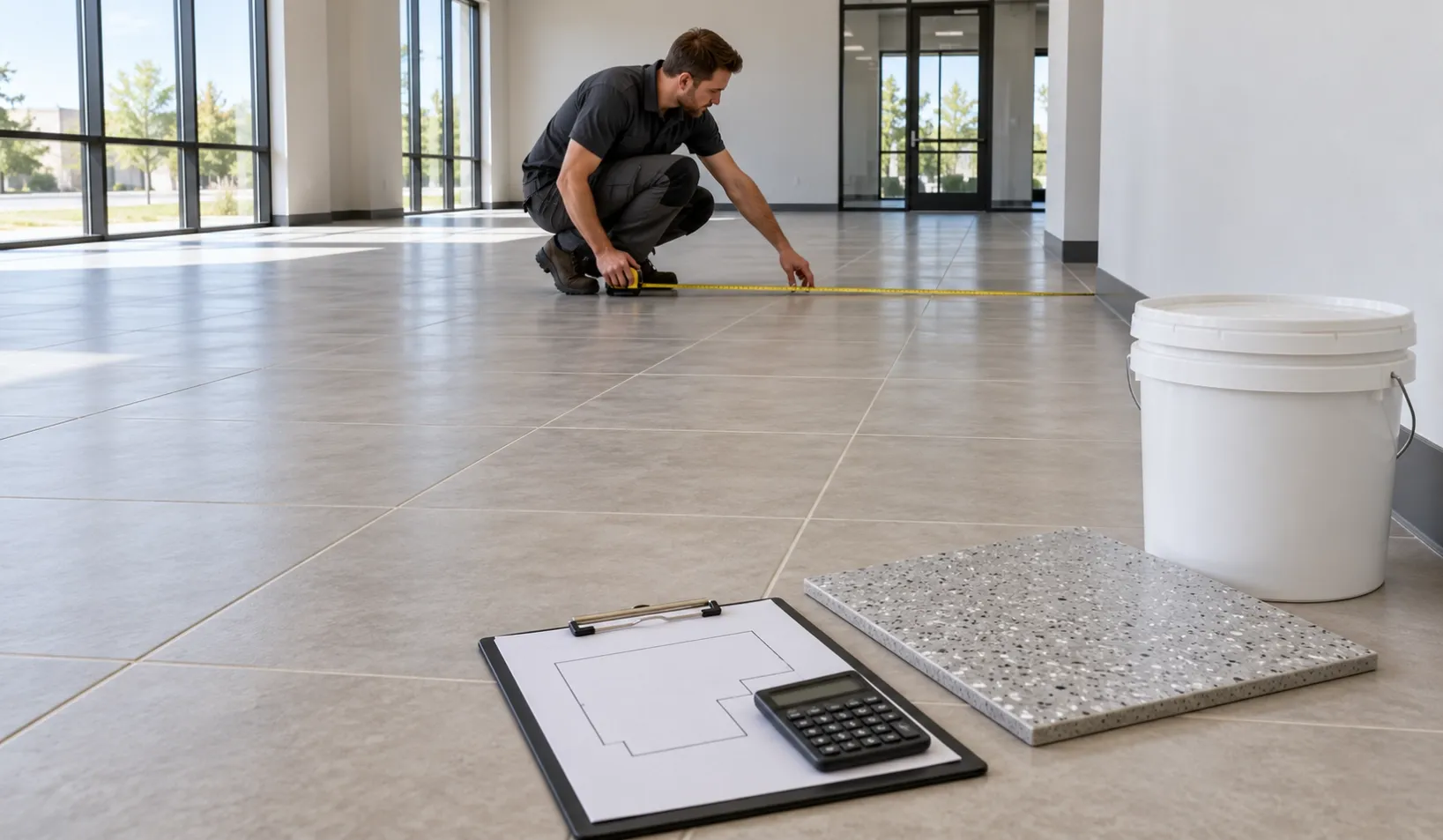
How Much Epoxy Color Sand Do You Need?
A 20 kg JUKE Epoxy Color Sand Self-Leveling set covers approximately 10 m², or 108 square feet. This provides a starting point for estimating how much material to order for a floor renovation.
The 20 kg refers to the combined net weight of Part A and Part B, not 20 kg of Part A plus additional curing agent.
Actual coverage depends on the substrate, application thickness, tile joints, surface irregularities, and installation loss. Use the stated coverage for initial planning, then check the floor before confirming your order.
Quick Coverage Calculation
For measurements in square metres:
Estimated sets = floor area ÷ 10
Round the result up to a whole set.
For measurements in square feet:
Estimated sets = floor area ÷ 107.64
The square-foot calculation uses a more precise conversion. Approximately 108 square feet is suitable for general product descriptions.
These formulas provide a baseline before any additional allowance for substrate condition or installation loss.
Coverage Examples
Floor Area | Approximate Square Feet | Baseline 20 kg Sets | Total Net Material |
|---|---|---|---|
10 m² | 108 | 1 | 20 kg |
18 m² | 194 | 2 | 40 kg |
25 m² | 269 | 3 | 60 kg |
40 m² | 431 | 4 | 80 kg |
65 m² | 700 | 7 | 140 kg |
100 m² | 1,076 | 10 | 200 kg |
Set quantities are calculated from the square-metre areas. Square-foot values are rounded for reference.
A floor measuring exactly 40 m² uses the full estimated coverage of four sets. That leaves no additional allowance if the surface requires more material than expected.
Step 1: Measure the Area to Be Coated
For a rectangular room, multiply its length by its width:
Floor area = length × width
A room measuring 5 metres by 4 metres has an area of 20 m². At approximately 10 m² per set, the baseline requirement is two sets.
For an irregular room, divide the floor into smaller rectangles, calculate each section, and add the areas together.
Measure the actual application area rather than relying only on the property's advertised floor area. Include connecting passages, recesses, and thresholds where the coating will continue.
Subtract permanently excluded areas only when they will definitely remain uncoated. Confirm the installation boundary around cabinets and fixed equipment before calculating the total.
Step 2: Round Up to Complete Sets
A 25 m² floor requires an estimated 2.5 sets. The baseline purchase quantity is therefore three complete sets, providing 60 kg of material.
Rounding up helps avoid ordering a fractional package, but it is not a substitute for assessing the substrate.
JUKE supplies Part A and Part B in factory-matched quantities. Using a complete matched set simplifies proportioning. Do not reduce the curing-agent quantity or alter the mixture to make the product cover a larger area.
Plan batch sizes and application sections before mixing. Unmixed material and material already combined with the curing agent are not interchangeable for storage or later use.
Step 3: Check What May Reduce Coverage
Two floors with the same measured area may require different quantities.
Deep Tile Joints
Deep or damaged grout joints create additional spaces that consume material. Filling suitable joints before the main application can make consumption more predictable.
Movement joints require separate consideration and should not simply be filled as ordinary grout lines.
Uneven Floors
Depressions and height differences can create thicker areas. Epoxy color sand should not be used as an unlimited filling material for major substrate defects.
Correct significant unevenness before estimating the finishing layer.
Rough or Repaired Surfaces
A rough surface or extensive repairs may change the amount of material needed to achieve a consistent finish. Mixed substrates should be assessed before applying one coverage figure to the entire project.
Application Loss
Material can remain on tools and inside containers. Spillage and material that becomes unusable before spreading can also reduce practical coverage.
Does a Thicker Layer Cover Less Area?
Yes. With the same material quantity, increasing the average application thickness generally reduces the area covered.
This means approximately 10 m² per 20 kg set should not be interpreted as guaranteed coverage at every possible thickness.
Coverage and thickness must be considered together. If a project requires a specific finished thickness, ask JUKE to confirm the expected consumption for that requirement and substrate.
Do not stretch the material beyond its intended application by scraping it excessively thin. Uneven distribution may affect appearance and layer continuity.
The advertised coverage implies approximately 2 kg/m²:
20 kg ÷ 10 m² = 2 kg/m²
This is a reference consumption derived from the coverage estimate. It is not a confirmed consumption rate per millimetre.
How Much Extra Material Should You Order?
There is no single allowance that fits every floor.
A flat, well-prepared tiled surface may be easier to estimate than a floor with deep joints, multiple repairs, or irregular levels.
Before adding an allowance, establish:
- The measured application area
- The condition of the existing floor
- Whether joints and depressions will be repaired separately
- The required application thickness
- The size and sequence of application sections
Consider how much spare coverage is already created by rounding up. Three sets for 25 m² provide some estimated headroom, while three sets for exactly 30 m² do not.
Ask for a project-specific quantity check when the calculation is close to the stated coverage limit.
Can You Apply It Directly Over Existing Tiles?
JUKE is designed for zero-demolition renovation over suitable existing tiles.
The tiles must be firmly bonded, stable, clean, dry, and prepared according to the approved application instructions. Loose tiles and significant defects must be corrected before coating.
No separate primer is required on suitable dense, non-porous tiles under the JUKE direct-to-tile system. This does not eliminate cleaning, inspection, or necessary repairs.
Direct-to-tile application can avoid complete tile removal, but it does not make substrate condition irrelevant to material consumption.
Plan the Application Before Mixing
Have the full project quantity available before starting a continuous visible area.
The basic process is Mix–Pour–Spread. Combine the factory-matched components, mix thoroughly, and distribute the material evenly with a suitable notched trowel or spreading tool.
Self-leveling helps the distributed material settle. It does not determine the correct quantity automatically or compensate for every low spot.
Arrange the mixing and spreading sequence so that material is ready when needed, without mixing more than the team can apply within the approved working time.
What Buyers Should Send for a Quantity Check
To help JUKE assess your requirement, provide:
- Total floor area in m² or square feet
- Photos of the existing floor
- Substrate type
- Details of joints, cracks, repairs, or uneven areas
- Intended use of the room
- Any specified application thickness
These details support a more useful estimate than floor area alone.
For distributors and retailers, clear coverage guidance also helps customers understand what each set contains and reduces the risk of underordering.
Frequently Asked Questions
Does one 20 kg set cover 10 m² exactly?
No. Approximately 10 m² is a planning estimate. Actual coverage varies with substrate condition, thickness, and installation loss.
Does the 20 kg include both components?
Yes. It is the combined net weight of the supplied Part A and Part B.
How many sets are needed for 500 square feet?
500 square feet is approximately 46.45 m². The baseline estimate is five 20 kg sets, before checking whether additional material is needed.
Can I add water or filler to increase coverage?
Do not modify the formulation to increase coverage. Follow the approved mixing instructions.
Does the estimate include major floor repairs?
No. Significant repairs and leveling should be assessed separately from the decorative finishing layer.
Get the Quantity Right Before You Start
Start with approximately 10 m², or 108 square feet, per 20 kg set. Measure carefully, round up to complete sets, and adjust the order for the actual floor condition.
For distributors, tile suppliers, wholesalers, and e-commerce sellers, JUKE offers factory-direct supply, OEM packaging, marketing support, and wholesale trial orders starting from 36 sets.