
Oct 10, 2026B2B & Sourcing
Epoxy Flooring vs Vinyl Flooring: A Buying Guide for Distributors
Compare epoxy flooring and vinyl flooring by installation, substrate preparation, appearance, project costs and wholesale supply to choose the right products for your distribution business.
Epoxy Flooring vs Vinyl Flooring: A Buying Guide for Distributors
Epoxy flooring creates an applied resin surface, while vinyl flooring uses manufactured planks, tiles or sheets. For distributors and wholesalers, choosing between them depends on customer demand, renovation conditions, installation resources and the support needed to sell each product.
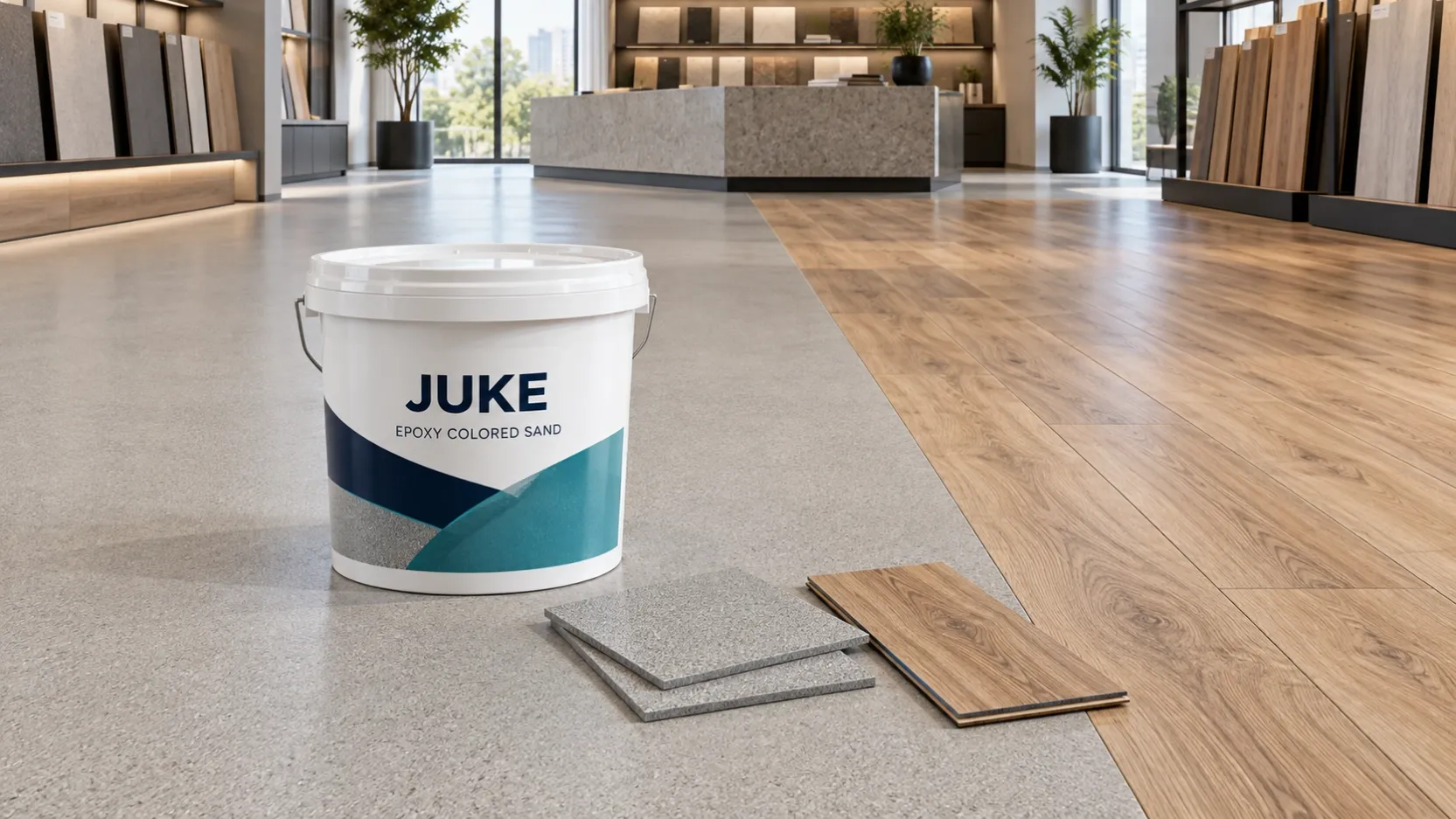
Vinyl offers familiar flooring formats and a wide range of decorative designs. An epoxy colored sand system provides a continuous mineral finish and a different renovation option, including direct application over suitable existing tiles.
This guide compares the two categories from a distributor’s purchasing and sales perspective.
Understand Which Flooring Systems You Are Comparing
“Epoxy flooring” and “vinyl flooring” each describe several products with different installation requirements.
Epoxy products include thin coatings, self-leveling systems and decorative finishes. JUKE Epoxy Colored Sand Self-Leveling is a two-component decorative system with factory-prepared colored quartz sand incorporated into Part A.
Vinyl products include sheet vinyl, luxury vinyl tile and plank formats. Installation methods include gluedown, loose lay and rigid-core floating systems. Requirements vary by product, so distributors should review the specific manufacturer’s instructions.
A useful comparison identifies the exact systems, their approved applications and what is included in the purchase.
Purchasing factor | JUKE epoxy colored sand flooring | Vinyl flooring |
|---|---|---|
Product format | Two-component flooring set | Planks, tiles or sheets |
Finished appearance | Continuous colored mineral surface | Manufactured patterns and formats |
Installation | Mix, pour, spread and allow to cure | Product-specific cutting, fitting and fixing |
Existing tiles | Direct application when suitable | Overlay possible for selected products |
Concrete preparation | Grinding, repairs and compatible primer | Preparation according to flooring and adhesive requirements |
Quantity calculation | Consumption per square meter | Pack or roll coverage plus cutting allowance |
Sales support | Samples, mixing guidance and application training | Samples, layout guidance and installation instructions |
Can Both Products Go Over Existing Tiles?
Selected products in both categories can support renovation over existing tiles.
For JUKE, the tiles must be firmly bonded, stable, clean and dry. Suitable tile substrates do not require demolition, grinding or primer. Defects and contamination must still be addressed before application.
Some rigid-core vinyl products also permit installation over existing hard floors, including ceramic tiles. However, grout-line treatment and flatness requirements depend on the selected product. Gluedown vinyl may require smoothing work over old grout lines.
Distributors should therefore explain the specific installation route rather than presenting tile overlay as exclusive to one category.
JUKE’s distinction is the combination of direct-to-tile application and a continuous decorative colored sand finish.
Compare the Finished Appearance
Vinyl flooring can reproduce wood, stone and tile designs. Its manufactured formats give buyers a range of patterns and layout options.
JUKE produces a fine mineral appearance with a generally matte-to-satin finish. It creates a continuous surface across the application area, while required movement joints must remain properly detailed.
For distributors, these products address different design requests:
- Vinyl suits buyers seeking plank layouts or manufactured decorative patterns.
- Epoxy colored sand suits buyers seeking a continuous mineral finish.
- A flooring showroom can display both to help customers compare the surfaces directly.
Use representative samples and installation photographs. Do not describe colored sand flooring as metallic epoxy, or promise that it will reproduce a particular vinyl design.
Compare Installation and Reopening Requirements
Vinyl installation follows the selected format’s requirements. Gluedown and floating systems have different preparation, fixing and detailing procedures.
JUKE requires accurate mixing, organized application and protection during curing. The factory-matched Part A and Part B ratio is 8:1 by weight. Installers mix the components thoroughly, pour the material, spread it with a notched tool and use a spiked roller as instructed.
Concrete requires mechanical grinding and a compatible epoxy primer. Uneven areas, holes and cracks should be repaired first. Self-leveling does not mean the material can correct every substrate defect.
For JUKE, light pedestrian traffic is typically permitted after approximately 48 hours under suitable conditions, once adequate cure is confirmed. Temperature and site conditions can extend the schedule.
Retailers and e-commerce sellers should make installation and access requirements clear before purchase.
Is Epoxy Flooring Cheaper Than Vinyl Flooring?
Neither category is automatically cheaper.
Compare the complete installed project, including preparation, accessories, labor, material losses and access restrictions.
For vinyl, check pack coverage, cutting allowance, adhesives or underlay where required, trims and preparation materials.
For epoxy colored sand, check complete set contents, consumption, primer requirements, repairs and application losses.
JUKE’s current standard 20 kg set covers approximately 10 m² at a typical consumption of 2 kg/m². Actual coverage depends on substrate flatness and application conditions.
For example, a 100 m² project requires a baseline calculation of ten sets. Additional material may be needed for site conditions and losses. This is a quantity estimate, not a complete project quotation.
What Should Wholesalers Check Before Purchasing?
The buying checklist should match the product category.
For vinyl, confirm the format, dimensions, pack coverage, installation method, intended use and availability of matching accessories.
For epoxy colored sand, confirm:
- Complete set contents and mixing ratio.
- Coverage and substrate preparation.
- Storage conditions and shelf life.
- Application instructions and curing schedule.
- Technical data and safety documentation.
- Sample, training and marketing support.
For either category, review the performance documentation relevant to your customers’ projects. A general “commercial” description does not establish suitability for every traffic level or exposure.
JUKE offers factory-direct supply with a minimum order of 36 sets. Mixed colors, OEM labels and marketing support help distributors prepare a trial range.
Should Vinyl Distributors Add Epoxy Colored Sand?
A vinyl distributor can evaluate epoxy colored sand as an additional renovation category.
It may suit customers asking for a continuous decorative surface, particularly where suitable existing tiles can remain in place.
Start with representative samples, a demonstration installation and a clear customer profile. Train sales staff to explain tile and concrete preparation separately.
The commercial decision should consider local installation capability, customer demand and the support required after sale. A distinct product story is useful only when customers can understand and successfully install the system.
Frequently Asked Questions
Which is better: epoxy flooring or vinyl flooring?
The choice depends on the intended appearance, substrate, installation method and project requirements. Compare specific products rather than the categories alone.
Can JUKE be applied over vinyl flooring?
Direct application over vinyl should not be assumed. JUKE’s standard guidance covers suitable tiles and correctly prepared concrete. Other substrates require technical assessment.
Does JUKE require primer?
Suitable, firmly bonded, clean and dry tiles do not require primer. Concrete requires mechanical preparation and a compatible epoxy primer.
Can a vinyl wholesaler offer JUKE under its own brand?
JUKE offers OEM labels, subject to agreement on packaging and artwork. The minimum order is 36 sets.
Discuss a Wholesale Trial With JUKE
JUKE supplies epoxy colored sand self-leveling flooring for flooring distributors, building material wholesalers, tile suppliers and retail channels.
Share your sales channel and typical renovation projects to discuss a 36-set trial order, OEM labels and marketing support.