
Oct 10, 2026B2B & Sourcing
Resin Flooring vs Epoxy Flooring: What Distributors Need to Know
Epoxy flooring is a type of resin flooring. Learn how to compare resin chemistry, application methods, substrate requirements and complete system contents before placing a wholesale order.
Resin Flooring vs Epoxy Flooring: What Distributors Need to Know
Epoxy flooring is a type of resin flooring. The terms describe a broad product category and one of the resin chemistries within it.
For distributors and wholesalers searching for “resin flooring vs epoxy flooring,” the useful question is which specific system fits their customers’ projects. A supplier’s product name alone does not establish its composition, installation requirements or performance.
This guide explains the terminology and the details buyers should check before adding a flooring system to their range.
Is Resin Flooring the Same as Epoxy Flooring?
Resin flooring is a broad category covering flooring systems made with synthetic resin binders. Epoxy, polyurethane and methacrylate are among the chemistries used in this category. Epoxy flooring therefore falls within resin flooring, while other resin floors use different binders.
When a supplier offers “resin flooring,” ask which chemistry the product uses. When a supplier offers “epoxy flooring,” ask which epoxy system is included.
Neither name gives you the complete specification.
Product description | What it tells buyers | What still needs checking |
|---|---|---|
Resin flooring | Broad flooring category | Resin chemistry, system build-up and application |
Epoxy flooring | Epoxy-based system | Components, thickness, finish and preparation |
Self-leveling epoxy | Epoxy system with a flow-applied installation method | Consumption, application thickness and substrate requirements |
Decorative epoxy flooring | An appearance-focused epoxy system | Decorative materials, installation sequence and finish |
Epoxy colored sand flooring | Epoxy system incorporating colored sand | Whether sand is premixed or supplied separately |
For wholesale purchasing, request the complete product description and technical documentation before comparing quotations.
Resin Chemistry and Installation Method Are Separate Questions
Resin chemistry identifies the binder. Installation method describes how the floor is constructed.
A resin floor may be a thin coating, a multilayer system, a flow-applied floor or a trowel-applied screed. FeRFA’s classification distinguishes systems by their construction, thickness and finish rather than treating all resin floors as equivalent.
This matters when comparing suppliers.
A roller-applied epoxy coating and a decorative self-leveling epoxy system can share the same broad resin chemistry while requiring different materials, tools and application procedures.
Likewise, “self-leveling” describes application behavior. It does not establish suitability for every substrate or service condition.
Distributors should record both the chemistry and the installation method in their product specifications.
Where Does JUKE Epoxy Colored Sand Fit?
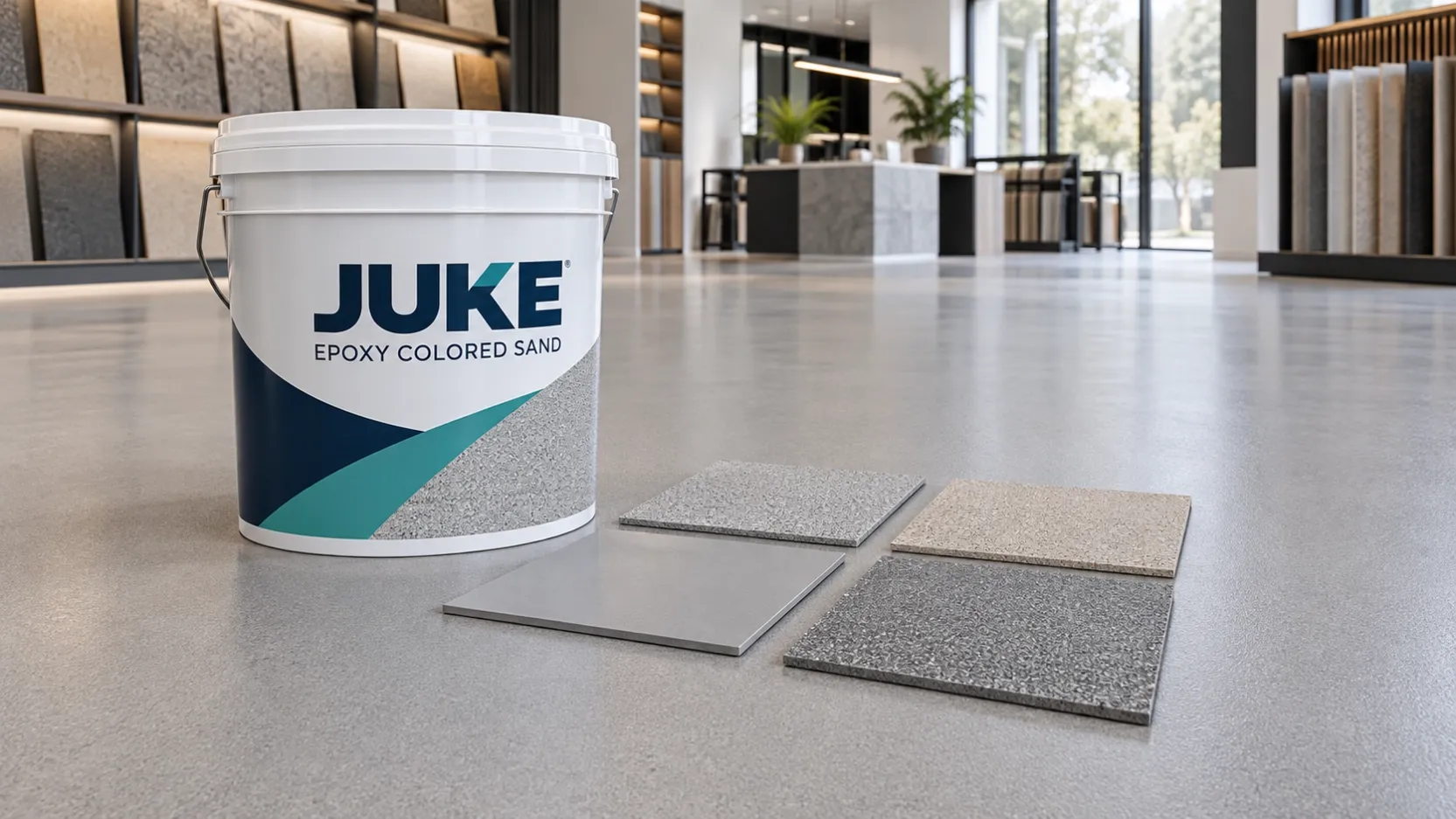
JUKE Epoxy Colored Sand Self-Leveling is a two-component decorative epoxy flooring system.
Part A incorporates the colored sand, fillers and pigments. Part B is the hardener. The factory-matched components are mixed at an 8:1 ratio by weight before application.
For this premixed system, installers do not add a separate bag of colored sand on site.
After thorough mixing, the material is poured, spread with a notched tool and treated with a spiked roller according to the application instructions. It forms a continuous decorative surface with a fine mineral appearance.
Its product identity can be described as:
- Category: Resin flooring.
- Chemistry: Epoxy.
- System: Two-component decorative colored sand.
- Application: Self-leveling.
- Renovation route: Direct application over suitable existing tiles or correctly prepared concrete.
Compare Substrate Requirements Before Selling the Product
The words “resin flooring” and “epoxy flooring” do not tell buyers whether primer, grinding or demolition is required.
Those requirements belong to the specific system and substrate.
Suitable Existing Tiles
JUKE can be applied directly over existing tiles when they are firmly bonded, stable, clean and dry.
Suitable tile substrates do not require demolition, grinding or primer. Loose tiles, contamination and damaged areas must be assessed and addressed first.
This provides a clear renovation application for tile suppliers, flooring distributors and building material wholesalers.
Concrete Floors
For JUKE, concrete requires mechanical grinding and a compatible epoxy primer.
Cracks, holes and uneven areas should be repaired before application. The self-leveling material does not replace substrate repair or resolve active movement.
Sales staff should explain the tile and concrete routes separately so customers receive accurate preparation advice.
Compare Complete Systems Rather Than Bucket Prices
Two suppliers may both advertise epoxy flooring while quoting different contents.
One quotation may cover resin and hardener only. Another may include decorative materials. A third may include a primer and protective topcoat.
Before comparing prices, confirm what the complete installation requires.
Ask suppliers to identify:
- Every included component and its quantity.
- Mixing ratios and application sequence.
- Coverage at the specified application rate.
- Required primers or additional coats.
- Preparation materials supplied separately.
- Packaging, storage conditions and shelf life.
JUKE’s current standard 20 kg set covers approximately 10 m² at a typical consumption of 2 kg/m². Actual coverage varies with substrate flatness, application conditions and losses.
Use coverage to estimate material cost per square meter, then account for preparation and any additional materials.
Check Performance Against the Intended Application
A broad product category is insufficient for choosing a floor.
Buyers should define the intended traffic, exposure, cleaning regime, appearance and installation conditions. FeRFA’s selection guidance emphasizes consultation about the floor’s intended use, including the type and frequency of traffic.
Request documentation relevant to your customers’ requirements. Confirm what reported results apply to and whether the proposed installation matches the tested system.
Avoid assuming that every epoxy floor has the same chemical resistance, slip resistance or suitability for sunlight exposure.
For distributors, accurate application guidance helps prevent unsuitable sales and gives staff a stronger basis for answering technical questions.
Build Clear Product Listings and Sales Materials
Use a specific product name in catalogues, quotations and online listings.
“JUKE Epoxy Colored Sand Self-Leveling Flooring System” tells buyers more than “resin flooring.”
The supporting copy should explain the finish, components, coverage, supported substrates and preparation requirements. Include representative photographs, samples and installation guidance.
For channel partners, JUKE offers factory-direct supply, OEM labels and marketing support. The minimum order is 36 sets, with mixed colors available for a trial range.
A clear product listing helps wholesalers introduce the system without creating confusion between decorative epoxy, thin floor coatings and other resin products.
Frequently Asked Questions
Is resin flooring better than epoxy flooring?
Epoxy flooring belongs to the resin flooring category. Compare specific systems according to the project requirements.
Is all resin flooring self-leveling?
No. Resin flooring includes several application methods, including coatings, flow-applied systems and trowel-applied systems.
Does “epoxy flooring” mean no primer is needed?
No. Primer requirements depend on the product and substrate. JUKE does not require primer on suitable tiles, while concrete requires a compatible epoxy primer.
Does JUKE require separate sand mixing?
The JUKE premixed colored sand system incorporates sand, fillers and pigments into Part A. Installers mix Part A with Part B according to the instructions.
Can distributors order under their own brand?
JUKE offers OEM labels, subject to agreement on artwork and packaging. The minimum order is 36 sets.
Discuss a Wholesale Order With JUKE
JUKE supplies decorative epoxy colored sand self-leveling flooring for distributors, building material wholesalers, tile suppliers and retail channels.
Share your sales channel and typical flooring applications to discuss samples, a trial pallet, OEM labels and marketing support.