
Oct 10, 2026B2B & Sourcing
Epoxy Floor Paint vs Epoxy Flooring: A Wholesale Buyer’s Guide
Understand the differences between single-component floor paint, two-component epoxy coatings and decorative self-leveling flooring before comparing wholesale prices or adding products to your range.
Epoxy Floor Paint vs Epoxy Flooring: A Wholesale Buyer’s Guide
“Epoxy floor paint” and “epoxy flooring” are not reliable specifications by themselves. Floor paint may refer to a ready-to-use single-component product or a two-component epoxy coating. Epoxy flooring is a broader term that also includes decorative and self-leveling systems.
For wholesalers and distributors, the practical comparison is between specific formulations, application methods and complete installation requirements.
Before comparing prices, establish what the supplier is offering and what your customers expect the product to do.
Why the Product Names Can Be Confusing
Products containing “epoxy” in their names do not necessarily have the same chemistry or installation process.
For example, BEHR describes its 1-Part Epoxy product as a ready-to-use, single-component water-based floor paint. Its technical data identifies it as an epoxy acrylic product. Rust-Oleum describes its EpoxyShield garage coating as a two-component water-based epoxy.
These examples show why buyers should read the technical documentation rather than classify a product from the front label.
Likewise, “water-based” does not automatically mean single-component, and “two-component” does not automatically mean self-leveling.
Compare Three Common Product Formats
For purchasing purposes, distinguish ready-to-use paint, mixed epoxy coatings and self-leveling systems.
Purchasing factor | Single-component floor paint | Two-component epoxy coating | JUKE epoxy colored sand self-leveling |
|---|---|---|---|
Components | One ready-to-use product | Separate components mixed before application | Factory-matched Part A and Part B |
Application | Follow the specified painting procedure | Follow the coating’s mixing and application instructions | Mix, pour, spread and use a spiked roller |
Finish | Product-specific painted finish | Product-specific coating finish | Fine decorative mineral finish |
Quantity calculation | Specified coverage and number of coats | Coverage for the complete coating system | Approximately 2 kg/m² |
Main purchasing check | Formulation and approved uses | Complete contents, mixing and coating sequence | Complete set, coverage and substrate preparation |
These are purchasing distinctions, not a universal ranking of quality. Performance depends on the exact product and installation.
What Makes a Self-Leveling System Different?
A self-leveling system is formulated for a flow-applied installation rather than simply being described as paint.
FeRFA distinguishes floor coatings, high-build coatings, multilayer systems and flow-applied flooring. This supports comparing construction and application requirements alongside resin chemistry.
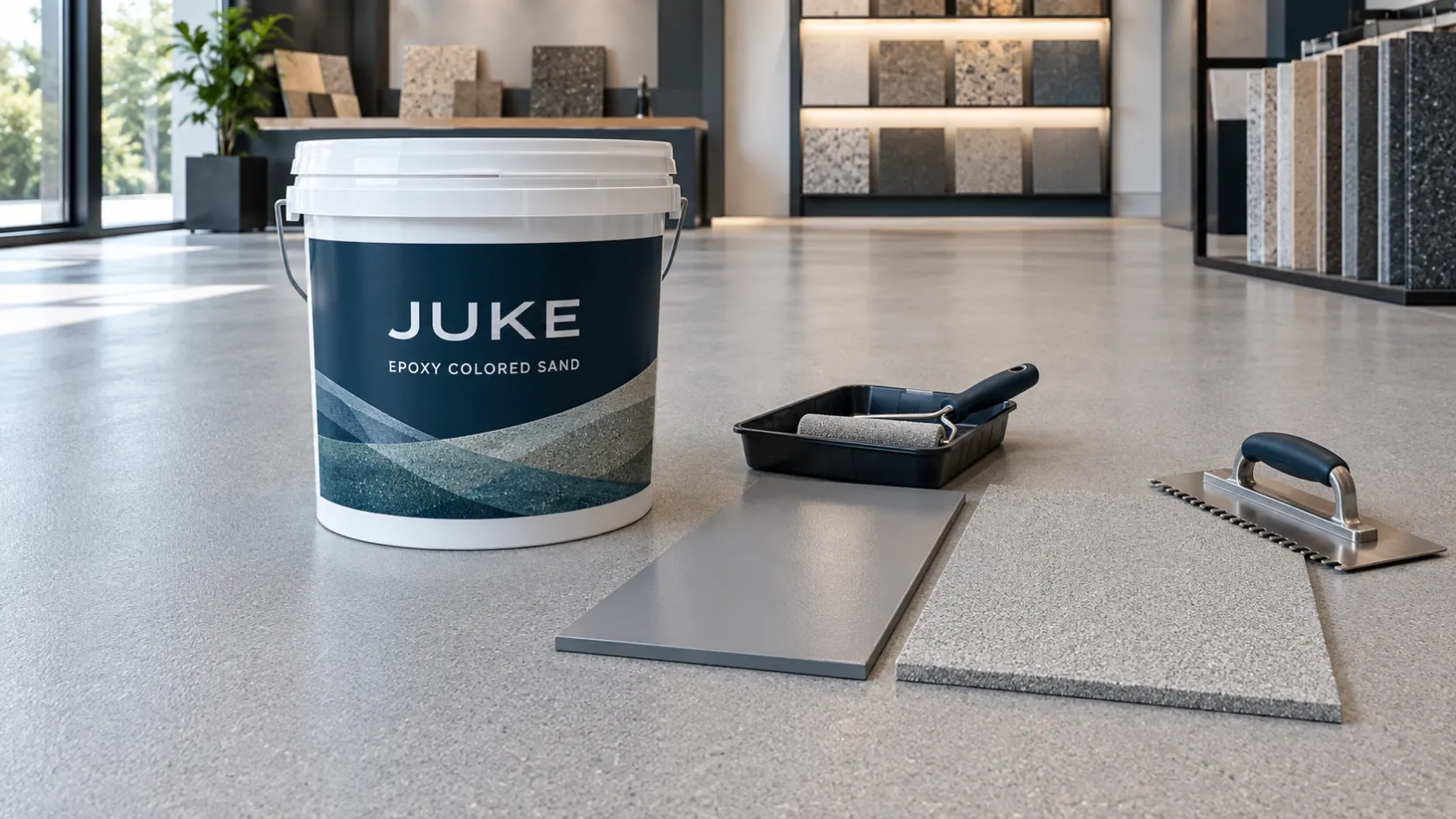
JUKE Epoxy Colored Sand Self-Leveling uses a factory-prepared Part A containing colored sand, fillers and pigments. Part B is the hardener. Installers mix them at an 8:1 ratio by weight before application.
The material is poured and spread with a notched tool, then treated with a spiked roller according to the instructions. It produces a continuous decorative surface with a fine mineral appearance.
Self-leveling does not mean that cracks, holes or significant unevenness can be ignored. Substrate repair remains a separate preparation step.
Compare Substrate Requirements
Do not assume that products with similar names support the same substrates.
A product specified for prepared concrete should not automatically be promoted for application over ceramic tiles, vinyl or an existing coating.
Ask each supplier to identify approved substrates and the preparation required for each.
JUKE Over Suitable Tiles
JUKE can be applied directly over tiles that are firmly bonded, stable, clean and dry.
Under those conditions, tile demolition, grinding and primer are not required. Loose tiles, contamination and damaged areas must be addressed before application.
JUKE Over Concrete
Concrete requires mechanical grinding and a compatible epoxy primer. Cracks, holes and uneven areas should be repaired first.
Sales materials should explain these two routes separately. A qualified direct-to-tile statement is more useful than a general promise that preparation is unnecessary.
Compare Coverage on the Same Basis
A high coverage figure does not establish that one product offers better value.
Check whether the stated coverage refers to one coat, multiple coats or the complete installed system. Confirm the application rate and what materials are included.
JUKE’s current standard 20 kg set covers approximately 10 m² at a typical consumption of 2 kg/m². Actual coverage varies with substrate flatness, application conditions and losses.
A useful material-cost calculation is:
Complete required material cost ÷ expected finished area
Include primers, additional coats and separately supplied materials where required. Then compare preparation, labor and access restrictions.
Avoid comparing a thin paint application with a decorative self-leveling system as though they deliver the same floor.
Check Installation Support and Curing Requirements
Distributors need instructions that customers can follow accurately.
For mixed systems, confirm the ratio, mixing procedure, working time and conditions for application. Check when the floor can be reopened and how installers should protect it during curing.
For JUKE, light pedestrian traffic is typically permitted after approximately 48 hours under suitable conditions, once adequate cure is confirmed. Temperature and site conditions can extend the schedule.
Do not treat surface dryness as permission for normal service.
Retailers and e-commerce sellers should make preparation and curing requirements available before purchase, alongside photographs and representative samples.
Match Products to Customer Demand
A wholesaler may stock several floor-finishing products for different customer requests.
A buyer seeking a painted finish may need a different product from someone seeking a decorative mineral surface. A contractor’s installation resources may also differ from those of a retail customer.
Use these questions to guide selection:
- What appearance does the customer want?
- What is the existing substrate?
- Which preparation and application resources are available?
- What traffic and exposure requirements must be documented?
- How much installation time is available?
The answers help determine which specific product deserves consideration.
JUKE’s channel proposition combines a decorative colored sand finish, direct application over suitable tiles and factory-matched components.
What Should Wholesale Buyers Request?
Before placing an order, obtain the current technical data sheet, safety data sheet and application instructions.
Confirm complete set contents, coverage, packaging, storage conditions, shelf life and batch identification. Review documentation relevant to the intended use rather than relying on broad claims such as “commercial grade.”
Also establish what training, troubleshooting and marketing support the supplier provides.
JUKE offers factory-direct supply, a minimum order of 36 sets, mixed-color trial orders, OEM labels and marketing support.
Frequently Asked Questions
Is epoxy floor paint always single-component?
No. Product naming varies. Check the component count and formulation in the technical documentation.
Are all two-component epoxy coatings self-leveling?
No. The component count does not establish the application method. Confirm the specific system.
Is JUKE applied like ordinary floor paint?
JUKE uses a mix, pour and spread process with the specified application tools. It should not be presented as a standard roller-applied paint.
Which product is cheaper?
Compare complete systems and equivalent project requirements. Coverage alone does not establish the total cost.
Can wholesalers sell JUKE under their own brand?
JUKE offers OEM labels, subject to agreement on artwork and packaging. The minimum order is 36 sets.
Discuss Wholesale Decorative Flooring With JUKE
JUKE supplies epoxy colored sand self-leveling flooring for distributors, wholesalers, tile suppliers and retail channels.
Share your sales channel and intended applications to discuss samples, a trial pallet, OEM labels and marketing support.