
Aug 31, 2026Epoxy Color Sand
Epoxy Color Sand vs. Tile Replacement: Which Is Better?
Compare epoxy color sand overlays with traditional tile replacement, including demolition, installation, maintenance, cost factors, and suitable applications.
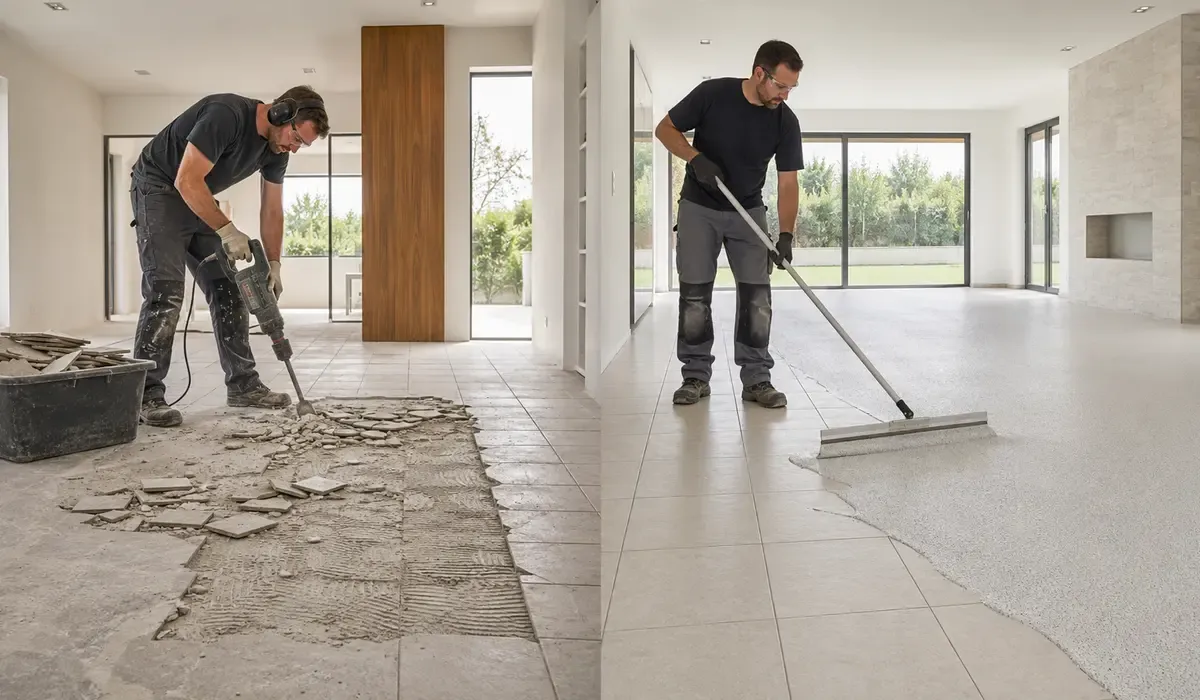
Epoxy Color Sand vs. Tile Replacement: Which Is Better?
When an existing tiled floor looks outdated, damaged, or difficult to maintain, property owners usually consider two options: remove the tiles and install a new floor, or renovate directly over the existing surface.
When the old tiles are firmly bonded and stable, epoxy color sand can provide a cleaner alternative without complete demolition.
JUKE Epoxy Color Sand Self-Leveling is designed for direct application over suitable tiles. The system combines factory-matched Part A and Part B, spreads as a continuous layer, and forms a seamless decorative surface.
The right choice depends on substrate condition, downtime, maintenance, and the desired appearance.
Quick Comparison
Comparison | Epoxy Color Sand Overlay | Traditional Tile Replacement |
|---|---|---|
Existing tiles | Suitable tiles remain in place | Existing tiles are normally removed |
Demolition | No complete tile demolition | Demolition is normally required |
Dust and waste | Reduced | More demolition debris and dust |
Surface | Seamless continuous finish | Repeated tile and grout joints |
Primer over suitable tiles | No separate primer | Depends on the selected installation system |
Application | Mix, pour, spread, and self-level | Remove, prepare, set tiles, grout, and clean |
Repairs | Local substrate defects must be corrected | Full removal exposes the underlying base |
Best use | Stable tiled floors requiring rapid visual renovation | Unstable floors or projects requiring complete reconstruction |
Neither option is automatically correct for every project. The condition of the existing tile system should be evaluated before materials are selected.
What Is an Epoxy Color Sand Overlay?
An epoxy color sand overlay is a two-component mineral-resin flooring system applied over a suitable prepared substrate.
Part A contains epoxy resin, special colored sand, silica, mineral fillers, and other formulation components. Part B is the curing agent. After mixing, the material is spread evenly and allowed to self-level before curing into a hard, continuous surface.
Unlike ordinary epoxy paint, the colored mineral particles are incorporated into the complete formulation. They help create a textured, stone-inspired appearance rather than a thin solid-color paint film.
A 20 kg JUKE set covers approximately 10 m². The current recommended application thickness is 1.0–2.0 mm, with an allowable deviation of ±0.2 mm. Actual coverage depends on floor flatness, tile joints, surface profile, and installation loss.
What Does Traditional Tile Replacement Involve?
Traditional replacement normally requires removing the existing tiles, adhesive, and loose substrate material before installing the new finish.
The exposed base is inspected, repaired, cleaned, and leveled before new tiles and grout are installed.
This method provides access to the substrate and is valuable when the existing tiles are loose, badly cracked, uneven, or affected by moisture. It also allows major changes to floor height, slope, drainage, tile size, or layout.
The trade-off is additional demolition, waste handling, dust control, noise, and disruption.
Advantage 1: Zero Demolition
The main advantage of epoxy color sand is that suitable existing tiles can remain in place.
Avoiding complete demolition can reduce:
- Broken tile waste
- Dust from tile and adhesive removal
- Noise during renovation
- Disposal and transport work
- Work required to rebuild the floor before finishing
Zero demolition does not mean damaged areas should be hidden. Loose tiles, active cracks, deep joints, and unstable repairs must still be corrected.
Advantage 2: A Seamless Surface
Traditional tiled floors contain grout joints. These joints influence the final appearance and may collect dirt, stains, soap residue, or moisture if they are poorly maintained.
Epoxy color sand creates a continuous main floor surface without repeated exposed grout lines. This provides a more unified appearance and simplifies routine cleaning.
The seamless finish can be particularly useful in kitchens, bathrooms, showrooms, retail spaces, offices, corridors, and other interiors where cleanliness and visual continuity are important.
However, necessary expansion and movement joints must remain functional. A seamless decorative finish should not be used to eliminate required structural movement details.
Advantage 3: A Simpler Renovation Sequence
Once the tiles have been approved, preparation normally includes inspection, degreasing, mechanical abrasion of smooth surfaces, repairs, vacuuming, and drying.
On suitable dense, non-porous tiles, JUKE can be applied without a separate primer. Part A and Part B are supplied in factory-matched quantities, so a complete set can be combined without calculating a new ratio onsite.
The mixed material is poured, spread with a suitable notched trowel or long-handled tool, and allowed to self-level. Installers must remain on the uncoated area and should not kneel or stand in the wet material.
Advantage 4: Decorative Continuity
Tile design is defined by individual units and joints. Epoxy color sand creates a continuous mineral appearance across the room.
Depending on the selected color, the surface can appear speckled, stone-inspired, neutral, or marble-like. Customers should review a cured sample because lighting, substrate color, thickness, and finish can affect its appearance.
When Tile Replacement Is the Better Choice
Epoxy color sand should not be used simply to cover an unsuitable floor.
Complete or partial tile removal may be the better option when:
- Large areas of tile are loose or hollow
- The floor has active structural movement
- Rising moisture or leakage must be repaired below the tiles
- Major level or slope changes are required
- Drainage details must be reconstructed
- The existing floor height cannot accept an overlay
- The substrate requires extensive structural repair
- The project specifically requires a new tiled layout
In these situations, demolition provides access to the underlying base and allows the root problem to be corrected.
When Epoxy Color Sand Is the Better Choice
An overlay is particularly attractive when:
- The existing tiles are firmly bonded
- The floor is reasonably flat and dry
- The customer wants to avoid demolition
- Reduced dust and waste are priorities
- A seamless surface is preferred
- Grout-line maintenance is undesirable
- The space requires a significant visual update
- Renovation disruption needs to be controlled
The substrate must still be degreased, prepared, repaired, vacuumed, and dried. No-demolition installation is a renovation method, not permission to ignore the existing floor condition.
Curing and Return to Service
Under suitable conditions, the JUKE TDS lists a surface-dry time of approximately 4–6 hours and a hard-dry time of approximately 24 hours. Light pedestrian traffic is allowed after approximately 48 hours, while vehicle traffic is permitted after approximately 72 hours.
Actual curing depends on temperature, humidity, thickness, ventilation, and mixing accuracy. The area must remain protected from water, dust, foot traffic, and construction activity during the initial curing period.
Tile replacement schedules vary considerably because the process may include demolition, substrate repair, leveling, adhesive curing, grouting, and cleaning. Project timing should therefore be compared using the actual site conditions rather than a universal number.
Cost Factors to Compare
Comparing material price alone can be misleading. A complete budget may include demolition, disposal, repairs, preparation, materials, labor, equipment, business downtime, cleaning, and future maintenance.
Epoxy color sand may reduce demolition-related expenses, but the final saving depends on local costs, floor condition, and project size. Use a project-specific comparison instead of promising a fixed saving percentage.
Frequently Asked Questions
Can epoxy color sand be applied over every tiled floor?
No. Tiles must be firmly bonded, stable, clean, dry, prepared, and reasonably flat.
Must the old grout joints be removed?
Not always. Stable shallow joints can be covered, while deep, damaged, or missing joints should be filled and leveled.
Is a primer required over tiles?
No separate primer is required on suitable dense, non-porous tiles after correct preparation.
Does self-leveling repair loose tiles or deep holes?
No. Structural defects and major unevenness must be repaired before application.
Does the standard system need a topcoat?
The standard JUKE system forms the finished surface without requiring an additional topcoat. Project-specific finishes may still be selected for special performance requirements.
Which Option Should You Choose?
Choose traditional tile replacement when the existing floor must be reconstructed, major moisture or movement problems need access, or a completely new tiled design is required.
Choose epoxy color sand when the existing tiles are stable and the project needs a seamless new finish with zero demolition, direct-to-tile application, no separate primer, and less demolition waste.
For distributors, tile suppliers, renovation contractors, and building material wholesalers, the system also creates a differentiated renovation product that can be supported with OEM packaging, application training, samples, videos, and marketing materials.