
Sep 24, 2026Technical & Installation
How Thick Should Epoxy Color Sand Flooring Be?
Learn the recommended thickness for epoxy color sand flooring, why 1.8–2.0 mm matters, how coverage is calculated, and how substrate condition affects material use.
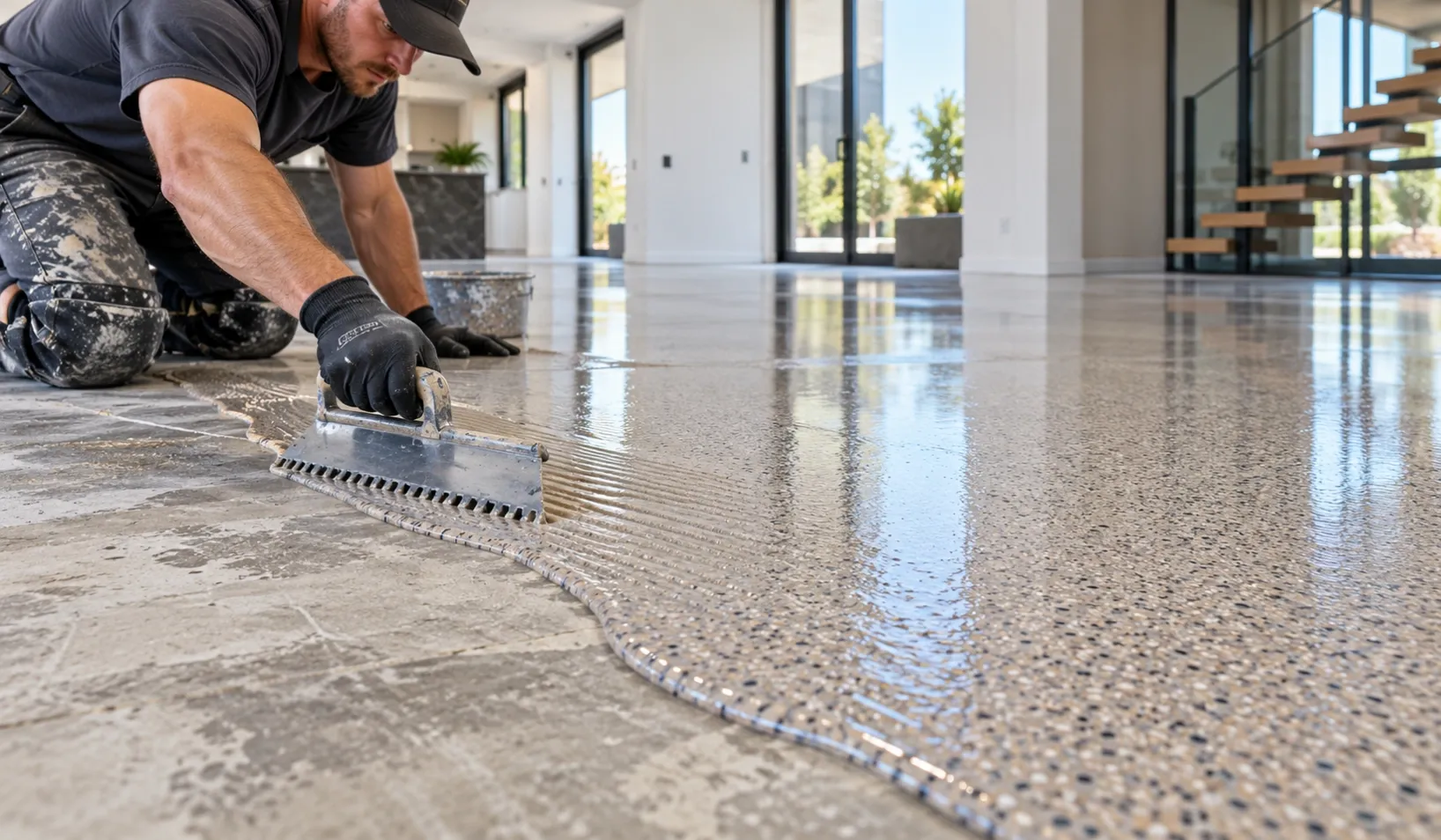
How Thick Should Epoxy Color Sand Flooring Be?
The recommended thickness for JUKE Epoxy Color Sand Self-Leveling Flooring is approximately 1.8–2.0 mm for a standard application over a properly prepared substrate.
Thickness matters because it affects material consumption, self-leveling performance, appearance, and overall installation quality.
A thicker layer is not automatically better, and a thinner layer may not provide the intended finish. The correct approach is to prepare the substrate first and then apply the flooring at a controlled, consistent thickness.
For most projects, the basic rule is:
Prepare the substrate properly → Apply approximately 1.8–2.0 mm → Allow the material to self-level → Protect the floor during curing.
Quick Answer: Recommended Epoxy Color Sand Thickness
For JUKE Epoxy Color Sand Self-Leveling Flooring:
- Recommended thickness: approximately 1.8–2.0 mm
- Standard package: 20 kg per set
- Typical coverage: approximately 10 m² per 20 kg set
- Suitable substrates: properly prepared tile, terrazzo, concrete, and other stable floor surfaces
- Application method: Mix → Pour → Spread → Self-Level
Actual material consumption can vary depending on substrate flatness, porosity, repairs, joints, and application technique.
This is why coverage should always be treated as an estimate rather than an exact number for every project.
Why Does Epoxy Flooring Thickness Matter?
Self-leveling flooring needs enough material to form a continuous surface.
If the layer is applied too thinly, irregularities in the substrate may become more visible and maintaining a consistent finish becomes more difficult.
If excessive material is applied unnecessarily, project cost increases and material consumption becomes less efficient.
The objective is therefore not to maximize thickness.
It is to create a consistent self-leveling layer over a properly prepared substrate.
For JUKE Epoxy Color Sand, approximately 1.8–2.0 mm provides a practical balance between appearance, material consumption, and application performance.
Can Epoxy Color Sand Be Applied Thicker Than 2 mm?
Additional material may be required in localized areas when the substrate is not perfectly flat.
However, large depressions, deep holes, damaged joints, or major unevenness should not simply be filled by applying a much thicker finishing layer.
A better installation sequence is:
Repair deep defects → Level damaged areas → Prepare the complete substrate → Apply the normal self-leveling layer
This helps control material usage and creates a more consistent finished floor.
Epoxy color sand is a flooring finish, not a substitute for major substrate repair.
Can You Apply a Very Thin Layer?
Reducing the application thickness simply to save material is not recommended.
A self-leveling flooring system needs sufficient material to flow and form a uniform continuous surface.
Applying too little material may lead to:
- Uneven appearance
- Visible substrate irregularities
- Inconsistent coverage
- Difficulty maintaining a continuous layer
- Greater variation in finished thickness
The correct way to reduce material consumption is not to make the coating excessively thin.
It is to prepare and level the substrate before application.
A flat floor requires less corrective material than a damaged or highly uneven floor.
Why Substrate Flatness Changes Material Consumption
The published coverage of approximately 10 m² per 20 kg set assumes typical application conditions.
Consider two floors with the same total area.
Floor A: Smooth Existing Tile
The tiles are firmly bonded, relatively flat, clean, and properly prepared.
Very little material is needed to compensate for surface irregularities.
Material consumption is therefore easier to predict.
Floor B: Rough Damaged Concrete
The surface contains pits, cracks, depressions, and uneven areas.
If these defects are not repaired first, the epoxy color sand will naturally flow into lower areas.
More material will be required to achieve a level surface.
Both projects may cover 50 m², but they may not consume exactly the same amount of flooring material.
This is why floor area alone is not enough to calculate a project accurately.
How Much Material Is Needed for a 20 m² Floor?
Using the typical coverage rate:
20 kg ≈ 10 m²
A 20 m² project would require approximately:
2 sets × 20 kg = 40 kg
For a 50 m² project:
5 sets × 20 kg = 100 kg
For a 100 m² project:
10 sets × 20 kg = 200 kg
These calculations provide a starting point.
Additional material may be needed when the substrate is:
- Uneven
- Rough
- Highly porous
- Damaged
- Heavily repaired
- Divided by deep tile joints
Contractors should inspect the floor before confirming the final quantity.
Does Existing Tile Affect the Required Thickness?
Existing tile is often a good substrate for zero-demolition renovation when it is stable and properly prepared.
Because tile surfaces are generally relatively flat and dense, material consumption can be more predictable than on rough concrete.
Before application, contractors should still check for:
- Loose tiles
- Hollow areas
- Broken tiles
- Deep joints
- Oil or wax contamination
- Uneven transitions
Damaged areas should be repaired first.
Once the substrate is stable and prepared, the epoxy color sand layer can be applied across the existing tile surface without removing the complete floor.
The objective remains approximately the same:
Create a consistent 1.8–2.0 mm self-leveling layer rather than using the finish material to correct major defects.
What About Tile Joints?
Tile joints are one of the most common questions in direct-to-tile flooring renovation.
Shallow and consistent joints may be covered as part of the flooring application, depending on their condition.
If deep joints are filled entirely with the final flooring material, consumption increases.
For larger projects, preparing these areas beforehand can make both thickness and material usage more predictable.
The main principle is:
The flatter the substrate, the easier it is to maintain a consistent finished thickness.
Does Concrete Require a Different Thickness?
The target self-leveling thickness remains approximately 1.8–2.0 mm, but concrete condition can affect the preparation process.
Concrete may be:
- Dense
- Porous
- Rough
- Dusting
- Cracked
- Pitted
- Moisture affected
Porous concrete may require an appropriate primer or sealing treatment before the main layer is applied.
Cracks, holes, and damaged sections should be repaired first.
A very rough concrete surface should not be corrected simply by increasing the amount of epoxy color sand.
Good concrete preparation improves both coverage and final appearance.
Does Primer Add to the Finished Thickness?
Primer and the main self-leveling layer perform different functions.
A primer is primarily used to treat the substrate when required, particularly on porous surfaces.
It should not be considered part of the main decorative self-leveling thickness.
For suitable dense substrates such as properly prepared tile, a separate primer is normally not required.
For porous concrete, additional substrate treatment may be appropriate.
The main JUKE Epoxy Color Sand layer is then applied at approximately 1.8–2.0 mm.
How Do Installers Control the Thickness?
Material quantity and the spreading tool are both important.
A typical workflow is:
1. Calculate the Floor Area
Measure the total square meters that will be coated.
2. Inspect the Substrate
Identify defects, deep joints, cracks, holes, and uneven sections.
3. Complete Repairs
Repair significant defects before mixing the flooring material.
4. Calculate Material Quantity
Use approximately 20 kg per 10 m² as the standard planning reference, then adjust for actual substrate condition.
5. Mix Part A and Part B
Mix thoroughly until the material is uniform.
6. Pour the Material
Distribute the mixed material across the prepared floor.
7. Spread With a Notched Trowel
The notched trowel helps installers control distribution and maintain a more consistent layer.
8. Allow the Material to Self-Level
After spreading, the system flows to form a continuous finished surface.
Accurate preparation and controlled spreading are more reliable than trying to judge thickness visually.
Is Thicker Epoxy Flooring Stronger?
This is not the best way to evaluate the system.
Flooring performance depends on several factors working together:
- Substrate strength
- Surface preparation
- Correct mixing
- Application consistency
- Appropriate thickness
- Curing conditions
Adding unnecessary thickness does not compensate for an unstable or poorly prepared substrate.
For example, applying more material over loose tile does not fix the loose tile underneath.
Applying a thicker coating over contaminated concrete does not remove the contamination.
A correctly prepared floor with the appropriate application thickness is more important than simply using more material.
How Does Thickness Affect Curing Time?
- 4–6 hours: surface dry
- 24 hours: hard dry
- 48 hours: light pedestrian traffic
- 72 hours: vehicle traffic
Temperature, humidity, substrate conditions, and application consistency can affect actual curing.
The floor should therefore be protected during the curing period even if the surface already appears dry.
For garages and vehicle areas, waiting until the recommended vehicle-traffic stage is particularly important.
What Thickness Is Best for Garage Floors?
For a properly prepared garage substrate, the standard JUKE application remains approximately 1.8–2.0 mm.
The key question is not whether a garage automatically requires a thicker floor.
The important question is whether the existing substrate is suitable.
Before application, check:
- Concrete condition
- Existing tiles
- Cracks
- Oil contamination
- Surface flatness
- Moisture
- Vehicle-related damage
Repair and preparation should be completed before applying the main self-leveling layer.
What Thickness Is Best for Commercial Floors?
Commercial projects should also begin with substrate evaluation rather than automatically increasing coating thickness.
Retail stores, showrooms, offices, corridors, and other commercial interiors may have very different existing floors.
A sound, flat substrate can normally receive the standard self-leveling layer.
A damaged commercial floor may require more extensive repair before installation.
For distributors and contractors quoting commercial projects, this distinction is important because substrate condition directly affects both labor and material consumption.
Frequently Asked Questions
How thick is JUKE Epoxy Color Sand Flooring?
The recommended self-leveling layer is approximately 1.8–2.0 mm over a properly prepared substrate.
How much area does one 20 kg set cover?
One 20 kg set covers approximately 10 m² under typical application conditions.
Will coverage always be exactly 10 m²?
No. Coverage varies with substrate flatness, porosity, joints, defects, repairs, and application thickness.
Can I use a thicker layer to fill holes?
Small variations may consume additional material, but deep holes and significant defects should be repaired before applying the main flooring layer.
Is a thicker floor always better?
No. Correct substrate preparation and consistent application are more important than simply increasing thickness.
Do old tiles need to be removed first?
Not necessarily. Sound existing tile can be used as the substrate after proper inspection and preparation, allowing a zero-demolition renovation approach.
Does concrete need primer?
It depends on the concrete. Porous concrete may require primer or sealing, while substrate condition should always be evaluated before application.
Why Thickness Information Matters for Distributors
Material coverage is one of the first questions buyers ask when evaluating a new flooring product.
They want to know:
How many square meters does one set cover?
How thick is the finished layer?
How many sets do I need for a project?
A simple specification makes the product easier to explain:
20 kg per set → approximately 10 m² → approximately 1.8–2.0 mm application thickness.
For flooring distributors, decorative concrete suppliers, tile suppliers, contractors, and online sellers, JUKE also provides:
- Factory-direct supply
- OEM and private label options
- Marketing photos and videos
- Technical and application support
- Low MOQ starting from 36 sets
This makes it easier to introduce the system to both professional installers and renovation customers.
Final Thoughts
For JUKE Epoxy Color Sand Self-Leveling Flooring, the recommended application thickness is approximately 1.8–2.0 mm.
One 20 kg set covers approximately 10 m² under typical conditions.
But thickness and coverage should never be considered separately from substrate preparation.
The most reliable installation principle is:
Repair defects first. Prepare a stable and flat substrate. Apply the correct amount of material. Maintain a consistent 1.8–2.0 mm self-leveling layer.
Using more material is not a substitute for better preparation.
A well-prepared substrate is the foundation of a consistent, seamless finished floor.
Need help calculating material quantity or evaluating a project? Contact JUKE for samples, wholesale pricing, OEM cooperation, and technical support.