
B2B & Sourcing
Epoxy Flooring Suppliers UK: Sourcing Guide
Sourcing epoxy flooring suppliers in the UK? Learn what to check — MOQ, OEM terms, samples, and CIF shipping to UK ports — before you place an order.
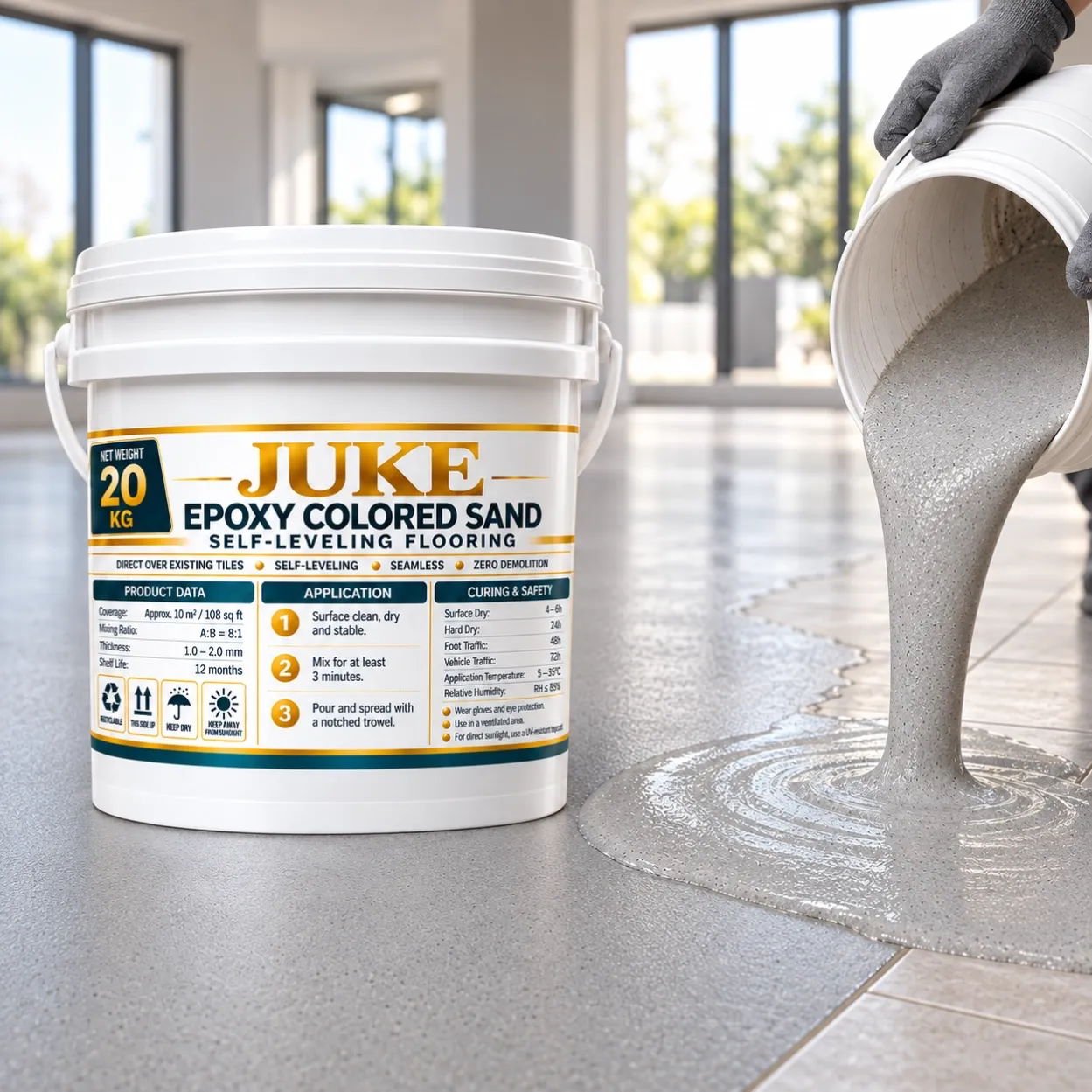
UK flooring distributors, contractors, and retailers who need epoxy flooring in volume usually import factory-direct: much of the UK market is supplied by importers and distributors, and buying from the factory cuts out a layer of margin and gives access to OEM and private-label options. This guide explains what UK buyers should check in a supplier — MOQ, samples, CIF shipping to UK ports, and post-Brexit importing — before placing an order.
Why UK buyers import factory-direct
There are three practical reasons. First, the factory controls the formulation, the colors, and the packaging, so custom requests — an exclusive color, your own bucket label — are handled in production. Second, a single factory often supplies several systems (colored sand self-leveling, flake flooring, stone flooring, tile grout, repair putty), so one supplier can cover a full flooring range. Third, export to the UK is routine for established manufacturers: pallet and container shipments, CIF quotes to UK ports, and the documents a customs broker needs — commercial invoice, packing list, bill of lading, TDS, and SDS.
The risk is the same as in any import: choosing a supplier on price alone and discovering the product, the documents, or the support do not match. The checks below are how you avoid that.
What to check in a supplier
A serious factory can show you:
- A full TDS with test numbers. For JUKE's epoxy colored sand self-leveling system: ~98% solids, 16 g/L VOC, ~10 m² coverage per 20 kg set at 1.5–2.0 mm, ≥80 MPa compressive strength, Mohs 8 hardness, ~20 minutes working time, foot traffic ~48 hours, vehicle traffic ~72 hours. Vague claims without numbers are a warning sign.
- An SDS for both components.
- Production evidence — factory photos or video, not only rendered product images.
- A MOQ tied to production — for JUKE, 48 sets (one pallet) for the flagship system.
- Custom colors — a factory can develop an exclusive color for a distributor; a reseller cannot.
Ask directly whether the supplier produces the resin and the colored sand system itself, and whether it can make a custom color for your brand. If the supplier cannot answer technical questions from production experience, it is likely a trading company — which is not disqualifying, but it cannot change a formula or develop a color for you. Our guide on how to evaluate an epoxy floor coating supplier walks through these checks in more detail.
MOQ and order sizes
Minimum orders are set by the pallet. JUKE's MOQ is 48 sets — one pallet — with mixed colors allowed on the pallet, so a first order can cover several colors without committing to a full container.
A 20 ft high-cube container holds 880 sets. For a UK distributor planning warehouse space, the pallet is the unit to think in: one pallet footprint per 48 sets, and a container load is roughly 18 pallets. Start with a first pallet, confirm the product sells and installs well in your market, then scale to container quantities.
OEM and private label for UK brands
OEM and private label mean the factory makes the product and it carries your brand: your logo and brand name on the bucket labels and packaging. JUKE offers 12 standard colors — Milky White, Sesame Gray, Dark Gray, Cream Gray, Sky Blue, Titanium Blue, Stone Gray, Coral Red, Emerald Green, Light Beige, Light Green, Ivory Pink — and can develop a custom exclusive color for a distributor's brand.
For a UK brand, private label is what turns an imported product into your product: your customers see your name, your colors, and your documentation. Confirm the branding scope in writing before ordering — what is printed, what documentation carries your brand, and what the MOQ is for custom colors and packaging.
Sample first: test before you commit
Never place a bulk order on a TDS alone. JUKE provides a free 1 kg sample; the customer pays the courier freight. Use the sample to test the things that matter on a real job: coverage on your substrate, working time in your conditions, cure, color, and finish.
For UK buyers, the sample test should also cover your local conditions — a cold-day pour behaves differently from a mild-day pour, and damp substrates are common in UK buildings. Test the sample the way your crew will actually install it, on the substrates you actually meet: tiles and concrete, not just a lab board. Substrate moisture must be ≤8%, so test the slab, especially on grade and in older properties.
Shipping to UK ports
JUKE quotes CIF to the destination port by default: ocean freight and insurance to your port are included. The main UK container ports for flooring imports are Felixstowe, Southampton, and London Gateway — confirm with your forwarder which port suits your warehouse, since everything beyond the port is the buyer's responsibility: customs clearance, port charges, and inland delivery to your warehouse.
Two things to confirm before booking freight:
- Dangerous-goods status. Epoxy systems have two components, and the hardener is usually the one with transport restrictions. JUKE's A component (resin + colored sand) has passed non-dangerous-goods identification; the B hardener is the component your forwarder needs to check. Confirm the DG position before booking.
- Documents. Your customs broker will need the commercial invoice, packing list, bill of lading, TDS, and SDS. Confirm the supplier provides all of them with the shipment.
Duties, taxes, and clearance costs depend on the shipment value and the current tariff schedule — your broker or forwarder quotes those, not the factory. Ask for the quote before you order so there are no surprises at the port.
Importing into the UK after Brexit
Since Brexit, the UK runs its own customs and tariff system, separate from the EU. Imports from China arrive as third-country goods and need a full customs declaration. In practice, your customs broker handles the declaration, but you should know what they will ask for:
- Your GB EORI number. Any UK business importing goods needs an Economic Operators Registration and Identification number starting with "GB". If you do not have one yet, apply on GOV.UK before your first shipment.
- The commodity code. Epoxy flooring falls under HS code 3209.90. Give this code to your broker, who will confirm the exact classification, the duty rate under the UK Global Tariff, and the import VAT for your shipment. Duty rates and VAT rules change, so confirm them for each order rather than relying on a figure quoted months ago.
- The shipment documents. Commercial invoice, packing list, bill of lading, TDS, and SDS — the same set listed above. Missing documents are the most common cause of clearance delays.
The UK Global Tariff and the commodity lookup are published in the UK Integrated Online Tariff on GOV.UK. If your broker queries the classification, the TDS is the document that describes the product's composition and supports the code.
UK conditions: renovation, damp, and zero demolition
The UK market is largely a renovation market: high-street retail refits, office refurbishments, garage conversions, and rental property upgrades, where the existing floor is usually tile, terrazzo, or concrete. That is where the system's main advantage applies — it goes directly over suitable existing tiles with no primer on tiles and no demolition, so a refit can be completed without tearing out the old floor. Concrete must be primed with the sealing primer first. Our zero-demolition guide explains which existing floors qualify and what preparation is still needed.
UK conditions to plan for:
- Application temperature is 5–35 °C, with relative humidity at or below 85%. UK winters can drop below 5 °C — schedule pours for milder days or heat the space, and confirm the substrate temperature, not just the air temperature.
- Damp is the main UK risk. Substrate moisture must be ≤8%. Older UK slabs, basements, and ground floors without a damp-proof membrane can exceed that — test every floor, and do not skip the moisture check on a floor that looks dry.
- Indoor use is the system's home. Garages, showrooms, retail spaces, offices, and warehouses are the standard applications.
- Outdoor use is possible but the color slowly fades in direct sun. For outdoor or sun-exposed areas, confirm a compatible UV-protective topcoat and check suitability for the actual exposure. Do not assume all outdoor conditions are suitable.
Local building and product requirements vary by project type. If your project needs specific compliance documentation, raise it with the supplier before ordering, and check the requirement with your building control body or specifier.
Comparing quotes fairly
When comparing suppliers, compare the material cost per square metre — not the set price alone. A 20 kg set covering ~10 m² has a very different cost per square metre than the same set stretched over a smaller area, and thickness matters too: compare every quote at the same 1.5–2.0 mm build and the same coverage basis.
Also compare the trade terms: a CIF quote to your UK port includes ocean freight and insurance; an EXW quote does not include any freight at all. Two quotes at different terms are not comparable until the freight is added. Our guide to epoxy flooring cost per square metre explains the calculation step by step, with worked examples.
Because JUKE is a factory, pricing is quoted per order — it depends on volume, colors, packaging, and destination. Request a factory quote for your quantities and port, and the price will be exact. Working with an epoxy flooring manufacturer in China also means OEM and custom-color requests are handled at the source, not through a middleman.
FAQ
What is the minimum order for the UK?
48 sets — one pallet — with mixed colors allowed. A 20 ft high-cube container holds 880 sets.
How is epoxy flooring shipped to the UK?
Usually CIF to your destination port — Felixstowe, Southampton, or London Gateway — with ocean freight and insurance included. Your forwarder handles customs clearance, port charges, and delivery beyond the port. Confirm the hardener's dangerous-goods position with your forwarder before booking.
What do I need to import into the UK after Brexit?
A GB EORI number, a customs broker to file the declaration, and the shipment documents (commercial invoice, packing list, bill of lading, TDS, SDS). The commodity code is HS 3209.90 — your broker confirms the duty rate and import VAT.
Can I sell it under my own brand in the UK?
Yes. JUKE supports OEM and private label: your brand on the buckets and packaging, 12 standard colors or a custom exclusive color developed for you.
Does it suit UK renovation projects?
Yes — it applies directly over suitable existing tiles with no primer and no demolition, which suits retail refits, office refurbishments, and garage conversions. Concrete must be primed with the sealing primer. Check substrate moisture (≤8%) on every floor, and do not install below 5 °C.
How do I check quality before ordering?
Request the TDS and SDS, then order a sample and test it yourself: coverage, working time, cure, color, and finish. JUKE provides a free 1 kg sample; you pay the courier freight.
Next step
If you are sourcing epoxy flooring for the UK market, start with the documents and a sample: request the TDS and SDS, test the product on your substrates, and check the supplier against the list above. When you are ready, request a factory quote — and tell us your port and quantities so the quote is exact.