
B2B & Sourcing
Epoxy Flooring Manufacturer China: OEM & Private Label
Looking for an epoxy flooring manufacturer in China? Learn how OEM and private label work, what MOQ to expect, and how to check a factory before you order.
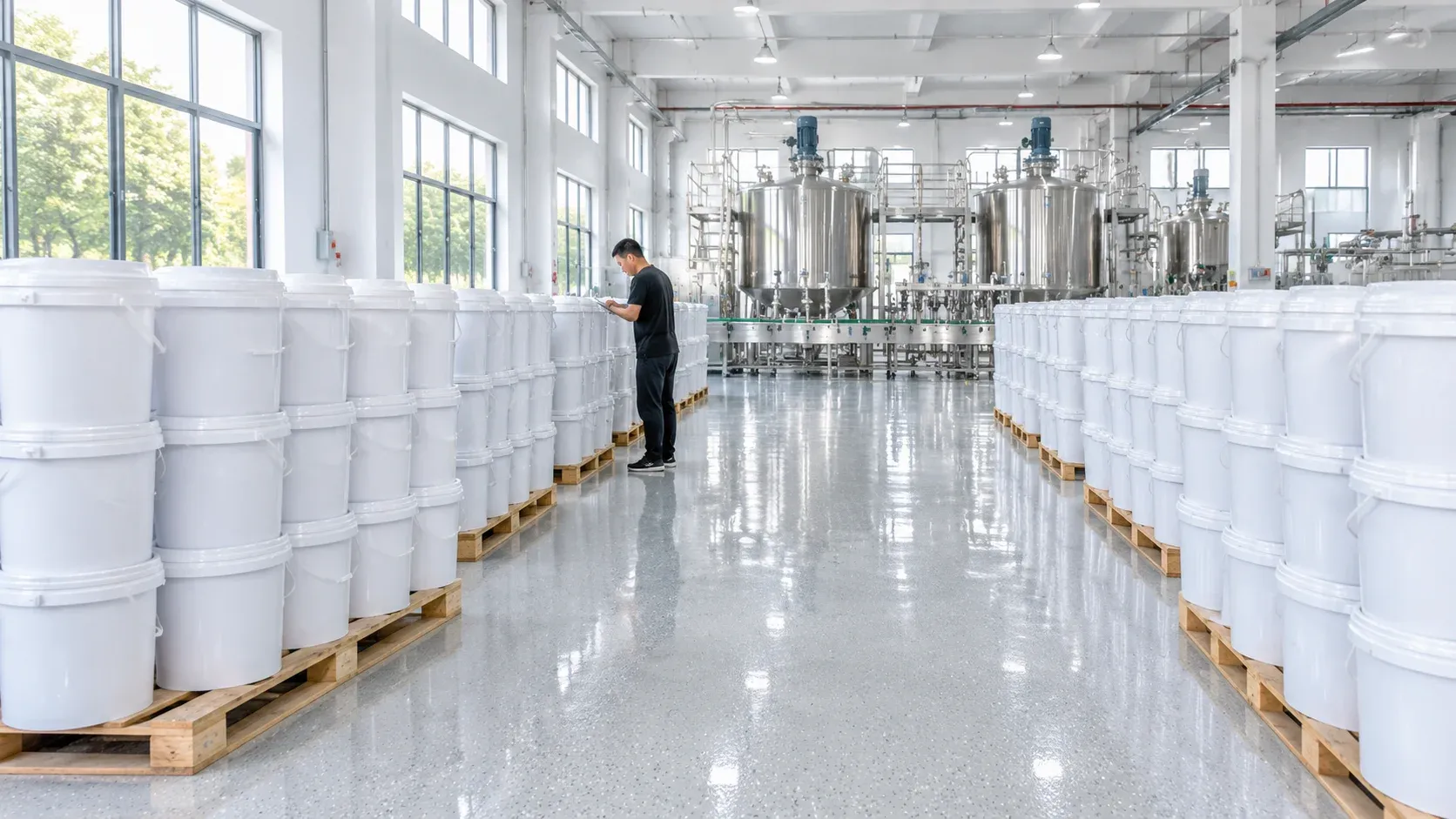
If you are a distributor, wholesaler, or contractor looking for an epoxy flooring manufacturer in China, the process is straightforward: choose a factory that publishes full technical data, confirm the OEM and private-label terms and the minimum order quantity, test a sample, and then place a trial pallet order. This guide explains each step, and what to check before you commit.
Why distributors buy epoxy flooring from China
China is where much of the world's epoxy flooring is produced, and buying factory-direct has three practical advantages for a distributor.
First, you deal with the source. A factory controls the formulation, the colors, and the packaging, so custom requests — an exclusive color, your own bucket label, a different pack size — are handled in production rather than passed through a middleman.
Second, the product range is wide. A single factory often supplies several systems: colored sand self-leveling, flake flooring, stone flooring, tile grout, and repair putty. That lets a distributor build a full flooring offer from one supplier instead of managing five.
Third, export is routine. Established manufacturers ship by pallet and by container every week, quote CIF to the destination port, and provide the documents a customs broker needs: commercial invoice, packing list, bill of lading, and the product's technical data sheet (TDS) and safety data sheet (SDS).
The risk is choosing the wrong supplier. The rest of this guide is about avoiding that.
Factory or trading company? How to tell
Not every "manufacturer" on a B2B marketplace makes the product it sells. Some are trading companies that buy from a factory and resell. There is nothing wrong with that in itself, but a trading company cannot change a formula, develop a custom color, or answer a technical question from production experience — and it adds a margin.
A real factory can show you:
- A full TDS with test data — not just a product name, but solids content, VOC, coverage, compressive strength, hardness, working time, and cure times. For example, JUKE's epoxy colored sand self-leveling system lists ~98% solids, 16 g/L VOC, ~10 m² coverage per 20 kg set at 1.5–2.0 mm, ≥80 MPa compressive strength, and Mohs 8 hardness.
- An SDS for both components.
- Production evidence — factory photos or video, not only rendered product images.
- A MOQ tied to production — for JUKE, 48 sets (one pallet) for the flagship system.
- Custom colors — a factory can develop an exclusive color for a distributor; a reseller cannot.
Ask directly: "Do you produce the resin and the colored sand system yourselves?" and "Can you make a custom color for my brand?" The answers will tell you quickly which kind of supplier you are dealing with.
How OEM and private label epoxy flooring works
OEM (original equipment manufacturing) and private label mean the same thing in practice: the factory makes the product, and it carries your brand. A typical process has six steps:
- Choose the system. Colored sand self-leveling is the most common starting point for distributors because it is simple to apply — mix, pour, spread — and goes directly over suitable existing tiles with no demolition. Flake and stone systems, tile grout, and repair putty can follow.
- Choose the colors. JUKE offers 12 standard colors, from Milky White and Stone Gray to Sky Blue and Emerald Green. If you want a color no competitor sells, the factory can develop a custom exclusive color for your brand.
- Confirm the branding. Your logo and brand name on the bucket labels and packaging, and documentation (TDS, application guide) in your brand where the factory supports it.
- Confirm the MOQ. For JUKE's flagship system the minimum order is 48 sets — one pallet — with mixed colors allowed on the pallet.
- Approve a sample. Before mass production, test a sample of the actual batch product. JUKE provides a free 1 kg sample; the customer pays the courier freight.
- Production, quality control, and shipping. Confirm the lead time in writing before you pay, and agree on how quality is checked before dispatch.
If you are new to private label, start with one system and one pallet. You can add colors and systems once the first order has sold through.
What to check before you order
Use this checklist on any factory you consider:
- TDS data, in numbers. Solids content, VOC, coverage per set, thickness, working time, cure times, compressive strength, and hardness. Vague claims ("high quality", "very durable") without numbers are a warning sign.
- Coverage you can verify. JUKE's flagship covers ~10 m² per 20 kg set at 1.5–2.0 mm, or about 2 kg/m². Ask how the factory's coverage figure was measured, and check it against your own sample test.
- Application conditions. Temperature range (JUKE: 5–35 °C), humidity limit (≤85%), substrate moisture limit (≤8%), and the primer rule: JUKE's system needs no primer on sound tiles, but concrete must be primed with a sealing primer first.
- Dangerous-goods status. Epoxy systems have two components, and the hardener is usually the one with transport restrictions. JUKE's A component (resin + colored sand) has passed non-dangerous-goods identification; the B hardener is the component your forwarder needs to check. Confirm the DG position before booking freight.
- Batch consistency. Distributors sell the same color repeatedly. Ask how the factory controls color consistency between batches.
- A sample, tested by you. Never place a bulk order on a TDS alone. Test the sample for coverage, working time, cure, color, and finish.
MOQ, pallets, and shipping
Minimum orders in this industry are set by the pallet, not by the bucket. JUKE's MOQ of 48 sets is one pallet, and a 20 ft high-cube container holds 880 sets — useful to know when you plan warehouse space and cash flow.
Shipping terms matter as much as the product price. JUKE quotes CIF to the destination port by default: ocean freight and insurance to your port are included, and customs clearance, port charges, and inland delivery beyond the port are the buyer's responsibility. If you need delivery beyond the port, ask — but expect it to be quoted separately.
Before you pay, confirm three things in writing: the lead time, the payment terms, and what happens if the goods arrive damaged. A common payment structure in this trade is 50% T/T in advance and 50% T/T before shipment, against a proforma invoice. Never pay 100% upfront to a supplier you have not worked with before.
What affects the cost of epoxy flooring from China?
The cost per square metre depends on several factors: the system type, the thickness applied, the order volume, the packaging, and the freight to your port. A 20 kg set covering ~10 m² has a very different material cost per square metre than the same set stretched over 6 m² — which is why comparing suppliers by set price alone is misleading. Our cost guide explains how to calculate material cost per square metre step by step, with worked examples.
Because JUKE is a factory, pricing is quoted per order — it depends on volume, colors, packaging, and destination. Request a factory quote for your quantities and we will price it exactly.
Red flags when choosing a supplier
Walk away — or at least slow down — if you see any of these:
- No TDS or SDS available, or a TDS with no test numbers.
- A price far below every other supplier, with no explanation of what is different.
- No samples offered, or samples that do not match the TDS.
- No factory evidence: no production photos, no address, no company registration details.
- A vague MOQ that changes every time you ask.
- Pressure to pay in full upfront, or to pay outside the proforma invoice.
A serious factory welcomes technical questions and sample tests. If a supplier resists either, that is your answer.
FAQ
What is the minimum order quantity for epoxy flooring from China?
It varies by factory and by system. For JUKE's epoxy colored sand self-leveling system, the MOQ is 48 sets — one pallet — with mixed colors allowed.
Can I sell epoxy flooring under my own brand?
Yes. JUKE supports OEM and private label: your brand on the buckets and packaging, 12 standard colors or a custom exclusive color developed for you.
How do I check quality before a bulk order?
Request the TDS and SDS, then order a sample and test it yourself: coverage, working time, cure, color, and finish. JUKE provides a free 1 kg sample; you pay the courier freight.
How is epoxy flooring shipped from China?
Usually CIF to your destination port — ocean freight and insurance included. Your forwarder handles customs clearance and delivery beyond the port. Confirm the dangerous-goods position of the hardener component with your forwarder before booking.
Can the factory make a color that only I sell?
Yes — JUKE can develop a custom exclusive color for a distributor. Factory colors are fixed per batch; end users cannot mix colors on site.
Next step
If you are comparing epoxy flooring manufacturers in China, start with the documents: request the TDS and SDS, order a sample, and check the factory against the list above. When you are ready, request the JUKE TDS, samples, and a factory-direct quote — and tell us your target market and quantities so the quote is exact.