
Oct 3, 2026B2B & Sourcing
Buying Your First Pallet of Epoxy Color Sand Flooring: A Trade Buyer’s Guide
Plan your first wholesale order of JUKE epoxy color sand flooring, including the 36-set MOQ, sample evaluation, color selection, packaging, shipping, and sales support.
Buying Your First Pallet of Epoxy Color Sand Flooring: A Trade Buyer’s Guide
Your first wholesale order of epoxy color sand flooring should begin with a clear application, a representative product trial, and an agreed supply plan. Before ordering, confirm the set size, approximate coverage, color selection, packaging, technical documents, and shipping responsibilities.
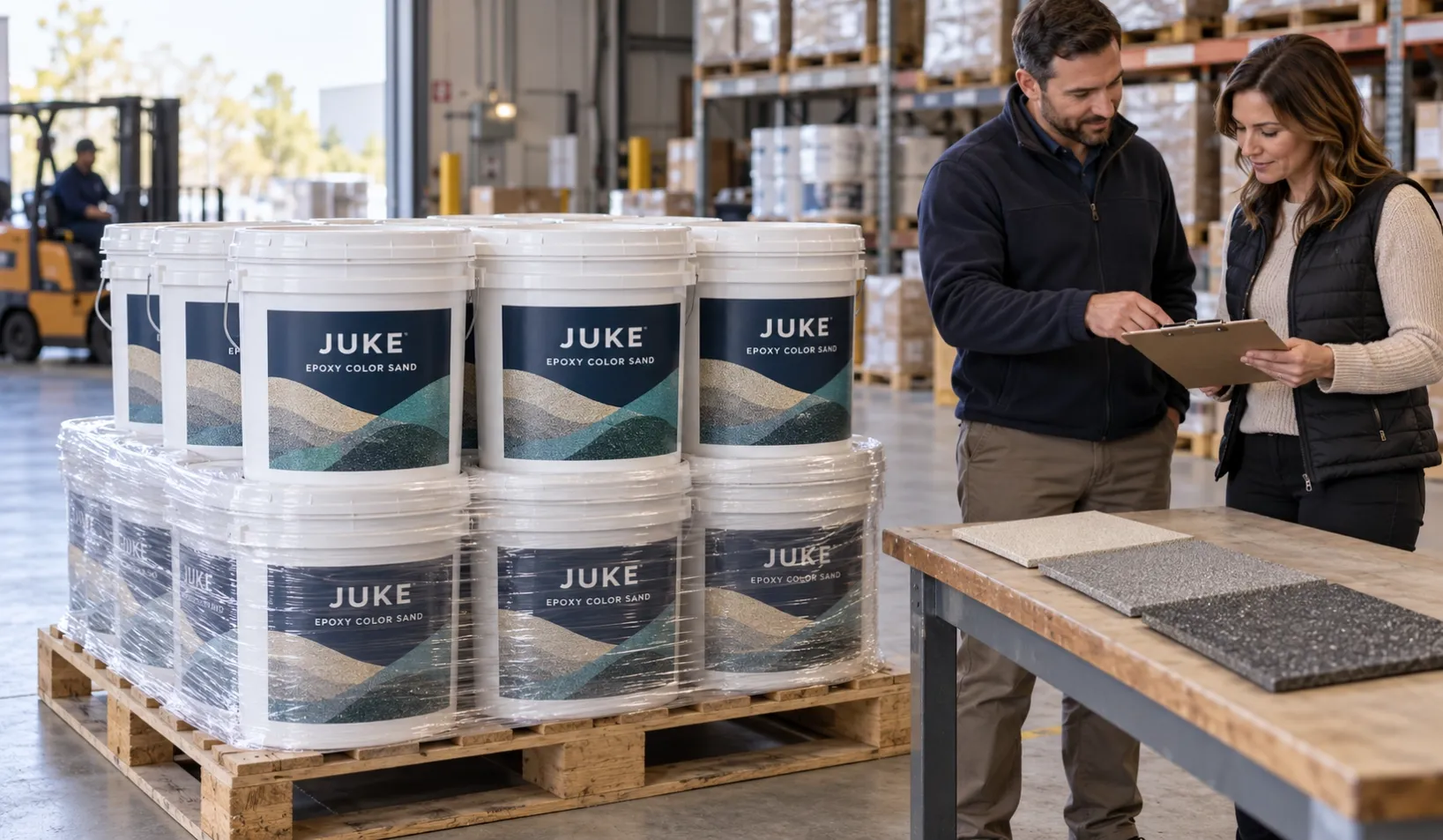
JUKE’s minimum order quantity is one pallet of 36 sets. Each standard 20 kg set covers approximately 10 m² under normal application conditions. For wholesalers, distributors, contractors, and online sellers, this provides a starting quantity for introducing a zero-demolition flooring system to their customers.
1. Define How You Will Use the First Pallet
The best order configuration depends on what happens after the goods arrive.
A distributor may need demonstration material and stock for local customers. A contractor may already have several renovation projects in mind. An e-commerce seller may need product photography, installation content, and a fulfillment plan before accepting orders.
Identify your main purpose:
First-order purpose | Planning priority |
|---|---|
Resale through a showroom | Samples, color displays, and staff product knowledge |
Contractor projects | Substrate assessment, quantities, and installation scheduling |
Online retail | Listings, instructions, shipping packaging, and customer support |
Private-label launch | Label approval, product information, and marketing materials |
Keep the initial offer focused. A manageable product selection makes it easier to explain the system, observe customer demand, and plan your next order.
2. Evaluate the System Before Committing to Stock
A finished sample board helps you review color and texture. An application trial helps you understand mixing, spreading, curing, and substrate preparation.
Use a surface that represents your intended projects. If your customers mainly renovate tiled floors, test on suitable existing tiles. If you plan to supply concrete renovation projects, include the required concrete preparation and primer.
JUKE Epoxy Colored Sand Self-Leveling Flooring can be applied directly over firmly bonded, stable, clean, and dry tiles. Suitable tiles generally need neither grinding nor primer.
Concrete follows a different preparation route and requires a compatible primer. Uneven or damaged areas should be repaired and leveled before application.
A trial should answer practical questions: Can your installer follow the instructions? Does the appearance suit your customers? What preparation and tools will you need to explain?
3. Plan Quantities Using Approximate Coverage
JUKE’s standard packaging is 20 kg per set, with approximate coverage of 10 m².
A 36-set pallet therefore represents approximately 360 m² of coverage under normal application conditions. This is a planning estimate. Surface flatness, application technique, and material loss affect actual consumption.
For contractors, calculate quantities for each project separately. Do not allocate every set solely from the headline coverage figure without assessing the floor.
For resellers, decide how much material you will reserve for demonstrations and how much will remain available for sale. Installation demonstrations can be useful, but they should form part of your stock plan.
4. Choose an Initial Color Range
JUKE accepts mixed colors within the 36-set minimum order. This allows buyers to introduce more than one appearance without ordering a separate pallet for each color.
Choose colors based on your existing customers and sales environment. Review physical samples where possible, because screens and lighting can change how a finish appears.
Avoid spreading the first order across too many colors before you understand demand. A smaller selection with sufficient stock per color can make it easier to fulfill enquiries.
Confirm the quantity of each color in writing before production. For continuous installation areas, discuss batch consistency and keep clear records of which material goes to each project.
5. Confirm Packaging and OEM Requirements
Before placing the order, establish whether you want JUKE-branded supply or an OEM arrangement.
For private-label orders, confirm the available customization, label artwork, approval process, and any applicable costs or requirements. Complete these discussions before production rather than after the goods are ready.
The packaging and instructions should help buyers understand:
- What is included in a complete set.
- How to mix the factory-proportioned components.
- Which substrates are suitable.
- Approximate coverage and application requirements.
- Storage and handling instructions.
JUKE supplies matched Part A and Part B quantities. Customers using a complete set should combine the supplied components according to the instructions.
For additional sourcing considerations, read Private Label Epoxy Color Sand Flooring: A Buyer’s Guide.
6. Agree on Shipping Responsibilities Before Comparing Prices
A product quotation needs a clear delivery basis. An EXW quotation and a CIF quotation include different responsibilities and costs, so they should not be compared as equivalent offers.
Confirm the named collection location or destination port, the quantity, and what the quotation includes.
Ask your freight forwarder or customs broker to review the proposed shipment before confirming the order. This helps you identify destination charges, import arrangements, and local delivery requirements.
For CIF shipments, destination customs clearance, duties, and local delivery still need to be arranged. Calculate these alongside the purchase price when planning your landed cost.
Obtain the relevant packing information and current transport documents from the supplier. Discuss any delivery appointment or unloading requirements with your receiving warehouse.
7. Prepare Your Sales and Installation Materials
Having stock available is only one part of a product launch.
Distributors and wholesalers need a concise explanation that staff can use consistently. Contractors need application instructions and a process for assessing floors. Online sellers need clear listings and answers to common customer questions.
JUKE offers marketing support. Confirm the available product images, videos, and supporting materials before launch.
Your core message should remain accurate: zero demolition over suitable existing tiles, a self-leveling decorative finish, and approximately 10 m² coverage per 20 kg set.
Explain the substrate requirements alongside the benefits. Customers should understand that damaged or uneven floors need preparation and that concrete requires primer.
Frequently Asked Questions
What is JUKE’s minimum wholesale order?
One pallet containing 36 sets. Each standard set weighs 20 kg.
Can the first pallet contain different colors?
Yes. Agree on the color selection and quantity per color before production.
Can I request OEM packaging?
JUKE offers OEM support. Confirm the customization scope, artwork, pricing, and approval requirements before placing the order.
What documents should I review?
Request the current technical data sheet, safety data sheet, application instructions, and the packing and shipping information relevant to your order.
Plan Your First Pallet With JUKE
A well-planned first order connects product evaluation with a clear launch or installation plan. Agree on the colors, packaging, supporting materials, and delivery responsibilities before production.
JUKE provides factory-direct supply, OEM options, marketing support, and a low MOQ of 36 sets.
Contact JUKE and tell us whether your first pallet is intended for resale or installation projects.