
Sep 29, 2026B2B & Sourcing
How to Evaluate Epoxy Color Sand Samples Before Buying Wholesale
Learn how to evaluate epoxy color sand samples before a wholesale order, including substrate preparation, mixing, finish, coverage, and supplier support.
How to Evaluate Epoxy Color Sand Samples Before Buying Wholesale
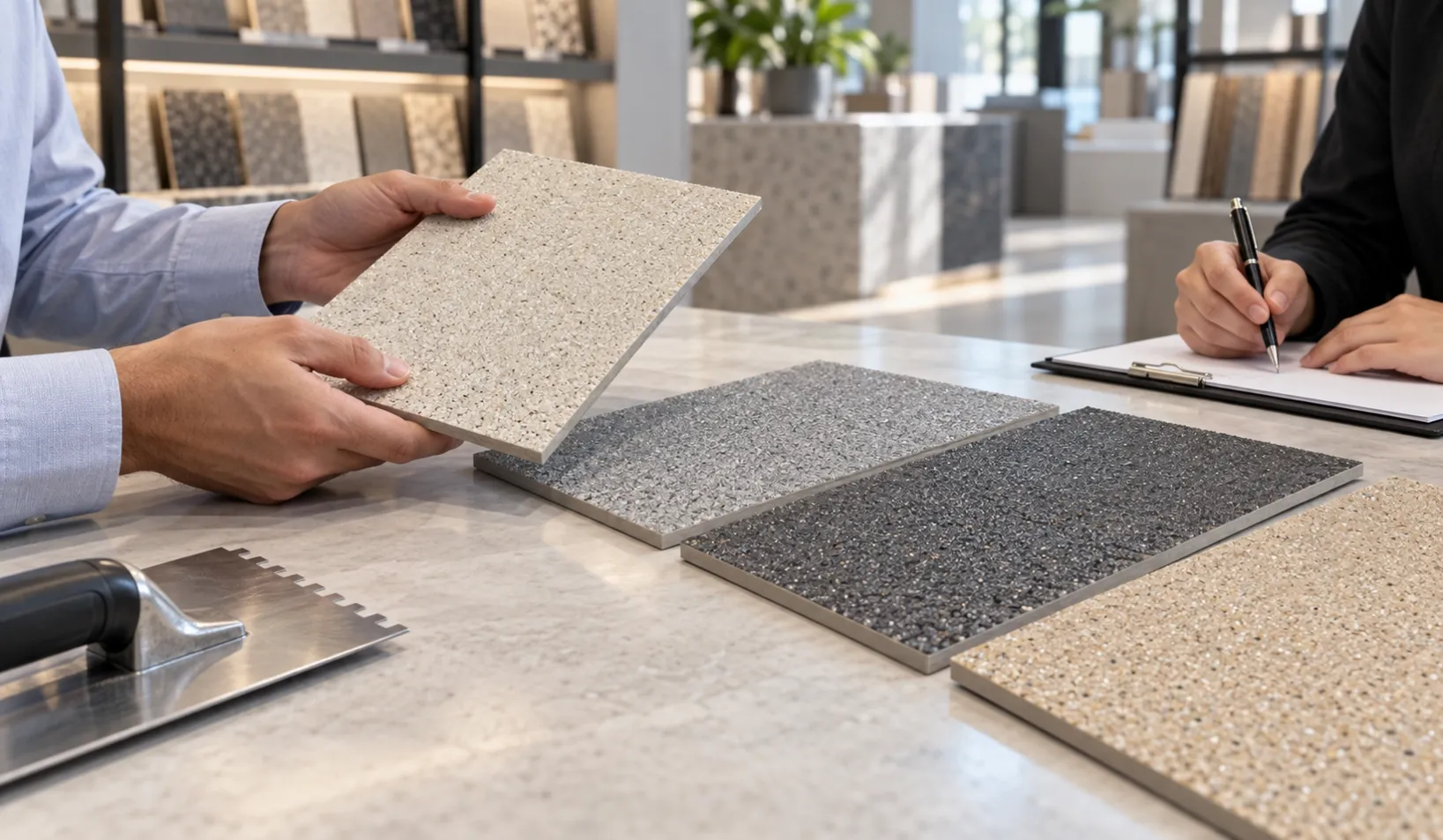
To evaluate an epoxy color sand sample before buying wholesale, test it on a representative substrate, follow the supplier’s mixing instructions, and assess application, curing, appearance, and adhesion. Record how much material you use and review the technical documents alongside the finished result. A decorative sample board shows the appearance; an application trial helps you understand how the product will work for your customers.
For distributors, building material wholesalers, and online flooring sellers, this evaluation also helps identify the instructions, tools, and support needed before launching a new product.
1. Decide What Your Sample Needs to Prove
Start with the renovation problem your customers want to solve.
If you sell to tile retailers, the main question may be whether customers can renovate suitable existing tiles without demolition. If you supply installers, application consistency and substrate preparation may matter most. For e-commerce sellers, clear instructions and realistic product images are also essential.
Write down a short test objective before opening the sample:
- Confirm the color and surface appearance.
- Understand the mixing and spreading process.
- Assess the result over a representative substrate.
- Identify questions customers may ask before purchasing.
Keep the scope realistic. A small sample cannot establish long-term durability or prove suitability for every floor.
2. Use a Representative Substrate
Testing only on a display board tells you little about installation over an existing floor. Where possible, prepare a test area that represents your intended application.
Testing over existing tiles
For JUKE Epoxy Colored Sand Self-Leveling Flooring, suitable tiles must be firmly bonded, stable, clean, and dry. Remove grease, wax, dust, and other contamination. Repair or replace loose or damaged tiles and fill surface defects before application.
On suitable existing tiles, grinding and primer are generally unnecessary. This direct-to-tile route is central to the system’s zero-demolition positioning.
However, “no demolition” does not mean “no preparation.” A coating cannot stabilize loose tiles or correct an unsuitable base.
Testing over concrete
Concrete requires a different preparation route. Prepare the surface, remove weak material and contamination, repair defects, and apply a compatible epoxy primer before installing the colored sand system.
If the floor is uneven, repair and level it first. Do not expect the decorative layer to correct substantial irregularities.
3. Follow the Supplied Mixing Instructions
JUKE uses a two-component system supplied as Part A and Part B in matched quantities. For a complete pre-proportioned set, combine the supplied components according to the instructions.
Do not estimate partial quantities by eye. If a test requires splitting a set, obtain accurate proportioning instructions and weigh both components correctly.
The JUKE technical data sheet specifies approximately two to three minutes of mixing until the color and consistency are uniform. Scrape the container sides and bottom to avoid leaving unmixed material.
Prepare your test area and tools before mixing. Working time is approximately 20 minutes under normal conditions, and higher temperatures may shorten it.
During the trial, record whether the instructions make these steps clear. Confusion at this stage can become a customer support problem later.
4. Observe Spreading and Self-Leveling
Pour the mixed material onto the prepared surface, spread it evenly with a suitable notched trowel, and allow it to self-level.
Watch the process as well as the finished floor:
- Does the material spread consistently?
- Can the installer maintain an even application?
- Are bubbles, pinholes, or visible defects developing?
- Do unrepaired substrate irregularities show through?
Self-leveling still requires controlled spreading and appropriate material consumption. It does not eliminate the need for a suitable base or careful application.
If the result is disappointing, document the substrate, preparation, mixing, temperature, and timing before drawing conclusions. These details help the supplier distinguish a material issue from an application issue.
5. Assess the Finish After Adequate Curing
Protect the sample from dust, water, and traffic while it cures.
JUKE’s typical guidance lists surface drying at approximately four to six hours and light pedestrian traffic at approximately 48 hours. Conditions can extend these times. A surface that feels dry is not automatically ready for every test or service condition.
Once adequately cured, assess:
Check | What to record |
|---|---|
Color | Appearance in daylight and indoor lighting |
Texture | Whether it matches customer expectations |
Uniformity | Visible mixing marks or uneven areas |
Surface defects | Bubbles, pinholes, or contamination |
Substrate visibility | Whether joints or repaired defects remain noticeable |
Discuss adhesion assessment with the supplier. Picking at an exposed edge or scratching a sample with a key does not establish a standardized performance rating.
Use technical documentation and appropriate testing for project-specific performance requirements.
6. Measure Consumption Without Overpromising Coverage
JUKE’s standard 20 kg set covers approximately 10 m², equivalent to typical consumption of around 2 kg/m².
For your trial, measure the coated area and record the mixed material used. Note material left in the container or on tools, because small samples can have proportionally higher handling losses.
Actual coverage varies with substrate flatness, application technique, and material loss. Treat the stated coverage as a planning estimate rather than a guaranteed result for every installation.
The existing guide, How Much Epoxy Color Sand Do You Need?, provides a useful starting point for quantity planning.
7. Evaluate the Supplier’s Commercial Support
A successful trial should help you prepare a product customers can understand and purchase confidently.
Before placing a wholesale order, confirm:
- Current technical data sheet and safety data sheet availability.
- Packaging, labels, and application instructions.
- Color selection and sample approval procedures.
- Minimum order quantity and delivery arrangements.
- OEM options and available marketing materials.
JUKE offers factory-direct supply, OEM support, marketing support, and a low MOQ of 36 sets. Match these options to your sales channel and confirm the scope before ordering.
For branding and sourcing considerations, read Private Label Epoxy Color Sand Flooring: A Buyer’s Guide.
Frequently Asked Questions
Is a finished sample board enough?
It is useful for reviewing color and texture. An application trial provides additional information about preparation, mixing, spreading, and curing.
Should I test on both tiles and concrete?
If you plan to sell for both applications, yes. Their preparation requirements differ, particularly the need for primer on concrete.
What should I send the supplier if the trial has defects?
Send clear photos, the substrate type, preparation steps, quantities mixed, application conditions, and elapsed curing time.
Plan Your First Wholesale Order
Before ordering, agree on the approved appearance, application instructions, packaging, and support materials. Keep a labeled reference sample and your trial notes so your team can answer customer questions consistently.