
B2B & Sourcing
Epoxy Flooring Suppliers in the Middle East: Sourcing Guide
Sourcing epoxy flooring suppliers in the Middle East? Learn what to check — MOQ, OEM terms, samples, and CIF shipping to Gulf ports — before you order.
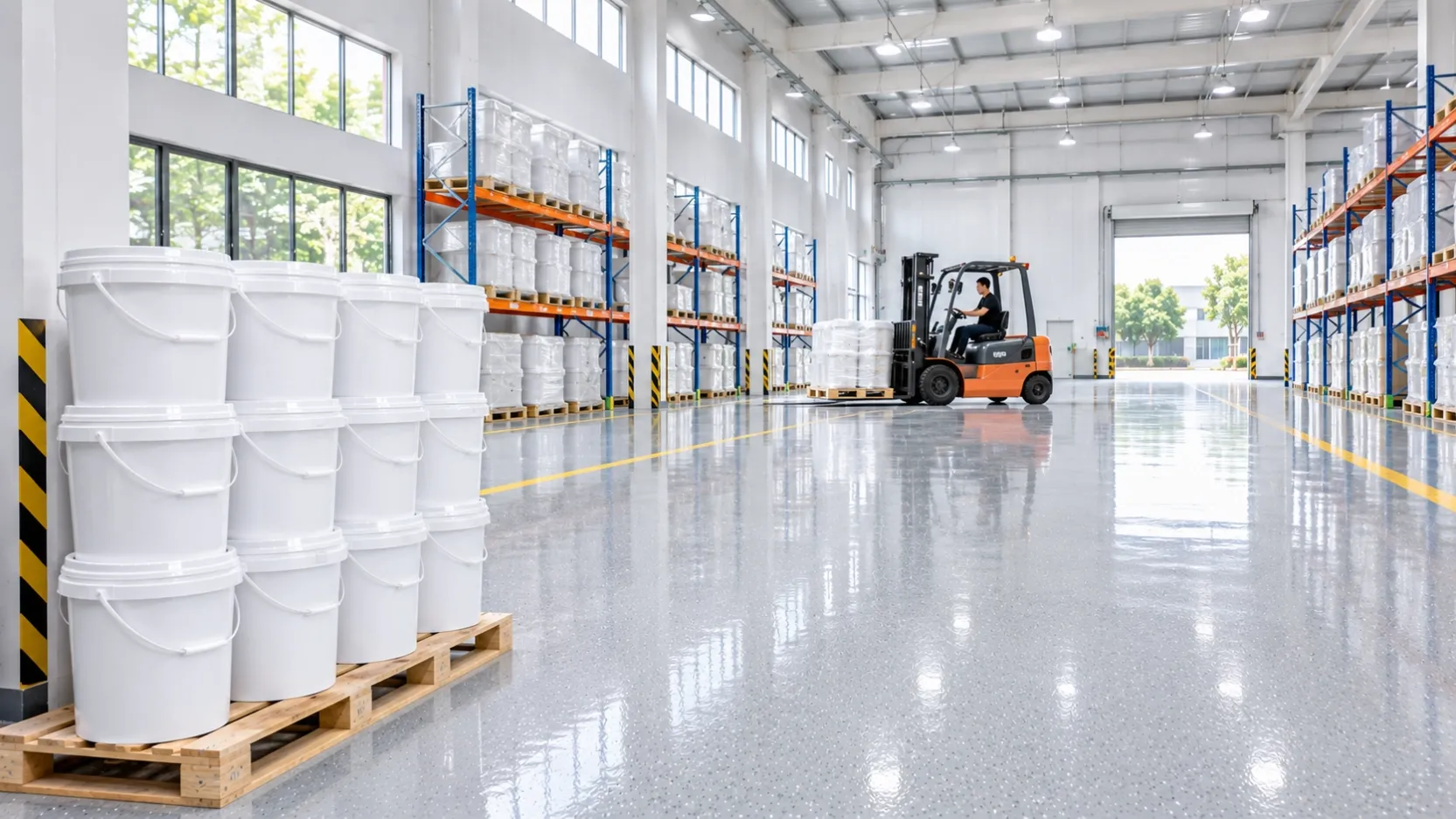
Flooring contractors, builders, and distributors in the UAE, Saudi Arabia, and Qatar who need epoxy flooring in volume usually import factory-direct: the regional market is supplied largely by importers and distributors, and buying from the factory cuts out a layer of margin and gives access to OEM and private-label options. This guide explains what Middle East buyers should check in a supplier — MOQ, samples, shipping to Gulf ports, and suitability for the region's extreme heat — before placing an order.
Why Middle East buyers import factory-direct
There are three practical reasons. First, the factory controls the formulation, the colors, and the packaging, so custom requests — an exclusive color, your own bucket label — are handled in production. Second, a single factory often supplies several systems (colored sand self-leveling, flake flooring, stone flooring, tile grout, repair putty), so one supplier can cover a full flooring range. Third, export to the Middle East is routine for established manufacturers: pallet and container shipments, CIF quotes to Gulf ports, and the documents a customs broker needs — commercial invoice, packing list, bill of lading, TDS, and SDS. English is the working language of B2B trade across the region, so specifications, documents, and technical questions are handled in English throughout.
The risk is the same as in any import: choosing a supplier on price alone and discovering the product, the documents, or the support do not match. The checks below are how you avoid that. Our guide to working with a manufacturer in China covers the factory side of the decision in more detail.
What to check in a supplier
A serious factory can show you:
- A full TDS with test numbers. For JUKE's epoxy colored sand self-leveling system: ~98% solids, 16 g/L VOC, ~10 m² coverage per 20 kg set at 1.5–2.0 mm, ≥80 MPa compressive strength, Mohs 8 hardness, ~20 minutes working time, foot traffic ~48 hours, vehicle traffic ~72 hours. Vague claims without numbers are a warning sign.
- An SDS for both components.
- Production evidence — factory photos or video, not only rendered product images.
- A MOQ tied to production — for JUKE, 48 sets (one pallet) for the flagship system.
- Custom colors — a factory can develop an exclusive color for a distributor; a reseller cannot.
Ask directly whether the supplier produces the resin and the colored sand system itself, and whether it can make a custom color for your brand. If the supplier cannot answer technical questions from production experience, it is likely a trading company — which is not disqualifying, but it cannot change a formula or develop a color for you.
If your project has specific compliance requirements, raise them before ordering: building-code and project-spec requirements vary by country and by project in the region, so confirm with the factory what documentation it can provide, and check the requirement itself with your consultant or local authority.
MOQ and order sizes
Minimum orders are set by the pallet. JUKE's MOQ is 48 sets — one pallet — with mixed colors allowed on the pallet, so a first order can cover several colors without committing to a full container.
A 20 ft high-cube container holds 880 sets. For a Middle East distributor planning warehouse space, the pallet is the unit to think in: one pallet footprint per 48 sets, and a container load is roughly 18 pallets. Start with a first pallet, confirm the product sells and installs well in your market, then scale to container quantities.
OEM and private label for Middle East brands
OEM and private label mean the factory makes the product and it carries your brand: your logo and brand name on the bucket labels and packaging. JUKE offers 12 standard colors — Milky White, Sesame Gray, Dark Gray, Cream Gray, Sky Blue, Titanium Blue, Stone Gray, Coral Red, Emerald Green, Light Beige, Light Green, Ivory Pink — and can develop a custom exclusive color for a distributor's brand.
For a Middle East brand, private label is what turns an imported product into your product: your customers see your name, your colors, and your documentation. Confirm the branding scope in writing before ordering — what is printed, what documentation carries your brand, and what the MOQ is for custom colors and packaging.
Sample first: test before you commit
Never place a bulk order on a TDS alone. JUKE provides a free 1 kg sample; the customer pays the courier freight. Use the sample to test the things that matter on a real job: coverage on your substrate, working time in your conditions, cure, color, and finish.
For Middle East buyers, the sample test should cover your actual working conditions — a pour in Gulf summer heat behaves differently from a mild-day pour, because higher temperatures shorten the ~20-minute working time. Test the sample the way your crew will actually install it, on the substrates you actually meet: tiles and concrete, not just a lab board.
Shipping to Middle East ports
JUKE quotes CIF to the destination port by default: ocean freight and insurance to your port are included. The main container ports for flooring imports into the region are Jebel Ali in Dubai, Jeddah Islamic Port for western Saudi Arabia, King Abdulaziz Port in Dammam for eastern Saudi Arabia, and Hamad Port in Doha — confirm with your forwarder which port suits your warehouse, since everything beyond the port is the buyer's responsibility: customs clearance, port charges, and inland delivery to your warehouse or job site.
Two things to confirm before booking freight:
- Dangerous-goods status. Epoxy systems have two components, and the hardener is usually the one with transport restrictions. JUKE's A component (resin + colored sand) has passed non-dangerous-goods identification; the B hardener is the component your forwarder needs to check. Confirm the DG position before booking.
- Documents. Your customs broker will need the commercial invoice, packing list, bill of lading, TDS, and SDS. Confirm the supplier provides all of them with the shipment.
Duties, taxes, and clearance costs depend on the shipment value and the current tariff schedule — your broker or forwarder quotes those, not the factory. Ask for the quote before you order so there are no surprises at the port.
Middle East conditions: extreme heat, sun, and indoor use
The Gulf climate affects both installation and service, and it is worth planning for:
- Application temperature is 5–35 °C, with relative humidity at or below 85%. Summer temperatures in the Gulf regularly exceed 50 °C, so schedule pours for the cooler hours of the day — early morning or evening — or work in climate-controlled indoor spaces. Hot conditions shorten the working time and affect curing time, so size the crew for a faster sequence and plan the pour around the coolest part of the day.
- Indoor use is the system's home. Showrooms, retail spaces, offices, hotels, villas, garages, and warehouses are the standard applications.
- The cured floor handles heat. It shows no flowing or bubbling below 80 °C, and no cracking at −20 °C. Do not assume performance beyond these published figures — if your project involves unusual heat exposure, confirm suitability with the factory first.
- Outdoor use needs a UV-protective topcoat. The color will slowly fade in direct sun without one, so for outdoor or sun-exposed areas, confirm a compatible UV topcoat and check suitability for the actual exposure. Do not assume all outdoor conditions are suitable.
- Substrate moisture must be ≤8%. Test before application, especially on grade and in humid coastal areas.
Zero demolition for renovation projects
Much of the Middle East's flooring work is renovation: malls, hotels, showrooms, and villas with existing tile floors that need a new surface without the cost and downtime of tearing the old floor out. JUKE's colored sand system applies directly over suitable existing tiles — no demolition, and no primer on tiles — which makes it a strong fit for this kind of project. Concrete substrates must be primed with the sealing primer.
Zero demolition does not mean zero preparation. The existing floor must be sound, stable, clean, and dry, and loose tiles, severe cracks, or hollow areas should be repaired before application — the new floor is only as reliable as the substrate underneath it. The zero-demolition approach saves the demolition step; it does not skip preparation.
Comparing quotes fairly
When comparing suppliers, compare the material cost per square metre — not the set price alone. A 20 kg set covering ~10 m² has a very different cost per square metre than the same set stretched over a smaller area, and thickness matters too: compare every quote at the same 1.5–2.0 mm build and the same coverage basis.
Also compare the trade terms: a CIF quote to your Gulf port includes ocean freight and insurance; an EXW quote does not include any freight at all. Two quotes at different terms are not comparable until the freight is added. Our guide to epoxy flooring cost per square metre explains the calculation step by step, with worked examples.
Because JUKE is a factory, pricing is quoted per order — it depends on volume, colors, packaging, and destination. Request a factory quote for your quantities and port, and the price will be exact.
FAQ
What is the minimum order for the Middle East?
48 sets — one pallet — with mixed colors allowed. A 20 ft high-cube container holds 880 sets.
How is epoxy flooring shipped to the Middle East?
Usually CIF to your destination port — Jebel Ali, Jeddah, Dammam, or Hamad Port — with ocean freight and insurance included. Your forwarder handles customs clearance, port charges, and delivery beyond the port. Confirm the hardener's dangerous-goods position with your forwarder before booking.
Can I sell it under my own brand in the Middle East?
Yes. JUKE supports OEM and private label: your brand on the buckets and packaging, 12 standard colors or a custom exclusive color developed for you.
Does it suit Middle East heat?
Install between 5 °C and 35 °C; Gulf summers regularly exceed 50 °C, so plan pours for cooler hours or climate-controlled indoor spaces. The cured floor shows no flowing or bubbling below 80 °C, and no cracking at −20 °C. Outdoor areas need a compatible UV-protective topcoat.
Next step
If you are sourcing epoxy flooring for the Middle East market, start with the documents and a sample: request the TDS and SDS, test the product on your substrates, and check the supplier against the list above. When you are ready, request a factory quote — and tell us your port and quantities so the quote is exact.