
Sep 14, 2026Applications
Epoxy Colored Sand for Garage Floors: A Zero-Demolition Renovation Solution
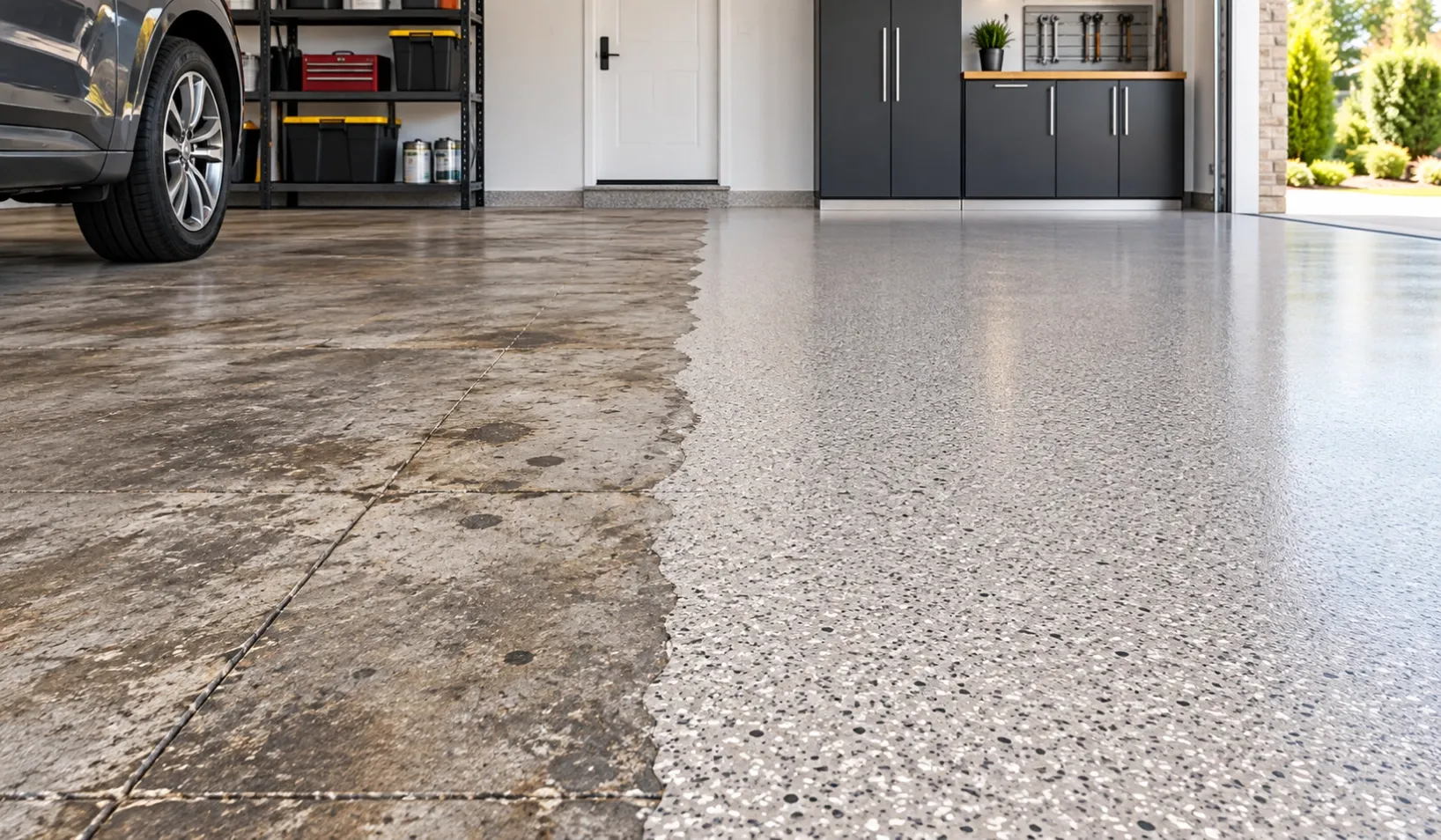
Upgrade old garage floors without removing existing tiles. JUKE Epoxy Colored Sand creates a seamless, durable and self-leveling surface that can be applied directly over suitable existing floors.
Epoxy Colored Sand for Garage Floors: A Zero-Demolition Renovation Solution
Garage floors are exposed to vehicle traffic, dust, water, oil stains, abrasion, and repeated daily use.
When an old garage floor becomes worn or outdated, the traditional solution is often to remove the existing surface and install a completely new flooring system.
But demolition is not always necessary.
JUKE Epoxy Colored Sand Self-Leveling provides a zero-demolition renovation option for suitable existing garage floors. It can be applied over sound old tiles, terrazzo, or prepared concrete to create a new seamless decorative surface without removing the entire original floor.
Why Garage Floor Renovation Often Becomes Complicated
Replacing a garage floor usually involves more than installing a new finish.
A traditional renovation may require:
- Removing the existing tiles or coating
- Breaking and transporting construction waste
- Repairing the exposed substrate
- Installing a new flooring system
- Waiting for multiple construction stages to finish
This adds labor, noise, dust, and downtime.
If the existing garage floor is still structurally sound, a resurfacing system can simplify the process.
Instead of removing the entire floor, the existing surface becomes the substrate for the new epoxy color sand layer.
Can Epoxy Color Sand Be Applied Over Existing Garage Tiles?
Yes, if the existing tiles are stable, dry, clean, and properly prepared.
JUKE Epoxy Color Sand Self-Leveling is designed for direct application over suitable old tile and terrazzo surfaces without demolition.
The important point is that zero demolition does not mean zero preparation.
Loose tiles, hollow areas, cracks, damaged joints, oil contamination, and uneven sections should be repaired before application.
The substrate should be ground and cleaned, with dust, oil, and loose particles removed. Cracks should also be repaired before coating.
For a garage with sound existing tiles, the renovation process can often be reduced to:
Inspect → Prepare → Mix → Pour → Spread → Cure
A Seamless Surface for Easier Garage Cleaning
Tile joints and damaged coatings can collect dust, water, and dirt.
A seamless epoxy color sand surface reduces these interruptions across the floor.
The system is self-leveling and forms a continuous decorative layer after spreading. It also provides strong water resistance, making the finished surface easier to clean and maintain.
For everyday garage use, a continuous surface is generally easier to sweep and clean than a floor with many joints or damaged areas.
Strength for Garage Use
Garage floors need more than decorative appearance.
JUKE Epoxy Colored Sand Self-Leveling is designed to provide high mechanical performance for demanding flooring applications.
Key performance characteristics include:
- Compressive strength: ≥80 MPa
- Mohs hardness: Level 8
- Solid content: approximately 98%
- Heat resistance: no flowing or bubbling below 80°C
- Strong water impermeability
These properties make epoxy color sand suitable for garage renovation where both durability and appearance matter.
Self-Leveling Application
Part A and Part B are mixed thoroughly before application. The material is then poured onto the prepared floor and spread using a notched trowel.
The recommended application thickness is approximately 1.8–2.0 mm.
After spreading, the material self-levels to form a continuous surface.
The system is designed as one integrated layer and normally does not require an additional topcoat for standard indoor applications.
Is Primer Required?
For suitable dense surfaces such as sound existing tiles, the JUKE renovation system can be applied directly after proper preparation.
However, porous concrete, moisture-sensitive substrates, or damaged areas may require additional treatment depending on actual site conditions.
This distinction is important:
No primer on a suitable dense tile surface does not mean no substrate preparation.
Grinding, cleaning, repairing, and checking the existing floor remain essential.
How Long Before the Garage Can Be Used?
Garage renovation normally needs a clear curing schedule.
Typical curing times are:
- 4–6 hours: surface dry
- 24 hours: hard dry
- 48 hours: light pedestrian traffic
- 72 hours: vehicle traffic
Actual curing time can vary with temperature, humidity, and job-site conditions.
Vehicles should not enter the garage before the floor has developed sufficient strength.
How Much Material Is Needed?
JUKE's current export specification is 20 kg per set, covering approximately 10 m² under typical application conditions.
Actual consumption depends on:
- Floor flatness
- Surface defects
- Repair work
- Final application thickness
A smooth existing tile floor usually gives more predictable material consumption than a rough or damaged concrete floor.
Before ordering, contractors should measure the garage area and inspect the substrate condition.
Garage Renovation Without Removing the Existing Floor
The most important question in many garage renovation projects is not:
“What new floor should we install?”
It is:
“Does the existing floor really need to be removed?”
If the old tile, terrazzo, or concrete substrate is still stable, resurfacing can be a more efficient solution.
JUKE Epoxy Color Sand Self-Leveling is designed around this concept:
Keep the existing substrate. Prepare it properly. Apply a new seamless surface.
This can reduce unnecessary demolition while giving the garage a completely different appearance.
A Product Opportunity for Flooring Distributors
Garage renovation is also easy to demonstrate visually.
A before-and-after presentation clearly shows the value of applying a new flooring surface over an existing floor without full demolition.
For flooring distributors, tile suppliers, decorative concrete suppliers, and online sellers, JUKE provides:
- Factory-direct supply
- OEM packaging
- Marketing photos and videos
- Technical support
- Low MOQ starting from 36 sets
This allows distributors to introduce a differentiated renovation product without committing to a large initial inventory.
Final Thoughts
Garage floors do not always need to be demolished before renovation.
When the existing substrate is stable, dry, and properly prepared, JUKE Epoxy Color Sand Self-Leveling can create a seamless new surface over suitable old tiles, terrazzo, or concrete.
For contractors and property owners, the main advantages are clear:
Less demolition. Less waste. Faster renovation. A seamless new finish.
For distributors, flooring suppliers, and online sellers, garage renovation also provides an easy-to-demonstrate product opportunity with strong before-and-after marketing potential.