
B2B & Sourcing
Epoxy Flooring Wholesale: A Buyer's Guide to Bulk Orders
Buying epoxy flooring wholesale means ordering by the pallet and comparing cost per square metre. This guide covers MOQ, pricing, shipping and checks.
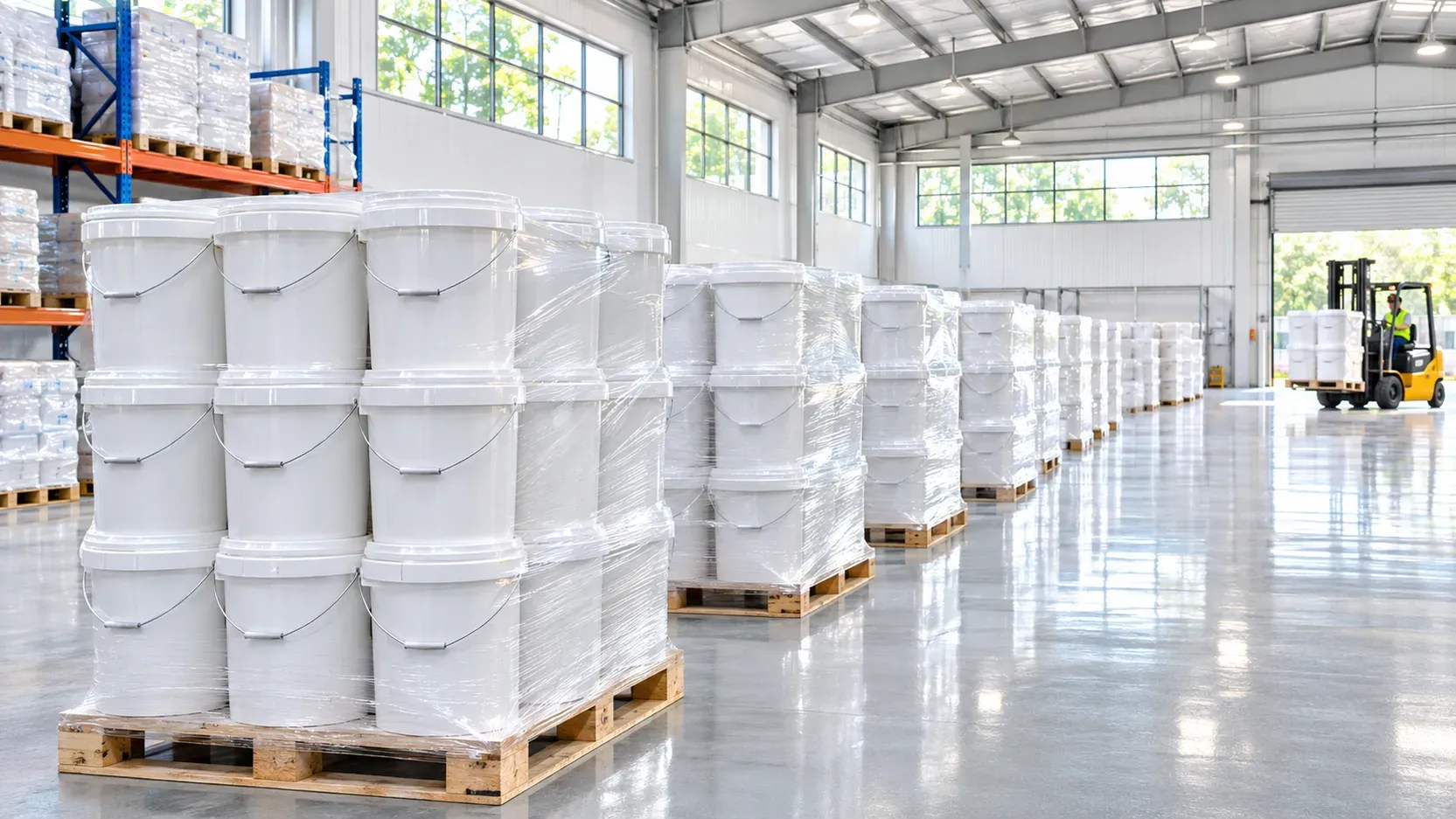
Wholesale epoxy flooring is bought by the pallet, not by the bucket. A standard order starts at one pallet — 48 sets of 20 kg — and the number that matters is not the price per set but the cost per square metre of finished floor.
This guide explains how wholesale epoxy flooring works: minimum orders, how to compare quotes, payment and shipping terms, and the warning signs that tell you to walk away from a supplier. It is written for distributors, contractors, retailers and online sellers who buy in volume.
How Epoxy Flooring Wholesale Works
Wholesale means buying directly from a manufacturer, or from a distributor, in quantities large enough to resell or to supply multiple projects. For epoxy flooring, the unit of sale is usually a 20 kg set — Part A resin and Part B hardener, mixed 8:1 by weight — covering approximately 10 m² at 1.5–2.0 mm. The arithmetic of any wholesale order starts from coverage, not from bucket count.
The minimum order is one pallet: 48 sets, covering roughly 480 m² — enough for a distributor's first stock order or a contractor with several jobs lined up. Mixed colours are available on a single pallet, so you do not need to commit all 48 sets to one colour; confirm this with your supplier before ordering, because not every factory allows it.
Larger buyers order by the container: a 20 ft high-cube container holds 880 sets. Between one pallet and one container, most factories will quote any quantity, and the per-set price generally improves as the quantity rises — but the real comparison is always cost per square metre, as explained below.
If you are new to sourcing from an epoxy flooring manufacturer in China, the factory's side of the deal is simple: it produces to order, packs to your label requirements, and ships to your port. What happens after the container lands is your side — see the shipping section below.
Epoxy Flooring Bulk Buy: What "Bulk" Really Means
An epoxy flooring bulk buy is a wholesale order large enough to qualify for volume terms — usually one pallet or more. "Bulk" sometimes suggests loose material in drums, but in epoxy flooring it means full sets in factory packaging, ordered by the pallet or container.
Bulk buying makes sense in three situations: you resell (distributor, retailer or online seller needing shelf stock), you install (a contractor with a pipeline of projects wanting consistent material from a single batch), or you are supplying one very large project — a warehouse, showroom or multi-unit development — where a single order covers the whole job.
Before committing to a bulk buy, check two practical points. Storage: unopened sets have a shelf life of 24 months, so do not order more than you can use or sell within two years. And colour planning: because mixed colours are available on one pallet, a first bulk order can cover several popular colours rather than betting everything on one. If you plan to resell regularly, ask about a distributor program — an ongoing arrangement usually comes with marketing materials and application guides that a single bulk purchase does not.
How to Compare Supplier Quotes by Cost per Square Metre
The most common mistake in wholesale epoxy flooring is comparing the price per set. Two offers can look similar per set and differ wildly per square metre, because coverage per set is not the same across products — one set may cover 6 m², another 10 m². The only fair comparison is cost per square metre: divide the price per set by the coverage per set.
The table below shows how the method works, using clearly labelled example figures — illustration numbers only, not JUKE's prices and not any supplier's real quote.
| Offer A (example) | Offer B (example) |
|---|---|---|
Price per set | $72 (example) | $80 (example) |
Coverage per set | 6 m² | 10 m² |
Cost per square metre | $12/m² | $8/m² |
Offer A looks cheaper per set, but Offer B costs one-third less per square metre — a lower set price is not a lower floor price. When you request quotes, always ask for the coverage figure in writing and confirm it against the technical data sheet: for a self-levelling colour-sand system, a typical figure is around 10 m² per 20 kg set at 1.5–2.0 mm, and the supplier should state the thickness the coverage assumes.
Price per square metre is the headline comparison, but not the only one. Check the solids content (a high-solids product, around 98%, leaves almost no shrinkage), the VOC level (16 g/L is low), the working time (around 20 minutes — short enough to demand an experienced crew), and the cured performance: compressive strength of 80 MPa or more and a Mohs hardness of 8 indicate a floor that will take heavy use. Foot traffic after about 48 hours and vehicle traffic after about 72 hours are typical curing times.
Also compare what is included in the quote: technical data sheets and safety data sheets, application instructions, colour charts, and sample availability. A quote that looks cheap but omits documents and support can cost more once your first project runs into a question nobody can answer. For a fuller walkthrough, see our guide to cost per square metre, and for the wider picture, our article on how much epoxy color sand flooring costs.
OEM and Private Label
Most wholesale buyers do not sell under the factory's brand. OEM and private-label arrangements let you put your own brand, label design and colour names on the buckets, and a good factory will supply the packaging artwork specifications and keep your label design on file for repeat orders.
Colour is part of the same conversation. Factory colours are fixed — the end user cannot mix colours on site — but a manufacturer can produce a custom, exclusive colour for a wholesale partner. Standard ranges typically run to 12 colours; if your market wants something specific, ask early, because a custom colour needs a production slot.
Territory and exclusivity are handled case by case — ask the factory about your market rather than assuming a standard arrangement. What a factory can usually offer from the start is marketing support: application videos, finished-floor photography and social media material for a new distributor.
Payment and Shipping Terms
Standard payment terms are 50% T/T in advance and the remaining 50% T/T before shipment. The advance covers raw materials and production; the balance is paid once the goods are ready and inspected. Be cautious of any supplier demanding 100% payment upfront with no written proforma invoice — that is not standard practice.
Shipping is normally quoted CIF to the destination port: ocean freight and marine insurance to your port are included in the price. Everything beyond the port is the buyer's responsibility — customs clearance, import duties and taxes, port handling charges, and inland delivery to your warehouse. Before confirming an order, agree on the destination port in writing and ask your customs broker what the landed cost will be; the CIF price alone does not tell you what the goods will cost at your door.
Two more points deserve attention. First, confirm the lead time: production, packing and sailing schedules vary, and a realistic delivery date matters more than an optimistic one. Second, ask for the safety data sheets for both components and confirm the transport classification with your forwarder before booking — epoxy hardeners are often classified as dangerous goods even when the resin is not, and the forwarder's answer decides how the shipment must be packed and declared.
Regional buyers can find port and market detail in our country guides — our guide to epoxy flooring suppliers in the UK and our guide to epoxy flooring suppliers in Australia both cover the main ports and what to confirm with a broker.
Red Flags When Choosing a Supplier
Spot these warning signs before paying:
- No technical data sheet or safety data sheet. A serious manufacturer provides both on request; without them, you cannot verify what you are buying.
- Coverage claims with no thickness stated. Coverage without a thickness figure is meaningless — the same set covers very different areas at 1 mm and at 2 mm.
- A price far below every other quote. Epoxy resin and colour sand have real material costs — a price far below the market usually means thinner coverage, lower solids, or a product that is not what it claims to be.
- No verifiable factory. Ask for factory photos, a business licence, and a video call from the production floor. A trading company can be a legitimate partner, but it should say so.
- No samples. A factory confident in its product will send a small sample for testing, with the buyer paying courier freight. Refusal to sample is a reason to stop.
- Vague shipping terms. "We handle everything" without a written CIF port, lead time and payment schedule is not a shipping term — it is a promise that will be reinterpreted later.
- Pressure to pay immediately. A genuine factory will hold a quotation for a reasonable period and accept the standard 50/50 split. Urgency is a sales tactic, not a production constraint.
Frequently Asked Questions
What is the minimum order for wholesale epoxy flooring?
The standard minimum order is one pallet: 48 sets of 20 kg. Mixed colours are available on a single pallet, so a first order can cover several colours. Larger quantities, up to a full 20 ft high-cube container of 880 sets, are quoted on request.
How many square metres does one pallet cover?
Roughly 480 m² — one 20 kg set covers approximately 10 m² at 1.5–2.0 mm, so 48 sets cover about 480 m². Confirm coverage with a representative site trial before quoting a project, and add a few extra sets as a wastage allowance.
Can I get my own brand on the buckets?
Yes. OEM and private-label packaging is standard for wholesale orders — your brand, label design and colour names on the buckets. Custom exclusive colours can also be produced; ask early, as a custom colour needs a production slot.
Does the wholesale price include delivery to my warehouse?
No. Wholesale epoxy flooring is normally sold CIF to the destination port — ocean freight and insurance to the port only. Customs clearance, import duties and inland delivery are the buyer's responsibility, so confirm the landed cost with your customs broker before ordering.
Ready to discuss a wholesale order? Contact the factory for a quotation — tell us your quantity, colours and destination port, and we will confirm pricing, lead time and shipping.