
Flooring Comparisons
Epoxy Color Sand vs Epoxy Flake: Which Flooring Wins?
Epoxy color sand vs epoxy flake: both are epoxy flooring, but they differ in application, look, and cost. Compare the two systems before you choose.
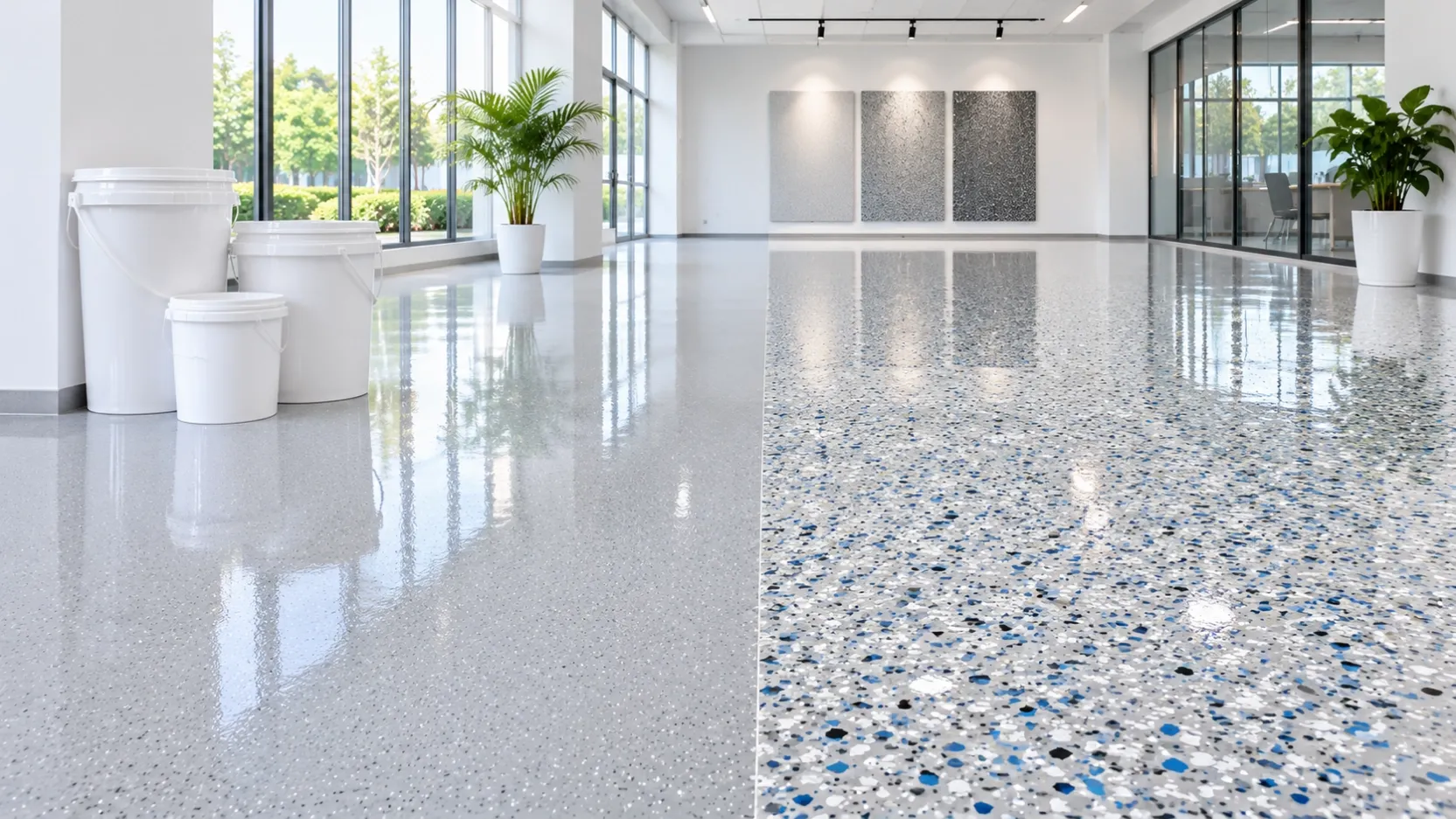
Epoxy color sand and epoxy flake are both epoxy flooring systems, and they suit the same application scenarios — garages, showrooms, retail spaces, workshops, and light-industrial floors. The difference is not what they are for; it is how they are applied and how they look. Color sand's biggest advantage is simple application: mix, pour, spread. Flake takes more steps and more crew skill. This guide compares the two so you can choose the right system for your project or your product range.
The short answer
Choose epoxy color sand if you want the simplest install: one premixed system, one main layer, no separate topcoat normally required indoors. Choose epoxy flake if your customer specifically wants the decorative chip look and a glossy clear-topcoat finish, and your crew is experienced with broadcast work. Both are epoxy flooring; neither is a "better" product in general — the right choice depends on the job, the look, and the applicator.
What epoxy color sand flooring is
Epoxy color sand self-leveling flooring is a two-component system in which colored quartz sand is already mixed into the resin. The factory supplies a pre-measured 20 kg set — Part A and Part B at an 8:1 ratio by weight — and the applicator mixes the full set, pours it out, and spreads it to 1.5–2.0 mm. One set covers approximately 10 m², or about 2 kg/m².
Because the sand is in the mix, the finish is uniform: a fine, speckled, stone-like surface that is both decorative and anti-slip. JUKE offers 12 standard colors, from Milky White and Stone Gray to Sky Blue and Emerald Green, and can develop a custom exclusive color for a distributor. The system applies directly over sound existing tiles with no demolition and no primer on tiles; concrete must be primed with a sealing primer first. For standard indoor use, no additional topcoat is normally required.
What epoxy flake flooring is
Epoxy flake flooring is built in layers. A pigmented epoxy base coat is applied first, then decorative vinyl flakes are broadcast by hand into the wet coating. Once cured, the loose flakes are scraped off and the floor is sealed with a clear topcoat — sometimes two — which gives the system its glossy finish and locks the flakes in place.
The look comes from the flakes: larger decorative chips in a random pattern, often compared to terrazzo. The flake blend determines the color and pattern, so the range of looks is wide. The trade-off is process: base coat, broadcast, scrape, topcoat is a multi-step, multi-day job that needs an experienced crew to get an even broadcast and a smooth sealed finish.
Application: the biggest difference
This is where the two systems separate most clearly.
Color sand is a one-layer main application. The crew mixes a complete pre-measured set with an electric mixer for 2–3 minutes, pours it onto the prepared base, and spreads it with a notched trowel to 1.5–2.0 mm. While the material is still workable, a spiked roller may be used to release trapped air, as confirmed by the site trial. Working time is approximately 20 minutes per mixed set, so the crew plans the pour sequence in advance — but there is no second coat to schedule and no broadcast step to get wrong.
Flake application has more stages and more waiting. Each layer must be applied and cured in sequence, the broadcast must be even, and the topcoat must be applied after scraping. That means more labor hours, more site visits, and more points where inexperience shows — an uneven broadcast or a thin topcoat is visible in the finished floor.
Both systems need the same substrate discipline: the base must be sound, clean, dry, and free of oil, wax, and loose material, with substrate moisture at or below 8%. Preparation is not where you save time on either system.
Look and finish
Color sand gives a fine, even, speckled finish with a natural stone-like appearance. The texture comes from the quartz sand itself, which also makes the surface anti-slip. The finish is uniform across the floor because the color is mixed into the material, not scattered on top.
Flake gives a bolder, more random look: visible decorative chips in mixed colors under a clear glossy topcoat. The topcoat adds depth and shine, and the chip pattern hides minor substrate imperfections well. Customers who want a high-gloss, terrazzo-style floor often prefer flake; customers who want a calm, even, stone-like floor often prefer color sand.
Neither look is objectively better. Show the customer a sample of each finish and let the project decide.
Where each system is used
Both systems cover the same scenarios: residential garages and living areas, retail stores, showrooms, offices, hotels, and selected light-industrial spaces such as workshops and warehouses, subject to project assessment.
Color sand has a practical edge in renovation work: it goes directly over suitable existing tiles with zero demolition, which matters on occupied commercial jobs where downtime is expensive. Flake is more often specified where the decorative chip look is the point — showrooms, feature floors, and residential garages where the owner wants a specific flake blend.
For a distributor, both systems sell to the same buyer types — flooring contractors, builders, and resellers — so the choice is about which system your customers ask for and which your applicators can install reliably.
Durability and maintenance
For epoxy color sand, the published numbers are: Mohs hardness 8, compressive strength ≥80 MPa, watertight at 0.4 MPa for 2 hours, foot traffic after approximately 48 hours, and vehicle traffic after approximately 72 hours. The seamless, joint-free surface is easy to clean — sweep or vacuum loose dirt and clean with suitable neutral products.
Flake flooring durability depends on the build: the base coat, the flake coverage, and above all the clear topcoat, which is the wearing layer. No flake performance figures are published here, because flake system data varies by supplier and by build — ask any flake supplier for its own TDS and compare it against the color sand numbers above, on the same basis.
Both systems need protection during cure and sensible maintenance afterwards. Neither system bridges active cracks or movement in the substrate — assess and repair those first.
Which one should you choose?
Choose epoxy color sand when:
- You want the fastest, simplest install with the smallest crew.
- The job is a renovation over existing tiles and demolition is not an option.
- The customer wants a uniform, stone-like, anti-slip finish.
- You are a distributor who wants a system that is easy to support, because the application is simple and the failure modes are few.
Choose epoxy flake when:
- The customer specifically wants the decorative chip look and a glossy topcoat finish.
- The crew is experienced with broadcast application and multi-coat work.
- The project schedule allows the extra steps and cure time between coats.
Many distributors stock both. Color sand is the easier first system to add to a range — the application is simple, the MOQ is 48 sets (one pallet) with mixed colors allowed, and the same buyers who purchase flake will buy color sand once they see the finish and the install speed.
FAQ
Are color sand and flake both real epoxy flooring?
Yes. Both are two-component epoxy systems. They differ in how the decorative layer is formed — premixed colored sand in the resin, versus flakes broadcast into a base coat — not in the chemistry family.
Which is easier to apply?
Color sand. It is a one-layer main application: mix the pre-measured set, pour, spread. Flake needs a base coat, a broadcast step, scraping, and a clear topcoat, each in sequence.
Can both systems go over existing tiles?
Color sand applies directly over sound, clean, dry existing tiles with no demolition and no primer on tiles. For flake, over-tile suitability depends on the supplier's system and base coat — check the flake supplier's own guidance.
Which looks better?
That is a matter of taste. Color sand is a fine, even, stone-like speckle. Flake is a bolder, random chip pattern under a glossy clear coat. Show the customer a sample of each.
Can a distributor sell both systems?
Yes. JUKE supplies both epoxy color sand self-leveling and epoxy flake flooring systems, so one supplier can cover both looks. Start with the system your customers ask for most, then add the other.
Next step
If you are deciding between the two for a project, order a sample of each finish and test them on your actual substrate. If you are a distributor building a range, start with the system your applicators can install confidently. Request the JUKE TDS and samples for both systems and compare them on your own floor.