
Epoxy Color Sand
Resin Flooring Guide: Types, Uses and How to Choose
Epoxy, polyurethane or MMA? This guide explains the three types of resin flooring, where each works best, and how to choose the right system.
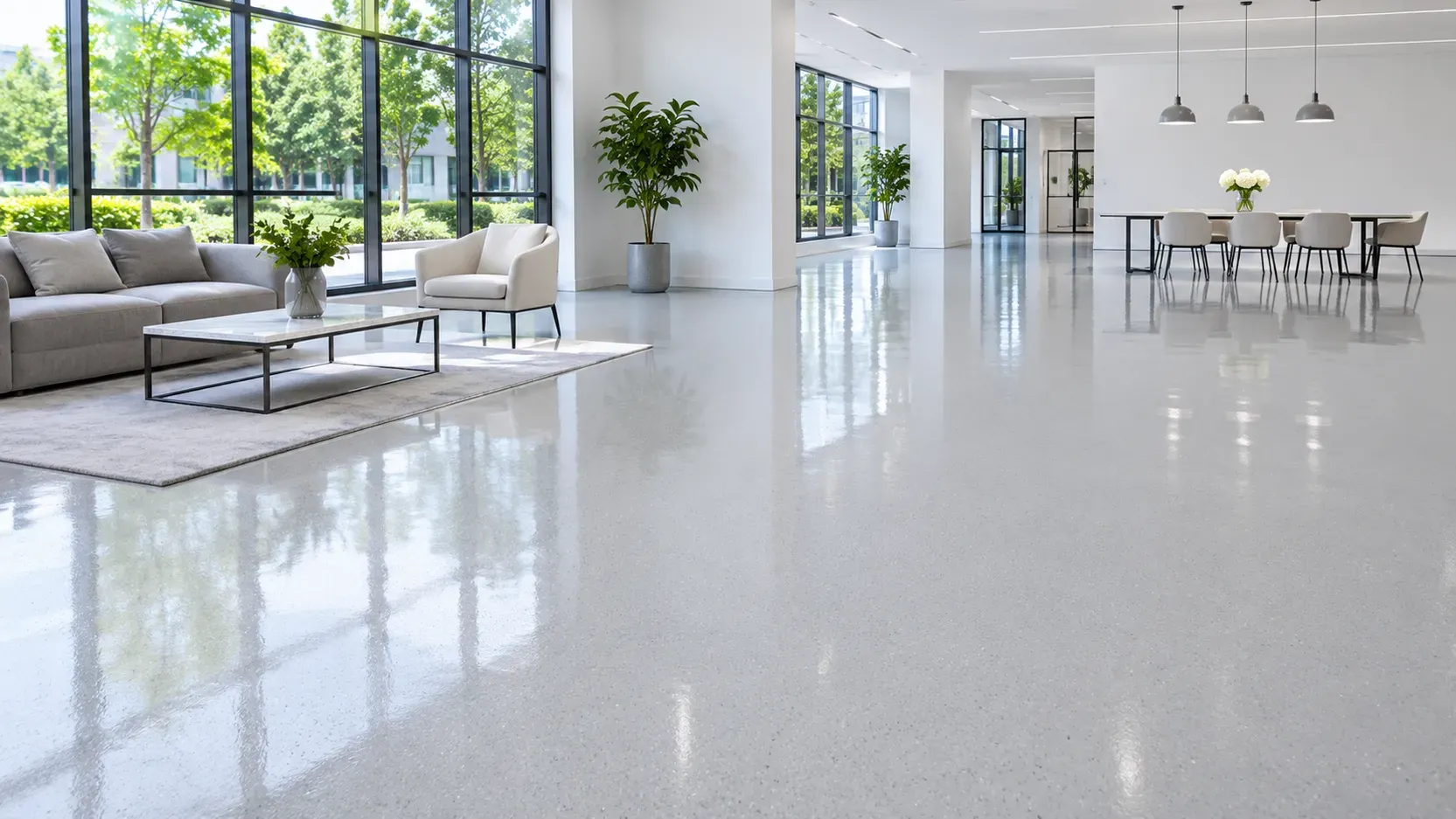
Resin flooring is a seamless floor system created by pouring liquid resin over a prepared substrate, where it cures into a hard, smooth, joint-free surface. Unlike tiles or vinyl sheets, a resin floor has no grout lines or seams where dirt and moisture can collect. That is why it is widely used in warehouses, showrooms, commercial kitchens, garages, and homes. The three main types are epoxy, polyurethane, and MMA, and the right choice depends on the substrate, the traffic the floor will take, and whether the priority is appearance, speed, or flexibility.
What Is Resin Flooring?
A resin floor starts as a liquid: a resin mixed with a hardener, poured or rolled onto a prepared floor, then left to cure into a solid surface bonded to the substrate beneath. Most systems are applied in layers and can be finished in a solid colour, with decorative flakes, or with coloured sand mixed through the resin.
Because the floor is poured rather than laid in pieces, the finished surface has no joints. Cleaning is simple — sweep or vacuum loose dirt and clean with suitable neutral products — and there are no grout lines to stain or crack. Thickness depends on the system: a self-levelling epoxy floor is typically applied at 1.5–2.0 mm, while heavy-duty mortar systems are built up much thicker.
Resin flooring is often described as a single product, but it is really a family of systems. The resin chemistry decides how the floor behaves: how hard it cures, how it handles movement and temperature change, how fast it can be used, and how it ages in sunlight. Understanding the three main types is the first step to choosing well.
The Three Main Types of Resin Flooring
Epoxy Resin Flooring
Epoxy is the most widely used resin flooring type, and the one most buyers mean when they say "resin flooring." An epoxy floor cures hard and rigid, carries heavy loads well, and resists wear from foot traffic, trolleys, and vehicles. It is available in a wide range of colours and finishes, from smooth gloss to textured decorative surfaces such as coloured sand and flake.
Epoxy needs a dry, sound substrate. The substrate moisture content must be within the manufacturer's limit — for JUKE epoxy systems, no more than 8% — and the surface must be flat and stable. Standard epoxy can slowly fade in direct sunlight, so outdoor use needs care: the colour will change gradually under strong sun, and an anti-UV topcoat is worth considering for exposed areas.
Polyurethane (PU) Resin Flooring
Polyurethane resin flooring is more flexible than epoxy. It handles movement, vibration, and temperature change better, which makes it a common choice for floors that expand and contract, such as car parks, cold rooms, and areas with underfloor heating. PU also has better resistance to yellowing in sunlight than standard epoxy, and it is often used as a topcoat over an epoxy base to combine the hardness of epoxy with the flexibility and UV stability of polyurethane.
MMA (Methyl Methacrylate) Resin Flooring
MMA resin flooring is the fast option. It cures very quickly — often ready for foot traffic within hours rather than days — and it can be applied at low temperatures where other resins would cure too slowly. That speed makes it popular for refurbishments that cannot afford a long shutdown, such as food production areas and retail spaces. The trade-off is a strong odour during application, so good ventilation is essential, and working time is short, which demands an experienced installation team.
Comparison Table
Type | Key strengths | Watch out for | Typical uses |
|---|---|---|---|
Epoxy | Hard, durable, wide colour range, cost-effective for large areas | Needs a dry, stable substrate; can fade in direct sun | Warehouses, garages, showrooms, homes |
Polyurethane | Flexible, handles movement and temperature change, better UV stability | Softer surface than epoxy; often used as a topcoat | Car parks, cold rooms, areas with underfloor heating |
MMA | Very fast curing, works at low temperatures | Strong odour during application; short working time | Fast-turnaround refurbishments, food production |
One honest note: JUKE manufactures epoxy resin flooring systems only. We do not sell polyurethane or MMA systems, and this guide covers them so that buyers can compare the options fairly. If a project genuinely needs the flexibility of PU or the curing speed of MMA, an epoxy floor is not the right answer, and a good supplier should say so.
Epoxy Resin Flooring in More Detail
Within epoxy flooring there are several systems, and they differ mainly in how the decorative layer is built. A self-levelling system is poured and levels itself into a smooth coat. A broadcast system scatters aggregate or flakes onto a wet base coat and seals them under a clear topcoat. A mortar system mixes resin with fine aggregate to build a thick, heavy-duty layer.
The simplest system to apply is a premixed self-levelling floor, where the decorative aggregate is already blended into the resin: mix, pour, and spread. A broadcast system needs more steps and more skill, but it allows heavier decorative effects. Our comparison of epoxy color sand vs epoxy flake explains the practical differences between two of the most popular decorative epoxy finishes.
Epoxy Colored Sand Self-Leveling: A Decorative Epoxy Resin Floor
JUKE's flagship product, epoxy colored sand self-leveling flooring, is a decorative epoxy resin floor in which coloured quartz sand is premixed with modified epoxy resin. It is poured onto the floor and levels itself, giving a smooth surface with a fine speckled appearance. The coloured sand is decorative and anti-slip at the same time.
The system is supplied as a 20 kg A+B set, mixed at a ratio of 8:1 by weight. Mix with a suitable electric mixer for approximately 2–3 minutes, then pour and spread. The working time is about 20 minutes, and one set covers approximately 10 m² at a thickness of 1.5–2.0 mm. The cured floor is hard and durable: compressive strength of at least 80 MPa, a Mohs hardness of 8, and a tensile bond strength of 6 MPa. Solids content is about 98% and VOC is 16 g/L.
One of its biggest advantages is renovation over existing floors. It applies directly over suitable existing tiles with no demolition and no primer on tiles. Concrete must be primed with a sealing primer first. Small holes and cracks can be filled with the coloured sand itself; large damaged areas need grinding and repair first, then epoxy on top. A floor with too many holes and cracks wastes material, so a flat, level floor is the best starting point.
After application, foot traffic is possible after about 48 hours and vehicle traffic after about 72 hours. The system comes in 12 standard colours, and JUKE can also make a custom exclusive colour for a customer. Application is possible between 5°C and 35°C with humidity at or below 85%.
Where Is Resin Flooring Used?
Resin flooring is used wherever a seamless, hard-wearing, easy-to-clean surface is needed.
Industrial. Warehouses, workshops, and factories use resin floors for their load-bearing strength and easy maintenance. See our guide to industrial epoxy flooring for warehouses for what to check before specifying a warehouse floor.
Commercial. Showrooms, retail stores, offices, restaurants, and salons choose resin flooring for its clean look and the absence of grout lines. A showroom floor can be resurfaced over existing tiles with no demolition, and the work can be done in sections.
Residential. Garages, basements, kitchens, and living areas are all suitable. A garage floor is the most common home project: the floor goes over the existing concrete, and the speckled finish gives it a clean, finished look.
Outdoor areas. Resin flooring can be used outdoors, but the colour will slowly fade in direct sunlight. For patios, balconies, and other exposed areas, an anti-UV polyaspartic topcoat is an option to ask the factory about.
How to Choose the Right Resin Floor
Start with the substrate. Sound tiles in good condition can take a self-levelling epoxy directly, with no demolition. Bare concrete needs a sealing primer first. A damp substrate must be dried or treated before any resin system goes down — trapped moisture is the most common cause of failure. Loose or hollow tiles must be fixed before coating.
Next, consider the traffic. Heavy forklift traffic and point loads call for a hard epoxy system at the full specified thickness. A showroom or home needs far less. If the floor will move — a car park deck, for example — a flexible polyurethane system is worth considering.
Then think about time. An epoxy floor needs about 48 hours before foot traffic and about 72 hours before vehicles. If the space cannot be closed for that long, a fast-curing MMA system may be the better fit, or the work can be done in sections.
Finally, compare quotes by cost per square metre, not by price per set or per bucket. Two products with different coverage rates cannot be compared by pack price alone: always divide by the area one set actually covers, and confirm the thickness the coverage figure is based on.
Buying Resin Flooring from a Manufacturer
Buying directly from a factory gives access to the full technical picture: the technical data sheet, the safety data sheet, application guidance, and custom colours. When evaluating an epoxy flooring manufacturer in China, ask for the TDS and check the figures that matter for your project — coverage per set, thickness, curing times, and substrate requirements — rather than relying on marketing claims.
For distributors and resellers, the usual starting point is one pallet of 48 sets, with mixed colours available on a single pallet. A full 20 ft high-cube container holds 880 sets. OEM and private-label packaging is available, and the factory supplies application instruction documents and videos as well as marketing materials. If you are interested in reselling, read how to become an epoxy flooring distributor. Buyers in Britain can also read our guide for epoxy flooring suppliers in the UK.
Standard international terms are CIF to the destination port: ocean freight and insurance to the port are included, and customs clearance and delivery beyond the port are the buyer's responsibility. Always confirm the port, the quantity, and the delivery schedule with the factory before ordering.
Frequently Asked Questions
How long does resin flooring last?
There is no single lifespan figure, because durability depends on the substrate preparation, the system thickness, the traffic, and the maintenance. A resin floor laid on a sound, dry, well-prepared substrate and cleaned with neutral products is a long-term surface. Hardness figures such as a compressive strength of at least 80 MPa and a Mohs hardness of 8 are useful indicators of wear resistance, but they are not a promise of a specific number of years.
Can resin flooring go over tiles?
Yes. Epoxy coloured sand self-levelling flooring applies directly over suitable existing tiles, with no demolition and no primer on tiles. The tiles must be sound and well bonded — loose or hollow tiles must be repaired or removed first, and large damaged areas need grinding and repair before the epoxy goes on.
Is resin flooring slippery?
It depends on the finish. A coloured sand surface has a fine texture that gives grip underfoot, which is one reason it is popular in garages, kitchens, and commercial spaces. A perfectly smooth high-gloss resin floor can be slippery when wet, so for wet areas a textured finish is the better choice.
How long before I can walk on a new resin floor?
For JUKE epoxy coloured sand self-levelling flooring, foot traffic is possible after about 48 hours and vehicle traffic after about 72 hours. Fast-curing MMA systems are ready much sooner, which is their main advantage on projects where downtime is expensive.
Looking for a factory quote? Contact the factory — tell us your floor area, the existing surface (tiles or concrete), and whether you are buying for your own project or for resale, and we will recommend the right system.