
Epoxy Color Sand
How Long Does Epoxy Flooring Last? What Decides It
How long does epoxy flooring last? There is no single number — it depends on thickness, preparation, traffic, and care. Here is what decides it.
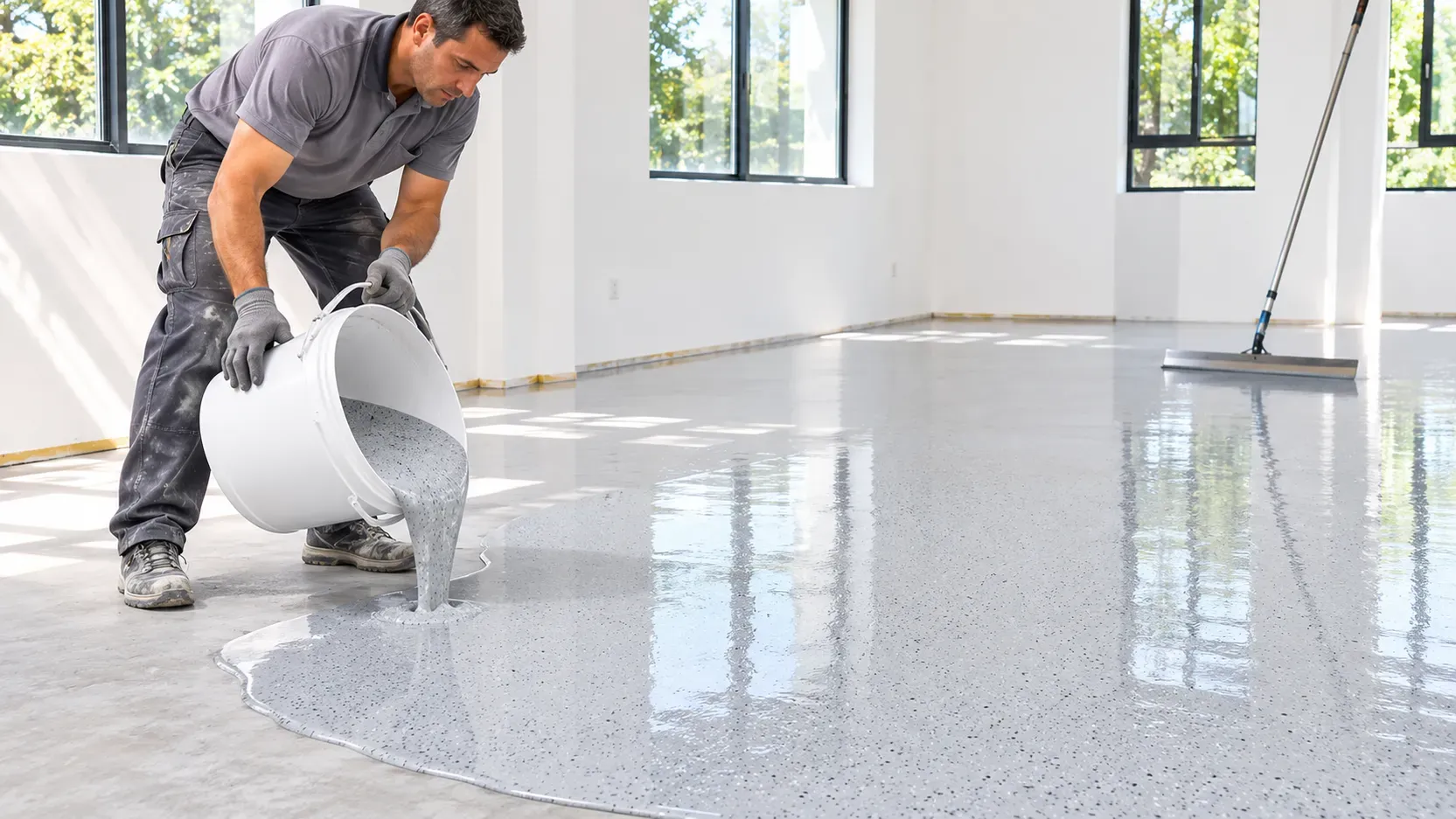
How long does epoxy flooring last? It is one of the first questions buyers ask, and the honest answer is that there is no single number. A well-installed epoxy floor in a home garage can serve for many years; the same material laid thin on a poorly prepared slab under heavy forklift traffic will not. What decides the lifespan is not the brand name on the bucket — it is thickness, substrate preparation, traffic, sunlight, and care.
This guide explains each factor with the numbers that can actually be checked, so you can judge a supplier's claims instead of taking them on trust.
The short answer
Epoxy flooring lasts as long as its weakest link. The floor fails first at the bond to the substrate, at thin spots, or at cracks in the slab underneath — almost never because the cured epoxy itself "wore out" evenly. So the right question is not "how many years does it last?" but "what was it installed on, how thick is it, and what will drive over it?"
No technical data sheet for JUKE's system states a service life in years, and any supplier who quotes you one without asking about your substrate and traffic is guessing. What the TDS does state — and what you can verify — are the durability numbers below. When choosing a supplier, buy from an epoxy flooring manufacturer in China that publishes full test data.
What the TDS actually says about durability
For JUKE's epoxy colored sand self-leveling system (TDS JK-TDS-EP01 Rev.02):
- Compressive strength ≥80 MPa — the cured floor resists heavy loads without crushing.
- Hardness Mohs 8 — a hard, scratch-resistant surface.
- Tensile bond strength 6 MPa — the bond to a properly prepared substrate is strong; bond failure is usually a preparation failure, not a material failure.
- Applied thickness 1.5–2.0 mm, ~2 kg/m² — this is what the strength is built on. A thinner coat has less material behind it.
- No flowing or bubbling below 80 °C; no cracking at −20 °C — the cured floor handles normal indoor temperature swings.
- Shelf life 24 months — note this is the unopened storage life of the material in the bucket, not the service life of the finished floor. Do not confuse the two.
These numbers describe a floor installed as specified. They say nothing about a floor installed on a damp, dusty, or cracked slab — which is where most short lives begin. For the wider picture, see our resin flooring guide.
Factor 1: Substrate preparation
Preparation decides more of the lifespan than any other factor. Epoxy bonds to the substrate; if the bond fails, the floor peels no matter how good the resin is.
- Moisture content of the substrate must be ≤8%. A damp slab weakens the bond and can cause blistering. Test it — do not guess.
- The surface must be clean, sound, and level. Small holes and cracks can be filled with the colored sand material itself; large damaged areas need grinding and repair first, then epoxy on top. A floor with too many holes and cracks wastes material and will not last — recommend a level floor before starting.
- On tiles, no primer is needed; on concrete, a sealing primer is required. Getting this wrong is a common cause of early failure on concrete.
- Bond strength is 6 MPa on a prepared substrate. That figure assumes the preparation in the TDS was followed.
If a contractor skips preparation to save a day, the floor pays for it for years. Ask your installer what preparation they will do, and check it happened before the pour.
Factor 2: Thickness
A self-leveling system is applied at 1.5–2.0 mm, using about 2 kg/m². That thickness is part of the product's durability: it is what carries the compressive strength and the wear resistance.
A thin rolled epoxy coating — usually well under 1 mm — is a different product with a different life. It follows every bump underneath and wears through faster under traffic. When comparing two quotes, compare them at the same thickness and the same coverage basis (~10 m² per 20 kg set), or the comparison is meaningless. Our self-leveling epoxy flooring guide explains the difference in detail. For the two most popular decorative finishes, see our comparison of epoxy color sand vs epoxy flake.
Factor 3: Traffic and use
What the floor carries matters as much as what it is made of:
- Foot traffic only (homes, showrooms, offices) is the lightest duty — the easiest life for any epoxy floor.
- Vehicle traffic (garages, workshops) adds weight, turning tires, and hot-tire pickup. Allow the full cure before driving on it: foot traffic ~48 hours, vehicle traffic ~72 hours.
- Forklifts and pallet jacks (warehouses, industrial floors) are the heaviest duty. They need the full 1.5–2.0 mm build, a sound slab, and control joints respected — do not bridge moving joints with a rigid coating and expect it to hold.
Tell your supplier what the floor will carry before ordering. A system that is right for a showroom may be the wrong choice for a forklift aisle, and the time to find out is before the pour.
Factor 4: Sunlight
Epoxy colored sand flooring can be used outdoors, but the color will slowly fade in direct sun. For demanding customers — or any sun-exposed area — use a compatible anti-UV topcoat, such as a polyaspartic topcoat. Without one, expect the color to fade over time even though the floor itself stays sound. Fading is a cosmetic failure, but it is the one customers notice first.
Indoors, away from direct sun, fading is not a factor.
Factor 5: Care and maintenance
A floor that is cleaned lasts longer than one that is not — grit underfoot is an abrasive, and chemical spills left standing attack any coating eventually.
- Clean with a neutral detergent and water; sweep or mop grit off regularly.
- Wipe up chemical spills promptly rather than leaving them to stand.
- Do not drag heavy sharp objects across the surface; use pads or wheels where loads move.
- Recoat or topcoat before wear reaches the substrate. A maintenance topcoat applied while the floor is still sound is far cheaper than a repair after the bond has failed.
None of this needs special equipment — it needs a routine, and someone who follows it.
When epoxy flooring does NOT last
Some floors are set up to fail, and it is better to know before ordering than after:
- A damp slab (moisture above 8%) with no moisture mitigation.
- A cracked, moving, or crumbling substrate that has not been repaired first.
- Application below 5 °C or above 35 °C, or at humidity above 85% — outside the TDS application window.
- Heavy traffic before curing — walking on it before ~48 hours, or driving on it before ~72 hours.
- Outdoor use in full sun with no UV topcoat, where fading is expected.
How to make it last: a checklist
Before you order, check these five things and the floor's odds improve sharply:
- Test the substrate — moisture ≤8%, sound, clean, and level.
- Confirm the thickness — 1.5–2.0 mm, ~10 m² per 20 kg set.
- Match the system to the traffic — foot, vehicle, or forklift.
- Plan the cure — ~48 hours before foot traffic, ~72 hours before vehicles.
- Protect it from sun — a UV topcoat for outdoor or sun-exposed areas.
And test before you commit: JUKE provides a free 1 kg sample; the customer pays the courier freight. Use it to check coverage, working time (~20 minutes), cure, color, and finish on your own substrate.
FAQ
How long does epoxy flooring last?
There is no single number. It depends on thickness, substrate preparation, traffic, sunlight, and maintenance. A well-prepared, correctly installed floor at 1.5–2.0 mm lasts far longer than a thin coat on a poor substrate — ask your supplier what was assumed behind any number they quote.
What is the shelf life of epoxy flooring material?
24 months unopened, for JUKE's system. That is storage life in the bucket, not the service life of the finished floor.
Does epoxy flooring fade?
Outdoors in direct sun, the color slowly fades without a UV-protective topcoat. Indoors it does not fade.
Can epoxy flooring be repaired if it peels?
Small damaged areas can be repaired, but peeling usually means the bond failed — often from poor preparation or moisture. Repair the cause first, or the repair will peel too.
How soon can I walk or drive on a new epoxy floor?
Foot traffic after ~48 hours, vehicle traffic after ~72 hours, per the TDS. Do not rush it.
Next step
If you are planning an epoxy floor, start with the substrate: test its moisture, check its condition, and confirm the traffic it will carry. Then request the TDS and a sample, and test the product the way your crew will install it. When you are ready, request a factory quote — and tell us your area, substrate, and use, so the quote and the advice are exact. If you are buying in volume, our epoxy flooring wholesale guide explains how bulk orders work.