
B2B & Sourcing
Epoxy Flooring Distributor USA: A Market Guide
Selling epoxy flooring in the US? This guide covers where demand comes from, distribution channels, importing from China, and how to start as a distributor.
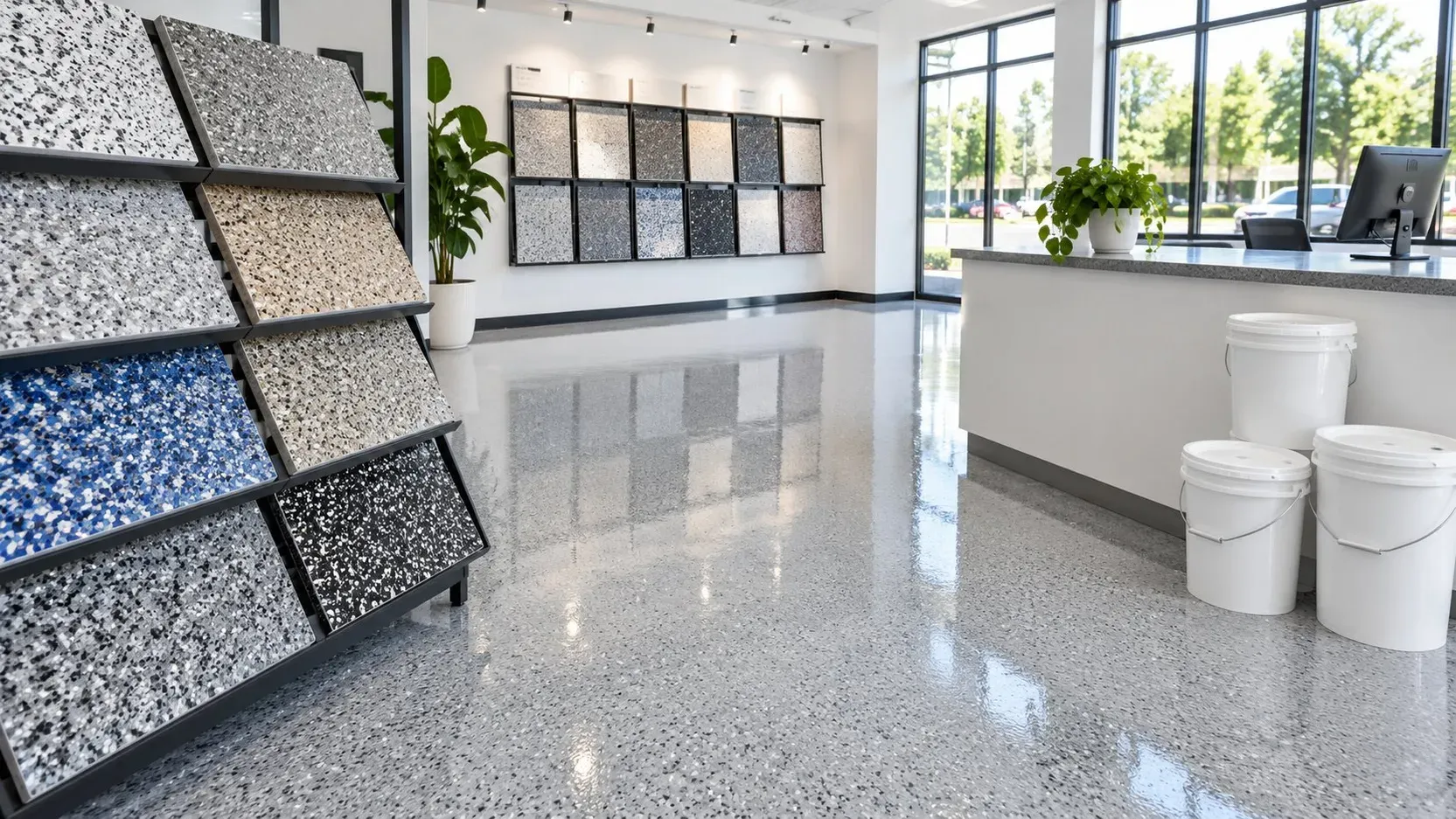
The United States is a broad and active market for epoxy flooring. Homeowners resurface garages, retailers refresh showrooms, warehouses need hard-wearing floors, and commercial buildings renovate without closing — and in many of those jobs the floor underneath is already there. A system that applies directly over existing tiles, with no demolition, fits the way the US renovation market actually works.
For a distributor, the opportunity is straightforward: stock a product that contractors can install quickly, that property owners can see the value of, and that you can sell under your own brand. This guide covers the US market itself — where demand comes from, how distribution works, what importing from China involves, and how to get started. For the details of JUKE's own distributor support, see the JUKE distributor program — this article is about the market, not the program.
Where US demand comes from
Demand for epoxy flooring in the US comes from four main directions:
- Garages. Residential garages are the most familiar application: a seamless, easy-to-clean floor that handles vehicle traffic and looks far better than bare concrete.
- Commercial spaces. Showrooms, retail stores, offices, and restaurants renovate without closing for long. A system that goes over existing tiles — no demolition, no primer on tiles — shortens the job and the disruption.
- Warehouses and industrial floors. These floors carry the heaviest loads — forklifts, pallet jacks, constant traffic — and need the full 1.5–2.0 mm build, a sound slab, and the strength the TDS documents: compressive strength ≥80 MPa and Mohs 8 hardness.
- Retail and hospitality. Shops, lobbies, and public areas want a floor that looks good, cleans easily, and stays seamless — no grout lines to trap dirt.
A large part of epoxy flooring work is renovation — existing floors being renewed rather than new slabs being coated. A self-leveling system covering ~10 m² per 20 kg set at 1.5–2.0 mm, with a working time of ~20 minutes, lets a crew resurface a space in days rather than weeks — and the colored sand is both decorative and anti-slip.
Outdoor use is possible, but with a limit to know about: the color slowly fades in direct sun. For sun-exposed areas, an anti-UV topcoat is the answer — ask the factory about a compatible option before promising an outdoor job. Our self-leveling epoxy flooring guide walks through the application process and the conditions it needs.
Distribution channels in the US
Epoxy flooring reaches US buyers through several channels, and a distributor needs to know which ones fit their business:
- Flooring distributors. Regional distributors stock flooring systems and sell to contractors and retailers. They buy by the pallet, hold inventory, and provide local availability — the channel closest to JUKE's wholesale model.
- Contractors. Flooring and general contractors buy for their own projects, and many prefer a distributor they trust over importing directly — the distributor holds stock and handles the paperwork.
- Building-material wholesalers. Wholesalers who already sell to builders, remodelers, and trade counters can add epoxy flooring as a complementary line — it fits alongside tile, concrete, and coatings.
- Online and e-commerce sellers. Epoxy flooring is sold online to contractors and trade buyers through dedicated stores and marketplaces. Online sellers need clear product data, application guidance, and marketing material — the same support a distributor program provides.
The channels overlap, so what matters is the fit — whether your customers buy by the pallet, whether you hold stock, and whether you can support installers with technical answers.
Importing from China: ports, terms, and customs
Most epoxy flooring sold by US distributors is imported, and China is a major source. The mechanics are straightforward once the terms are clear.
Ports. The main US container ports for flooring imports are Los Angeles / Long Beach (for the West Coast), New York / New Jersey (for the East Coast), Houston (for the Gulf Coast and the South), and Savannah (for the Southeast). Choose the port closest to your warehouse — inland delivery from the port is a real cost, and the nearest port is not always the cheapest once trucking is added.
Trade terms. JUKE quotes CIF to the destination port by default: ocean freight and insurance to your port are included. Everything beyond the port — customs clearance, port charges, and inland delivery to your warehouse — is your responsibility. Compare quotes at the same terms: a CIF quote and an EXW quote are not comparable until the freight is added.
Customs. The HS code for this type of product is 3209.90. Duty and any Section 301 applicability depend on the classification, the shipment value, and current regulations — confirm both with your customs broker before ordering. Do not rely on a factory's estimate of US duties; your broker quotes the exact landed cost.
Dangerous goods. Epoxy systems have two components, and the hardener is usually the one with transport restrictions. JUKE's A component (resin + colored sand) has passed non-dangerous-goods identification; the B hardener is the component your forwarder needs to check. Confirm the DG position before booking freight — never assume a shipping method.
Documents. Your broker will need the commercial invoice, packing list, bill of lading, TDS, and SDS. Confirm the supplier provides all of them with the shipment.
What to check in a supplier
A serious factory can show you:
- A full TDS with test numbers. For JUKE's epoxy colored sand self-leveling system: ~98% solids, 16 g/L VOC, ~10 m² coverage per 20 kg set at 1.5–2.0 mm, ≥80 MPa compressive strength, Mohs 8 hardness, ~20 minutes working time, foot traffic ~48 hours, vehicle traffic ~72 hours. Vague claims without numbers are a warning sign.
- An SDS for both components.
- Production evidence — factory photos or video, not only rendered product images.
- A MOQ tied to production — for JUKE, 48 sets (one pallet) for the flagship system.
- Custom colors — a factory can develop an exclusive color for a distributor; a reseller cannot.
Ask directly whether the supplier produces the resin and the colored sand system itself, and whether it can make a custom color for your brand. If the supplier cannot answer technical questions from production experience, it is likely a trading company — which is not disqualifying, but it cannot change a formula or develop a color for you. New to resin systems? Our resin flooring guide explains the main types and how to choose.
MOQ and order sizes
Minimum orders are set by the pallet. JUKE's MOQ is 48 sets — one pallet — with mixed colors allowed on the pallet, so a first order can cover several colors without committing to a full container.
A 20 ft high-cube container holds 880 sets — roughly 18 pallets. Start with a trial pallet, confirm the product sells and installs well in your market, then scale to container quantities. Our epoxy flooring wholesale guide explains how bulk buying works.
Storage is forgiving: unopened sets have a shelf life of 24 months, so stock held for a season is not a problem — but do not order more than you can use or sell within that window.
OEM and private label for US brands
OEM and private label mean the factory makes the product and it carries your brand: your logo and brand name on the bucket labels and packaging. JUKE offers 12 standard colors — Milky White, Sesame Gray, Dark Gray, Cream Gray, Sky Blue, Titanium Blue, Stone Gray, Coral Red, Emerald Green, Light Beige, Light Green, Ivory Pink — and can develop a custom exclusive color for a distributor's brand.
For a US brand, private label turns an imported product into your product: your customers see your name, your colors, and your documentation. Confirm the branding scope in writing before ordering — what is printed, what documentation carries your brand, and the MOQ for custom colors and packaging.
Sample first: test before you commit
Never place a bulk order on a TDS alone. JUKE provides a free 1 kg sample; the customer pays the courier freight. Use the sample to test the things that matter on a real job: coverage on your substrate, working time in your conditions, cure, color, and finish.
Test the sample the way your crew will actually install it, on the substrates you actually meet — tiles and concrete, not just a lab board — and remember that how long epoxy flooring lasts depends on preparation, thickness, traffic, and care, not on the brand name on the bucket.
Getting started: a realistic path
A realistic path into the US epoxy flooring market has three steps:
- Sample. Order the free 1 kg sample, pay the courier freight, and test it on your own substrates. Check coverage, working time, cure, color, and finish.
- Trial pallet. Order one pallet — 48 sets, mixed colors allowed — and sell through it. This proves the product in your market before you commit further.
- Scale. Once the trial pallet sells, move to regular pallet orders or container quantities, and talk to the factory about private label and distributor support.
JUKE's distributor support covers the things a new distributor actually needs: tiered pricing, TDS and MSDS documents, application instruction documents and videos, and social media marketing video materials. Exclusivity is discussed case by case. If you want to check the factory behind the product, our guide to buying from an epoxy flooring manufacturer in China explains what to look for.
FAQ
What is the minimum order for the US market?
48 sets — one pallet — with mixed colors allowed. A 20 ft high-cube container holds 880 sets.
How is epoxy flooring shipped to the US?
Usually CIF to your destination port — ocean freight and insurance included. Your forwarder handles customs clearance, port charges, and delivery beyond the port. Confirm the hardener's dangerous-goods position with your forwarder before booking.
Can I sell it under my own brand in the US?
Yes. JUKE supports OEM and private label: your brand on the buckets and packaging, 12 standard colors or a custom exclusive color developed for you.
What should I check before choosing a supplier?
Ask for the full TDS with test numbers and the SDS for both components, check production evidence, confirm the MOQ, and test a sample on your own substrates before ordering.
How do I get started as a distributor?
Start with a sample, then a trial pallet of 48 sets, then scale to regular orders. The JUKE distributor program page explains the support available — documents, instruction videos, and marketing materials.
Next step
If you are planning to distribute epoxy flooring in the US, start with the documents and a sample: request the TDS and SDS, test the product on your substrates, and check the supplier against the list above. When you are ready, request a factory quote — and tell us your port and quantities so the quote is exact.