
Flooring Comparisons
Colored Quartz vs Color Sand Epoxy: What's the Difference?
Colored quartz epoxy and color sand epoxy sound the same — but they are two different systems. One is broadcast in layers; the other is premixed and poured.
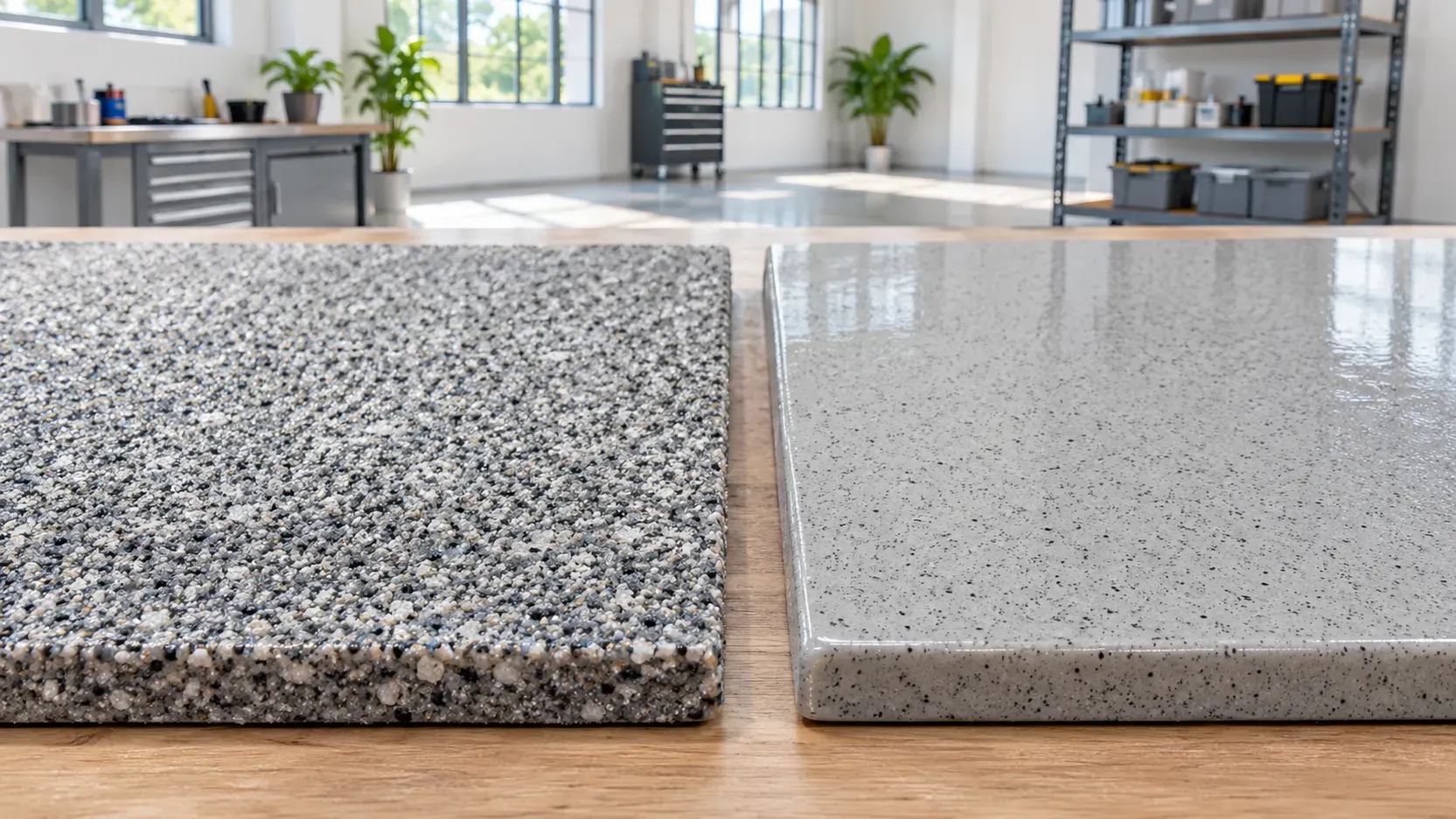
"Colored quartz epoxy" and "color sand epoxy" sound like two names for the same floor. They are not. In the US, "colored quartz epoxy" usually means a base coat with quartz aggregate broadcast over it in layers. JUKE's epoxy colored sand self-leveling is different: the colored quartz sand is pre-mixed into the epoxy and poured as a single self-leveling layer.
Both systems use colored quartz sand and produce a speckled decorative epoxy floor — but they are installed differently, feel different underfoot, and suit different jobs. This guide explains the difference, compares the two honestly, and shows how to tell which one a supplier is quoting.
The US meaning: double-broadcast quartz epoxy
In the US market, "colored quartz epoxy flooring" most often means a broadcast system: the quartz aggregate is not mixed into the resin but scattered by hand over a wet base coat. The usual sequence:
- Prepare the substrate — clean, repair, and prime as the system requires.
- Apply a base coat of epoxy resin.
- Broadcast quartz aggregate over the wet base coat, often to full saturation.
- Let it cure, then sweep off the excess quartz that did not bond.
- Repeat — many specifications call for a second broadcast layer.
- Apply a topcoat to seal the aggregate and set the final finish — matte, satin, or gloss.
The result is a floor with a pronounced granular texture: the quartz sits proud of the surface, giving strong slip resistance — one reason broadcast quartz is popular where grip matters, such as commercial kitchens and wet areas.
The trade-off is the process: every layer needs its own application, cure time, and cleanup, so a double-broadcast job means several site visits, more labor hours, and more chances for error between coats.
The JUKE meaning: premix color sand self-leveling
JUKE's epoxy colored sand self-leveling starts from the same raw materials — epoxy resin and colored quartz sand — but puts them together differently. The sand is pre-mixed into the resin at the factory. On site, the installer mixes A and B, pours the mixture onto the floor, spreads it, and lets it self-level. One pour, one layer, no broadcasting step.
The numbers for the JUKE system (TDS JK-TDS-EP01 Rev.02):
- Kit: 20 kg A+B set, A:B = 8:1 by weight
- Coverage: ~10 m² per set at 1.5–2.0 mm, ~2 kg/m²
- Mixing and working time: mix 2–3 minutes with a suitable electric mixer; working time ~20 minutes
- Solids: ~98%; VOC: 16 g/L
- Strength: compressive ≥80 MPa, hardness Mohs 8, tensile bond strength 6 MPa
- Curing: foot traffic ~48 hours, vehicle traffic ~72 hours
- Application window: 5–35 °C, humidity ≤85%, substrate moisture ≤8%
- Shelf life: 24 months unopened
The finish is smooth and glossy, with the colored sand visible as a fine speckle inside the surface rather than raised grains on top. The sand still adds slip resistance — colored sand is decorative and anti-slip — but the feel underfoot is smooth, not gritty, which suits showrooms, retail, offices, garages, and homes. JUKE offers 12 standard colors and can develop a custom exclusive color for a distributor's brand.
Installation is simpler too: the system applies directly over suitable existing tiles with no demolition and no primer on tiles; concrete must be primed with a sealing primer first. Small holes and cracks can be filled with the colored sand itself; large damaged areas need grinding and repair first. Our self-leveling epoxy flooring guide walks through the full application process.
Side by side
| Double-broadcast quartz epoxy | JUKE premix color sand self-leveling |
|---|---|---|
How the sand is applied | Broadcast by hand over a wet base coat, often twice | Pre-mixed into the epoxy; poured as one layer |
Application steps | Multiple: base coat, broadcast, cure, sweep, repeat, topcoat | One pour: mix, pour, spread, self-levels |
Surface finish | Textured, granular; quartz grains sit proud | Smooth, glossy; fine speckle inside the surface |
Feel underfoot | Gritty, high grip | Smooth with anti-slip from the sand |
Build | Layered; thickness built up coat by coat | Single layer, 1.5–2.0 mm |
Working time | Each coat has its own window; multi-step job | ~20 minutes per mix; one continuous pour |
Crew and time | More labor hours, several visits | Fewer steps, faster install |
Best for | Heavy texture and grip needs, thick layered builds | Smooth decorative floors, fast renovation over tiles |
Substrates | Prepared concrete and other sound substrates | Tiles (no primer), concrete (sealing primer), all solid substrates |
Application: one pour vs several steps
A broadcast job is a sequence: each coat must be applied, cured, and cleaned before the next step, and the site must stay clean and undisturbed between coats. The broadcast itself is a skill — an uneven scatter leaves thin patches, and excess aggregate has to be collected and removed. A double-broadcast floor needs an experienced crew and more days on site.
A premix pour is a single operation: mix A and B for 2–3 minutes, pour, spread, and the material self-levels. The working time is about 20 minutes per mix, so the crew works in sections — but there is no second visit for another layer and no loose aggregate to sweep up. The floor is back in use sooner: foot traffic after about 48 hours, vehicles after about 72 hours.
Finish and feel: textured vs smooth
Broadcast quartz feels granular — the aggregate stands proud of the resin, which is exactly what gives it grip in wet areas. It is the right texture where slip resistance is the priority, such as a commercial kitchen floor or a workshop.
Premix color sand feels smooth: the sand is inside the coating, not on top of it, so the surface is glossy and easy to sweep and mop. It still provides anti-slip performance, but it reads as a decorative finish first — showrooms, retail, offices, and homes are its natural home. For another common comparison, see our article on epoxy color sand vs epoxy flake.
Thickness and build
Broadcast systems build up layer by layer, so thickness depends on how many coats the specification calls for — suited to jobs where a thick, heavy-duty floor is wanted. JUKE's premix is a single layer at 1.5–2.0 mm (~2 kg/m²), a thin, hard decorative floor: that thickness carries the compressive strength (≥80 MPa) and the wear resistance. If a project needs a much thicker build, a layered system may fit better; if it needs a thin, smooth floor over existing tiles, premix is the direct answer. Our guide on when NOT to use epoxy color sand flooring covers the cases where a different system fits better.
Where each system fits best
Double-broadcast quartz epoxy fits best when:
- Maximum slip resistance is the priority — wet areas, commercial kitchens, ramps
- A thick, layered build is specified
- The budget and schedule allow a multi-step install
JUKE premix color sand self-leveling fits best when:
- A smooth, glossy decorative floor is wanted — showrooms, retail, offices, homes, garages
- The floor must go over existing tiles with no demolition
- A fast install with fewer steps matters — one pour, no broadcasting
Both systems need a sound, clean, level substrate and the right conditions — for JUKE, substrate moisture ≤8% and application at 5–35 °C. Outdoor use is possible with the JUKE system, but the color slowly fades in direct sun — for sun-exposed areas, ask the factory about a compatible anti-UV topcoat.
How to tell which system a quote is for
When a supplier quotes "colored quartz epoxy" or "color sand epoxy", ask these questions before you order:
- Is the sand pre-mixed or broadcast? The single most important question. Pre-mixed means one pour; broadcast means layers.
- How many application steps are there? One pour, or base coat plus broadcast plus topcoat?
- What is the finished thickness? A single-layer premix system is 1.5–2.0 mm; a broadcast quote should state its own build.
- What does the finished surface feel like? Smooth and glossy, or granular and textured?
- What does the TDS say? A serious supplier provides test numbers — compressive strength, hardness, bond strength, solids, VOC. Ask for the TDS and check the numbers.
- What is the working time and cure schedule? A premix pour has one working window (~20 minutes for JUKE); a broadcast job has a cure schedule per layer.
- What is the minimum order, and can colors be mixed on one pallet? JUKE's MOQ is 48 sets — one pallet — with mixed colors allowed. A 20 ft high-cube container holds 880 sets.
If the supplier cannot answer the first question clearly, be careful: the two systems are easy to confuse in words and impossible to confuse on site. Buy from an epoxy flooring manufacturer in China that publishes full test data — and test before you commit. JUKE provides a free 1 kg sample (the customer pays the courier freight) so you can check coverage, working time, cure, color, and finish on your own substrate.
Resin flooring covers several systems beyond these two — our resin flooring guide explains the main types. And how long the floor lasts depends on preparation, thickness, traffic, and care — our guide on how long does epoxy flooring last explains what decides it.
FAQ
Is colored quartz epoxy the same as color sand epoxy flooring?
Not necessarily. In the US, "colored quartz epoxy" usually means a double-broadcast system — quartz scattered over a base coat in layers. JUKE's epoxy colored sand self-leveling is a premix system: sand mixed into the epoxy, poured as one layer. Same raw materials, different process, different finish. Always ask whether the sand is pre-mixed or broadcast.
Which is easier to install?
Premix: one pour, one layer, no broadcasting step, and the material self-levels. A double-broadcast floor needs a base coat, one or two broadcast layers with curing and sweeping between them, and a topcoat — more steps, more labor, more time on site.
Which one is more slip-resistant?
Broadcast quartz grips harder because the aggregate stands proud of the surface. Premix color sand is also anti-slip, but the surface is smooth, so it suits spaces where easy cleaning matters as much as grip.
Can I apply premix color sand over existing tiles?
Yes — directly over suitable existing tiles, with no demolition and no primer on tiles; concrete must be primed with a sealing primer first. Small holes and cracks can be filled with the colored sand itself; large damaged areas need grinding and repair first.
Next step
If you are choosing between broadcast quartz and premix color sand, start with the job, not the name: how much grip the floor needs, how smooth it should feel, how fast it must be installed, and what it is going over. Then ask the supplier the questions above, and test a sample before you commit. When you are ready, request a factory quote — and tell us your area, substrate, and use, so the quote and the advice are exact.