
Sep 4, 2026Epoxy Color Sand
Epoxy Color Sand vs. Standard Epoxy Floor Coating
Compare epoxy color sand flooring with standard epoxy coatings, including composition, appearance, tile renovation, thickness, application, and buyer considerations.
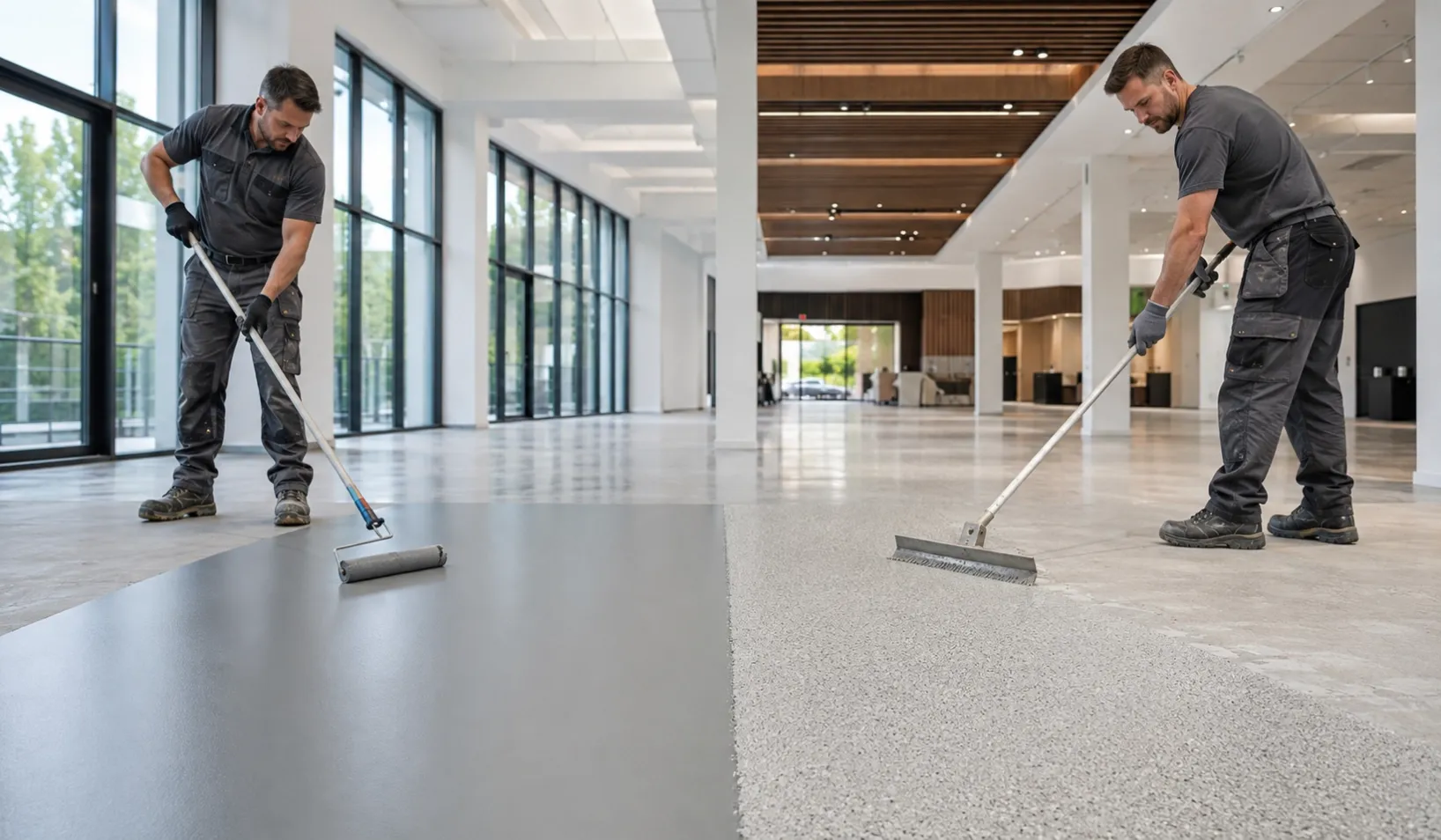
Epoxy Color Sand vs. Standard Epoxy Floor Coating
Epoxy color sand flooring and standard epoxy floor coatings both use epoxy chemistry, but they are not the same type of finished floor.
A conventional epoxy coating is commonly selected to create a solid-color protective surface. Epoxy color sand combines resin with colored mineral particles and fillers to produce a thicker-looking, textured, stone-inspired finish.
The better choice depends on the substrate, appearance, application, and budget. Buyers should compare complete systems rather than assume every “epoxy flooring” product is the same.
Quick Comparison
Comparison | Epoxy Color Sand Flooring | Standard Epoxy Floor Coating |
|---|---|---|
Main appearance | Mineral, speckled, or marble-inspired | Usually uniform solid color |
Material structure | Resin, colored sand, mineral fillers, and curing agent | Resin system with pigments and curing agent; formulation varies |
Finished surface | Seamless decorative mineral finish | Seamless coating finish |
Application style | Mix, pour, spread, and self-level | Commonly rolled, squeegeed, or troweled depending on the system |
Direct application over suitable tiles | Designed for this renovation use | Compatibility depends on the specific product system |
Separate primer over suitable dense tiles | Not required for the JUKE system | Often depends on the coating and substrate |
Decorative variation | Visible colored mineral character | Usually relies on pigment, flakes, or another decorative layer |
Best positioning | Decorative renovation plus protective performance | Functional coating, solid-color finish, or system-specific protection |
This comparison is general. Standard epoxy coatings vary widely in resin content, solids, thickness, preparation requirements, and performance.
What Is Epoxy Color Sand Flooring?
Epoxy color sand is a two-component mineral-resin flooring material.
JUKE Part A contains epoxy resin, specially selected colored sand, silica, mineral fillers, and other formulation components. Part B is a specialized curing agent. The components are supplied in factory-matched quantities and are combined before application.
After mixing, the material is spread over a suitable prepared substrate. The resin cures around the colored sand and mineral particles, creating a hard, continuous surface with a natural mineral appearance.
The visible character comes from the filled formulation rather than loose sand scattered onto the surface.
What Is a Standard Epoxy Floor Coating?
A standard epoxy floor coating normally combines an epoxy resin component with a curing agent. Pigments may be added to create a uniform color, while fillers or additives can modify viscosity, texture, gloss, curing, or mechanical performance.
Application methods vary. Some systems are applied with rollers, others with squeegees or trowels, and multi-layer systems may include primer, basecoat, decorative flakes, aggregates, or topcoat.
It is not accurate to assign one thickness, coverage rate, or durability level to every standard epoxy coating. Compare the TDS for each product.
Difference 1: Material Composition
The most important difference is the mineral content and how it is incorporated.
In epoxy color sand, decorative colored sand and mineral fillers are part of the factory-produced Part A compound. They contribute to appearance, material body, spreading behavior, and the structure of the cured layer.
A standard epoxy coating may be primarily designed to deliver pigment and protective resin across the surface. It may contain fillers, but it does not automatically create the same colored-mineral appearance.
Adding construction sand to ordinary epoxy paint does not convert it into a professionally formulated epoxy color sand system. Uncontrolled additions can affect mixing, flow, curing, color distribution, strength, and final appearance.
Difference 2: Appearance
Standard epoxy coatings commonly create a smooth, uniform, solid-color floor. They can be practical for factories, warehouses, garages, utility rooms, and other spaces where a clean functional appearance is the priority.
Epoxy color sand creates a more decorative finish. Its distributed mineral particles can produce a softly speckled, stone-inspired, or marble-like visual effect.
This makes it attractive for showrooms, shops, offices, hotels, kitchens, bathrooms, and other design-focused interiors.
Appearance still depends on color selection, lighting, application quality, thickness, and batch consistency. Customers should approve a cured physical sample before a large project.
Difference 3: Direct-to-Tile Renovation
JUKE Epoxy Color Sand Self-Leveling is designed to cover suitable existing tile floors without complete demolition.
The tiles must be firmly bonded, stable, clean, dry, and properly prepared. Loose tiles, active cracks, deep joints, oil, wax, and major unevenness must be corrected first.
On suitable dense, non-porous tiles, the JUKE system can be applied without a separate primer. This helps simplify renovation while retaining the sound tiled substrate.
Whether a standard epoxy coating can be applied directly over tiles depends on its formulation, preparation requirements, primer system, and manufacturer instructions. “Epoxy” alone does not guarantee direct-to-tile compatibility.
Difference 4: Thickness and Coverage
The current recommended JUKE application thickness is 1.0–2.0 mm, with an allowable deviation of ±0.2 mm. A 20 kg set covers approximately 10 m² under normal conditions.
Practical coverage can change with floor flatness, tile-joint depth, surface profile, selected thickness, and application loss.
Standard epoxy floor coatings are available in thin-film and higher-build systems. Their thickness and coverage should be taken from the relevant manufacturer’s TDS rather than estimated from the product name.
Price per kilogram is therefore not a complete comparison. Buyers should calculate the material required per square metre at the specified system thickness.
Difference 5: Application
The JUKE system follows a Mix–Pour–Spread process:
- Inspect and prepare the substrate.
- Combine the complete factory-matched Part A and Part B.
- Mix mechanically until uniform.
- Pour and distribute the material.
- Spread it with a suitable notched trowel or long-handled tool.
- Allow the material to self-level and cure.
Self-leveling does not eliminate spreading. Installers must distribute the material evenly while remaining on the uncoated area.
Application of a standard coating depends on its system design. It may require a primer, multiple coats, broadcast material, sanding between layers, or a protective topcoat. Another product may use a simpler roller-applied process. Its complete method must be checked before comparing labor or project time.
Which System Is Better for Your Project?
Epoxy color sand may be the better choice when:
- A decorative mineral appearance is required
- Existing tiles are suitable for direct renovation
- Complete demolition should be avoided
- A continuous surface without exposed grout lines is preferred
- The customer wants a differentiated alternative to ordinary epoxy paint
- The project needs a factory-premixed colored-sand system
A standard epoxy coating may be the better choice when:
- A simple solid-color finish is preferred
- The specified coating already matches the service environment
- Decorative mineral texture is not required
- The project uses an established multi-layer epoxy specification
- The priority is a conventional functional coating system
Selection should be based on the substrate, expected traffic, exposure, appearance, installation capability, and documented technical performance.
What Distributors Should Compare
Distributors should confirm whether the colored sand is factory premixed, whether Part A and Part B are supplied in matched quantities, the approved thickness and coverage, direct-to-tile compatibility, primer requirements, technical documents, samples, OEM packaging, and marketing support. These questions compare complete commercial systems rather than similar product names.
Frequently Asked Questions
Is epoxy color sand just epoxy paint mixed with sand?
No. It is a factory-formulated system in which the resin, colored sand, mineral fillers, and curing agent are designed to work together.
Are both systems seamless?
They can both create continuous surfaces, but epoxy color sand provides a different mineral appearance and material structure.
Does epoxy color sand require a primer over tiles?
No separate primer is required on suitable dense, non-porous tiles after correct preparation.
Which system is more durable?
Durability depends on the exact formulation, substrate, thickness, application, curing, traffic, and exposure. Product-specific test data should be compared rather than relying only on the category name.
Final Comparison
Standard epoxy floor coating remains useful when a uniform, functional, and specification-based coating is required. Epoxy color sand is better positioned when customers want a seamless mineral appearance combined with direct-to-tile, zero-demolition renovation.
For flooring distributors, decorative concrete suppliers, tile suppliers, wholesalers, and e-commerce sellers, JUKE also provides factory-direct supply, OEM packaging, marketing materials, application support, and trial orders starting from 36 sets.