
Oct 5, 2026B2B & Sourcing
Epoxy Color Sand Flooring for Tile Retailers and Distributors
Epoxy Color Sand Flooring for Tile Retailers and Distributors
Tile retailers and distributors can add epoxy color sand flooring to serve customers who want to renovate suitable existing tiled floors without removing them. JUKE Epoxy Colored Sand Self-Leveling Flooring applies directly over firmly bonded, clean, dry tiles, generally without grinding or primer, and creates a continuous decorative surface.
For businesses already selling tiles and renovation materials, this provides another option to discuss with customers. JUKE offers factory-direct supply, OEM options, marketing support, and a minimum order quantity of 36 sets.
Which Customer Enquiries Does It Address?
Some renovation customers want a new appearance even though their existing tiles remain sound. They may dislike the color, the joint pattern, or the way the floor fits a redesigned room.
Others are concerned about the disruption involved in tile removal. Demolition introduces debris, handling, and additional work before a replacement floor can be installed.
An overlay gives the retailer another way to respond when the existing base is suitable. The discussion starts with the condition of the floor and the customer’s preferred finish.
This is particularly relevant to a showroom that already receives renovation enquiries. Staff can ask about the existing surface and explain when keeping the tiles in place is possible.
Explain the Product in Familiar Terms
A clear explanation helps customers understand how the system differs from buying new tiles.
JUKE is a two-component epoxy colored sand flooring system. The installer mixes the factory-proportioned Part A and Part B, pours the material onto the prepared floor, spreads it with a suitable notched trowel, and allows it to self-level.
The result is a decorative surface with colored quartz texture and a continuous finish.
A standard 20 kg set covers approximately 10 m² under normal application conditions. Actual consumption depends on the floor’s flatness, application technique, and material loss.
Keep the Substrate Requirements Clear
The direct-to-tile benefit depends on the existing floor being suitable.
Tiles must be firmly bonded, stable, clean, and dry. Loose, cracked, or damaged areas require attention before application. Grease, wax, dust, and other contamination must be removed.
Recessed joints and surface defects may also need filling or leveling to achieve a consistent base.
Suitable tiled floors generally need neither grinding nor primer. Concrete requires a compatible primer, and uneven or damaged concrete should be repaired and leveled first.
These distinctions belong in sales conversations, product sheets, and installation instructions. They help customers assess their project before purchasing.
Give Customers a Useful Comparison
Customers deciding between an overlay and tile replacement need to understand the practical differences.
Consideration | Epoxy color sand over suitable tiles | Tile replacement |
|---|---|---|
Existing tiles | Retained as the base | Removed when the replacement method requires it |
Appearance | Continuous decorative colored-sand finish | Individual tiles with joints |
Preparation | Inspection, cleaning, and necessary repairs | Removal and preparation for new installation |
Material planning | Based on approximate consumption and area | Based on tile dimensions, layout, and waste |
Key suitability question | Is the existing floor stable and suitable? | Is the base ready for the selected tile system? |
Avoid promising a fixed saving without reviewing the project. Preparation, labor, access, and curing arrangements all affect the renovation plan.
The useful selling point is the option to retain a suitable tiled base while changing its appearance.
Build a Display That Answers Real Questions
A showroom display should help customers understand both the finish and the application.
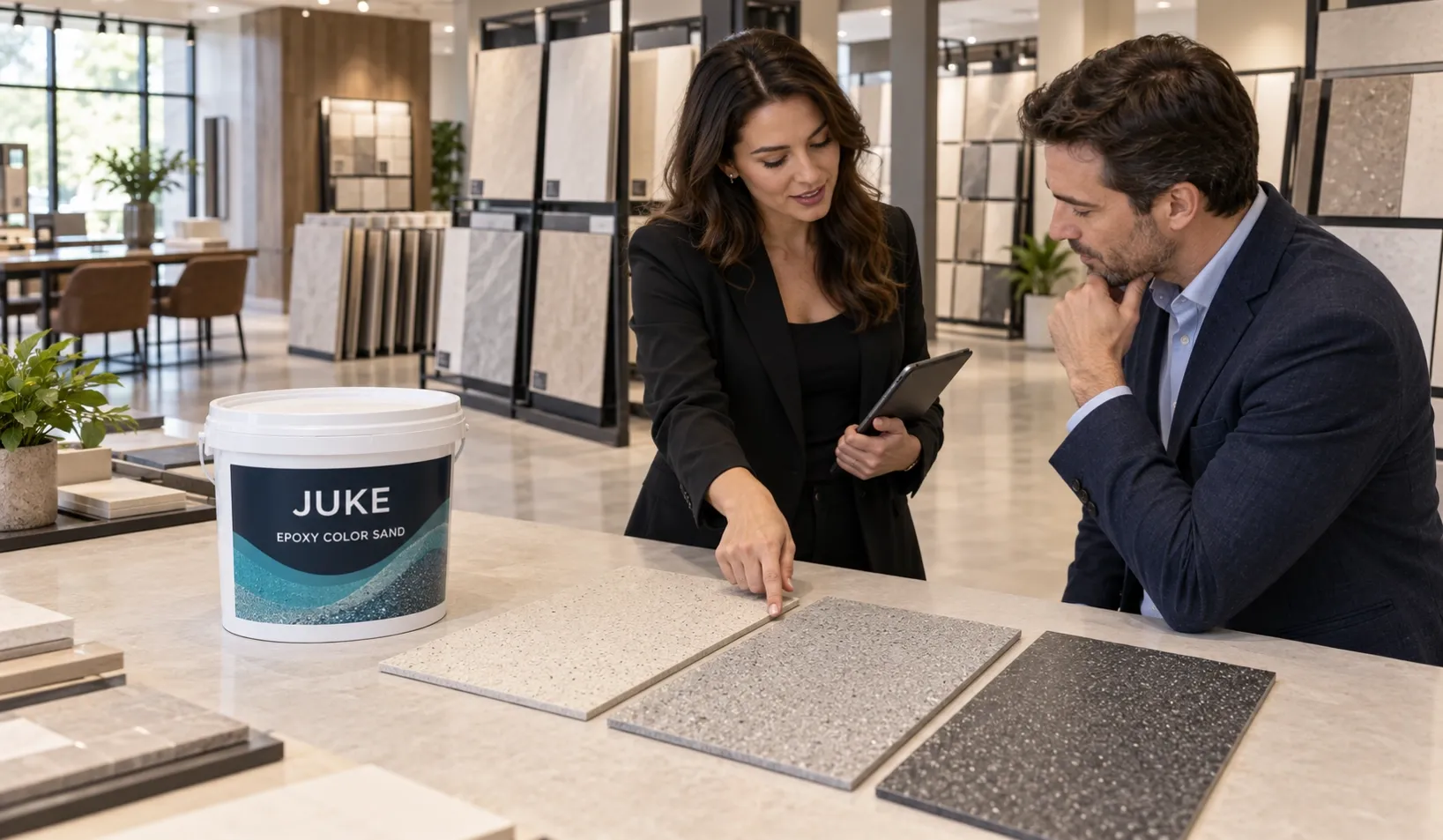
Include cured sample boards in a focused selection of colors. Let customers view them under the showroom lighting and inspect the texture closely.
Pair the samples with a short application video showing mixing, pouring, spreading, and the finished surface. Add a concise explanation of suitable substrates and preparation.
Staff should be ready to answer four questions:
- Can it go over my existing tiles?
- What preparation is needed?
- How many sets will the project require?
- When can the floor return to use?
Use current technical guidance for the answers. Keep coverage and curing information qualified by actual application conditions.
Prepare Your Team Before Launch
Sales staff need enough product knowledge to identify suitable enquiries and pass technical questions to the right person.
Start with a short internal briefing covering substrate suitability, mixing, approximate coverage, tools, and curing protection. Include common issues such as loose tiles, deep joints, and uneven floors.
Arrange an application trial where possible. Seeing the material mixed and spread helps staff explain the process more accurately than watching a finished-floor video alone.
Decide who will handle installation enquiries. If you work with local contractors, share the technical documents and application instructions before referring customers.
A clear support process helps the retailer introduce the product with consistent information.
Plan a Focused First Order
JUKE’s MOQ is one pallet of 36 sets, and mixed colors can be agreed within the order.
Choose the initial range around your customers’ preferences and the samples you plan to display. Avoid carrying too many colors before you have enquiry and sales feedback.
Allocate material for demonstrations separately from stock intended for sale. Confirm the packaging, quantities by color, delivery terms, and receiving arrangements before ordering.
Review the current TDS, SDS, and application instructions alongside the commercial quotation.
Factory-direct supply allows you to discuss these details with JUKE before production. OEM options can also support retailers developing their own branded offer.
See Private Label Epoxy Color Sand Flooring: A Buyer’s Guide for branding and sourcing considerations.
Frequently Asked Questions
Do tile retailers need to provide installation?
They can sell materials, offer installation, or work with local installers. Whichever model you choose, customers need clear preparation and application instructions.
Is primer needed over existing tiles?
Suitable firmly bonded, clean, dry tiles generally need no primer. Concrete floors require a compatible primer.
Can the product hide damaged tiles?
Damage and instability must be addressed before coating. The decorative layer should not be used to stabilize an unsuitable floor.
How much stock is required to start?
JUKE’s minimum order is 36 sets. Each standard 20 kg set covers approximately 10 m², subject to application conditions.
Discuss a Renovation Product Line With JUKE
Epoxy color sand gives tile retailers and distributors an additional response to renovation enquiries involving suitable existing floors. Start with sample evaluation, a clear display, trained staff, and a focused stock plan.
JUKE provides factory-direct supply, OEM options, marketing support, and a low MOQ of 36 sets.