
Oct 10, 2026B2B & Sourcing
How to Compare Bulk Epoxy Floor Coating Quotes: A Distributor’s Checklist
Compare bulk epoxy floor coating quotes by system contents, coverage, substrate requirements, packaging, shipping terms and supplier support before placing a wholesale order.
How to Compare Bulk Epoxy Floor Coating Quotes: A Distributor’s Checklist
To compare bulk epoxy floor coating quotes, check the complete system, usable coverage, preparation requirements and delivery costs—not just the price per bucket. For wholesalers and distributors, a useful comparison must also include packaging, order quantities, technical documents and support for resale.
Two suppliers may quote similar-looking products with different components, application methods and coverage assumptions. A lower bucket price can become a higher purchasing cost when hardener, decorative aggregate or other required materials are supplied separately.
Use the following checklist to compare offers before committing to inventory.
1. Confirm What Each Quoted Set Contains
Start with a written description of the product and everything included in the quoted price.
“Epoxy flooring” can describe a thin coating, a self-leveling system, a decorative quartz finish or a flake flooring system. These products should not be compared as if they were interchangeable.
Ask each supplier to identify:
- The resin and hardener included in each set.
- Whether decorative sand or flakes are included.
- Whether aggregates are premixed or separately packed.
- Any required primer or topcoat.
- The combined net weight of all components.
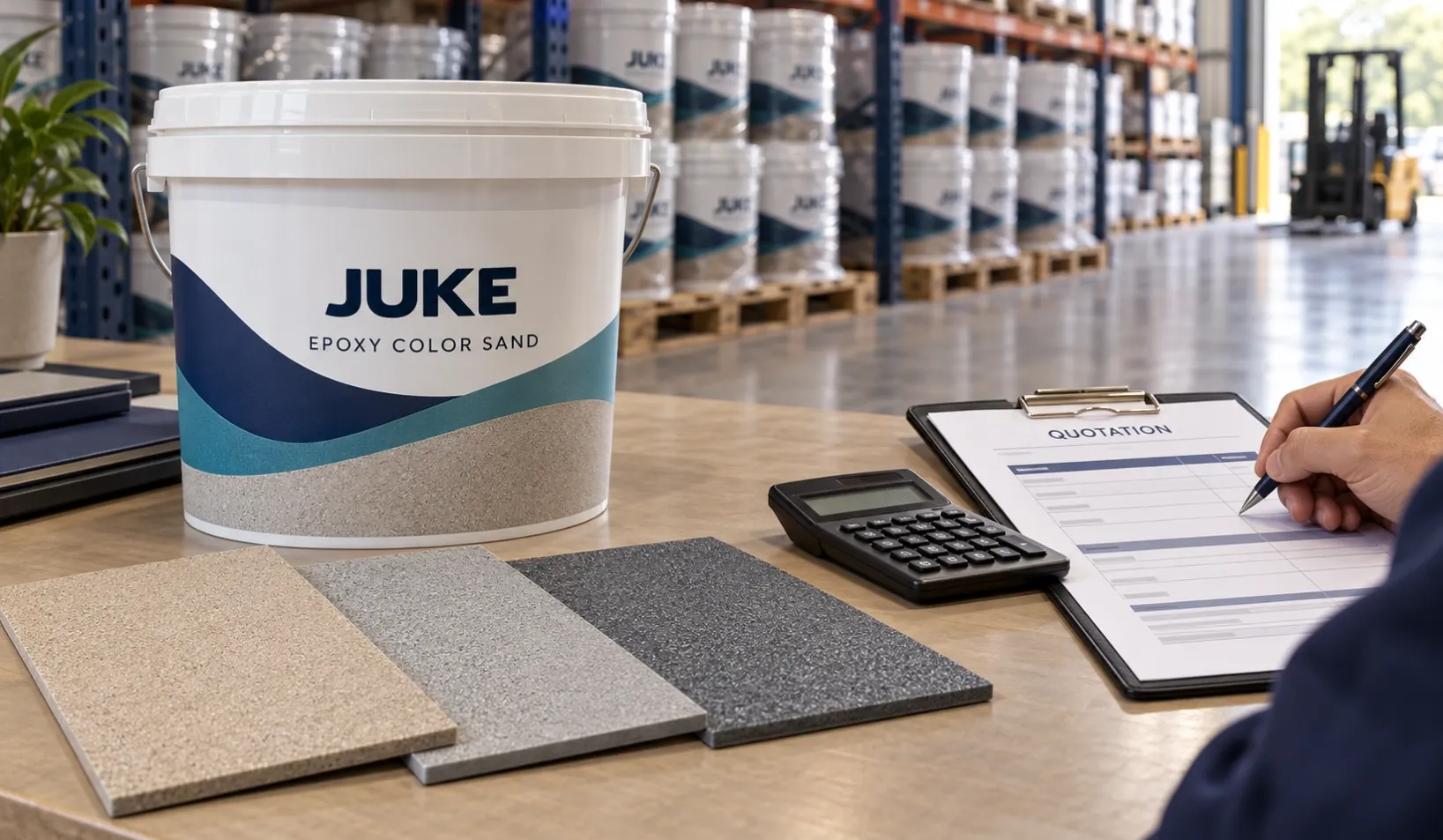
JUKE Epoxy Colored Sand Self-Leveling Flooring is supplied as a matched Part A and Part B system. The colored sand is incorporated into the formulation, so installers combine the supplied components without purchasing and adding separate decorative sand.
Confirm that a quoted “20 kg set” means the complete system weight, rather than 20 kg of resin with hardener priced separately.
2. Compare Material Cost per Square Metre
Bucket prices become more useful when converted into coverage at the recommended application rate.
A practical calculation is:
Material cost per m² = complete set price ÷ expected coverage per set
JUKE’s standard 20 kg set covers approximately 10 m² at a typical consumption of approximately 2 kg/m². Actual coverage depends on substrate condition, flatness, application technique and material loss.
For an illustrative comparison:
Quotation detail | Offer A | Offer B |
|---|---|---|
Complete set price | $60 | $80 |
Expected coverage | 6 m² | 10 m² |
Material cost per m² | $10 | $8 |
These figures are examples, not JUKE prices or competitor quotations.
Offer B has the higher set price but the lower material cost per square metre. However, the comparison is only meaningful if both systems meet the intended finish, thickness and service requirements.
3. Check Preparation and Additional Material Requirements
A coating quotation does not always include everything needed to complete the floor.
Ask suppliers to explain their requirements for existing tiles and concrete separately. This helps your sales team provide accurate advice and identify additional products customers may need.
For JUKE:
- Suitable existing tiles: Firmly bonded, stable, clean and dry tiles can normally be coated directly without demolition, grinding or primer.
- Concrete: Mechanical preparation and a compatible epoxy primer are required before applying the colored sand system.
- Damaged or uneven floors: Cracks, holes and unsuitable areas must be assessed and repaired first.
Self-leveling does not eliminate the need to repair substrate defects.
No additional topcoat is normally required for standard indoor JUKE applications. Other systems may require one, so confirm this before comparing total material costs.
4. Compare MOQ, Color Mix and Packaging
For distributors, the minimum order quantity affects both purchasing cost and inventory exposure.
A low unit price may be less attractive if it requires more stock than your business can reasonably sell. Check whether the minimum applies to the total order, each color or each packaging design.
JUKE’s minimum order is one pallet of 36 sets, with mixed colors available. Confirm your color allocation before ordering so the first shipment supports your customers’ likely requirements.
Also check:
- Net and gross weight per set.
- Pallet dimensions and gross weight.
- How Part A and Part B are identified and kept together.
- Batch identification and manufacturing dates.
- Label language and application instructions.
- Any separate charges for custom labels.
If you plan to sell online, confirm the packed dimensions and shipping weight of individual sets as well as the pallet specifications.
5. Put Delivery Costs on the Same Basis
Two wholesale epoxy floor coating quotations may use different delivery terms. One may cover collection from the factory, while another includes transport to a named port.
Ask each supplier to specify the trade term, named location and included charges. Then ask your freight forwarder to identify the remaining costs.
Your comparison should account for:
- Product and packaging charges.
- Origin handling and freight.
- Insurance where applicable.
- Destination handling and customs clearance.
- Duties, taxes and delivery to your warehouse.
Do not assume that a quotation including ocean freight also includes destination charges or local delivery.
Compare the estimated cost of stock arriving at your warehouse, using the same destination and shipment assumptions for every offer.
6. Review Documents and Resale Support
A supplier’s technical and commercial support affects how confidently you can sell the product.
Request the current Technical Data Sheet, Safety Data Sheet and application instructions. Check that the documents correspond to the exact product being quoted.
The SDS describes safety and handling information; it is not a substitute for a performance test report or product certification.
For OEM orders, also confirm the responsibilities for label artwork, technical wording and brand presentation.
JUKE offers factory-direct supply, custom labels and marketing support. Before ordering, agree on the materials your team needs, such as product photographs, application videos, color references and sales training.
Frequently Asked Questions
Is the lowest price per kilogram the best wholesale offer?
Not necessarily. Compare complete system cost, coverage, required additional materials and delivery costs. Products with different application rates or system requirements may have very different costs per finished square metre.
Should samples match the bulk order?
Samples should represent the formulation and finish you intend to purchase. Record the product reference and color, and confirm the bulk order specification in writing after evaluation.
What should distributors confirm before paying?
Confirm the product specification, quantity, color allocation, packaging, delivery terms, payment terms and agreed dispatch schedule. Keep the approved quotation and order documents together.
Request a Quote You Can Compare
A clear quotation makes purchasing decisions easier and helps your team explain the product accurately.
JUKE supplies a self-leveling, zero-demolition decorative flooring system for suitable existing tiles, with factory-direct supply, OEM options and a 36-set minimum order.
Contact JUKE to request a wholesale quotation, technical documents and packaging details for your distribution business.