
Aug 25, 2026Company News
How JUKE Manufactures Epoxy Colored Sand Flooring Systems
See how JUKE controls formulation, Part A and Part B matching, quality checks, packaging, and OEM support for epoxy colored sand flooring systems.
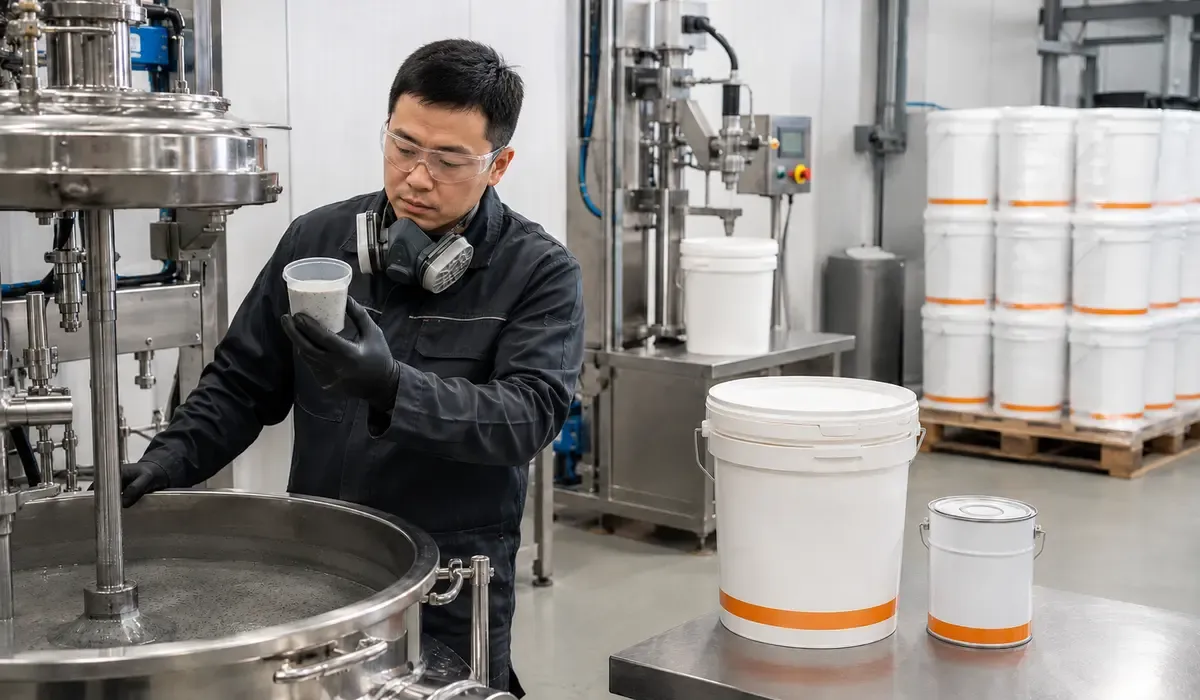
How JUKE Manufactures Epoxy Colored Sand Flooring Systems
Reliable epoxy flooring begins before the product reaches the project site. Manufacturing must control raw materials, formulation, mixing consistency, Part A and Part B matching, filling, packaging, and technical documentation.
JUKE manufactures two-component epoxy colored sand flooring systems for distributors, wholesalers, project suppliers, and private-label brands. Each complete set contains factory-matched Part A and Part B components, allowing the customer to mix the supplied units without measuring separate materials on site.
What Is Manufactured in an Epoxy Colored Sand System?
JUKE Epoxy Colored Sand Self-Leveling is a two-component flooring material.
Part A contains the colored sand matrix, including epoxy resin, mineral materials, silica, fillers, and decorative colored sand. Part B is the curing component that initiates the chemical reaction after mixing.
The manufacturing process must produce a material that:
- Mixes uniformly
- Maintains consistent color and texture
- Spreads with the required working consistency
- Self-levels after application
- Cures within the specified time
- Forms a seamless decorative surface
- Meets the published physical performance requirements
Consistency is especially important for distributors because different sets may be used on the same project.
Step 1: Raw Material Selection and Control
The finished flooring system depends on the consistency of its raw materials.
Core materials used in the formulation include:
- Epoxy resin
- Silica
- Special colored sand
- Mineral fillers
- Formulation additives
- Curing agent
Raw material variation can affect color, viscosity, working time, leveling, and final surface performance. Production control therefore begins with identifying and managing the materials used in each formulation.
For OEM colors, a physical sample should be confirmed before bulk production. Screen images and digital color references alone are not sufficient for final approval.
Step 2: Controlled Part A Formulation
Part A combines the resin system with colored sand and mineral materials.
The materials must be blended sufficiently to create a uniform mixture. Poor dispersion could result in:
- Uneven color
- Inconsistent decorative texture
- Localized filler concentration
- Different spreading behavior
- Visible variation after curing
The finished Part A should have a uniform appearance and suitable fluidity for mixing and application.
The JUKE 2026 Technical Data Sheet describes the combined material after mixing as a uniform fluid with a light-gray appearance for the standard tested version.
Step 3: Matching Part A and Part B
Correct component proportion is essential for epoxy curing.
The JUKE TDS specifies a Part A to Part B mixing ratio of 8:1 by weight. During packaging, the two components are supplied in the corresponding factory-prepared quantities.
This means customers using the complete supplied set do not need to weigh out an 8:1 ratio themselves. They combine the full Part A and Part B components and mix thoroughly.
Users should not divide a set without accurate weighing equipment or change the supplied proportion. Incorrect proportioning can affect curing, hardness, appearance, and overall performance.
Step 4: Filling and Set Matching
After formulation, Part A and Part B are filled as one matched product set.
The packaging process must ensure that:
- Part A and Part B remain separate before use
- The correct components are supplied together
- Containers are properly closed
- Product identification remains clear
- Packaging is suitable for storage and pallet transport
- Application information is available to the buyer
A standard 24 kg set covers approximately 12 square meters at the recommended application thickness of approximately 1.0–2.0 mm.
Coverage is approximate because substrate roughness, flatness, application thickness, and material loss can affect consumption.
Step 5: Checking Product Consistency
Quality control should focus on the characteristics that affect both application and final performance.
Production checks can include:
- Component appearance
- Color consistency
- Mixture uniformity
- Density
- Working consistency
- Packaging quantity
- Container sealing
- Product identification
The published JUKE Technical Data Sheet provides the reference specifications and test results used to explain the product’s performance.
These include:
- Density: 1.64–1.72 g/cm³
- Solid content: approximately 98%
- VOC content: 16 g/L
- Surface dry time: 4–6 hours
- Hard dry time: 24 hours
- Pot life: approximately 50 minutes
- Mohs hardness: Level 8
- Compressive strength: ≥80 MPa
- Water impermeability: watertight at 0.4 MPa for 2 hours
- Heat resistance: no flowing or bubbling below 80°C
- Low-temperature flexibility: no cracking at −20°C
Technical values should be communicated exactly as stated in the current TDS rather than increased for marketing purposes.
What Does Mohs Hardness 8 Mean?
The JUKE TDS records a Mohs hardness result of Level 8.
Mohs hardness is related to resistance to surface scratching by harder materials. It should not be presented as a guarantee that the floor can never be scratched or damaged.
Claims such as “Mohs 8+,” “scratch-proof,” or “resistant to every impact” go beyond the documented specification and should be avoided.
The correct expression is:
Mohs hardness: Level 8, according to the JUKE 2026 TDS.
Packaging for Wholesale Supply
JUKE supplies the flooring system in matched Part A and Part B sets.
For wholesale buyers:
- Standard set size: 24 kg
- Approximate coverage: 12㎡ per set
- Wholesale MOQ: one pallet
- Pallet quantity: 36 sets
- Supply model: factory direct
- OEM and private-label options: available
Actual freight requirements depend on order quantity, destination, carrier, packaging configuration, and import procedures.
The JUKE Safety Data Sheet states that the tested sample is not regulated as dangerous goods for transport under IMDG Code 41-24. Buyers should still confirm local carrier and destination requirements before shipment.
OEM and Private-Label Production
Distributors may need more than a standard factory product. Packaging, colors, sales materials, and market positioning can affect how successfully the system is introduced locally.
JUKE can support qualified partners with:
- Private-label packaging
- Custom logos and labels
- Selected color customization
- Pantone-based color development
- Product images
- Application videos
- Technical documents
- Marketing content
- Application guidance
The low starting MOQ of 36 sets allows a distributor to test the market before moving to larger-volume orders.
Read Marble-Look Epoxy Flooring: A Product Opportunity for Retailers for guidance on building a practical color and sample range.
Why Technical Documents Matter
A flooring supplier should be able to provide more than marketing claims.
Before purchasing, distributors should review:
- Technical Data Sheet
- Safety Data Sheet
- Application instructions
- Substrate requirements
- Mixing procedure
- Coverage information
- Curing requirements
- Storage conditions
- Available packaging and OEM options
The TDS explains performance and application requirements. The SDS provides handling, safety, storage, and transport information.
These documents help distributors train their sales teams and answer customer questions consistently.
How Buyers Can Evaluate a Factory Supplier
Before placing a wholesale order, buyers should:
- Review the current TDS and SDS.
- Request a sample.
- Mix and apply the sample on a suitable substrate.
- Check color, texture, leveling, and curing.
- Confirm package size and coverage.
- Review OEM artwork and labeling.
- Confirm pallet quantity and shipping terms.
- Request application and marketing materials.
Testing the actual material is more useful than relying only on product photos or promotional language.
JUKE Manufacturing FAQ
Is JUKE a manufacturer or trading company?
JUKE supplies epoxy colored sand flooring systems directly from the manufacturing source and supports factory-direct wholesale and OEM orders.
Do customers need to measure the 8:1 ratio?
When using a complete JUKE set, no separate weighing is required. Part A and Part B are supplied in the correct matched quantities and should be mixed completely.
Does every set require a primer?
No separate primer is required when the substrate is suitable and correctly prepared.
What is the correct Mohs hardness claim?
The JUKE 2026 TDS states Mohs hardness Level 8. It should not be changed to “8+” or described as completely scratch-proof.
What is the wholesale MOQ?
The starting MOQ is one pallet containing 36 sets.
Does JUKE support private labeling?
Yes. OEM support can include labels, packaging, selected colors, technical information, and marketing materials.
Request Factory and OEM Information
Distributors and wholesale buyers can request:
- Product samples
- Factory-direct pricing
- TDS and SDS documents
- Available colors
- OEM packaging options
- Application videos
- Marketing materials
- Shipping information