
Aug 25, 2026Applications
How to Resurface a Concrete Garage Floor Without Demolition
Learn how to resurface a sound concrete garage floor without demolition using JUKE self-leveling epoxy colored sand, from inspection and repair to curing.
How to Resurface a Concrete Garage Floor Without Demolition
A sound concrete garage floor can usually be resurfaced without removing or rebuilding the existing slab. The floor must first be inspected, repaired, ground, cleaned, and confirmed to be sufficiently dry.
JUKE Epoxy Colored Sand Self-Leveling can then be applied directly over the prepared concrete without a separate primer, creating a seamless decorative surface. Weak concrete, active cracks, excessive moisture, and unresolved oil contamination must be corrected before application.
Can a Stained or Cracked Garage Floor Be Resurfaced?
Surface stains, minor cracks, and ordinary wear do not always mean the entire concrete floor must be demolished.
Resurfacing may be possible when:
- The concrete slab is structurally stable
- The concrete strength is at least C20
- Cracks are inactive and can be properly repaired
- The substrate moisture content does not exceed 8%
- Oil, grease, wax, and other contamination can be removed
- The surface is sufficiently flat
- There are no serious moisture or movement problems
Active cracks, severe spalling, weak concrete, or continuing moisture problems require further assessment and corrective work.
The coating should never be used to hide an unresolved substrate defect.
Why Resurface Instead of Replacing the Concrete?
Removing a concrete garage floor can involve breaking the existing slab, transporting heavy debris, rebuilding the substrate, and waiting for the replacement concrete to become ready.
When the existing concrete is still sound, resurfacing avoids unnecessary structural removal and focuses on repairing and preparing the surface already in place.
Potential advantages include:
- Less demolition work
- Less construction debris
- No separate primer
- Seamless finished surface
- Decorative marble-like appearance
- Easier cleaning than damaged or porous concrete
- A defined mix, pour, and spread application process
The condition of the existing floor—not its appearance alone—determines whether resurfacing is appropriate.
Step 1: Inspect the Concrete Substrate
Begin by checking the entire garage floor.
Look for:
- Structural or active cracks
- Loose or powdering concrete
- Spalled sections
- Low and uneven areas
- Oil or chemical contamination
- Water penetration
- Excessive substrate moisture
- Existing coatings that are peeling or poorly bonded
According to the JUKE 2026 Technical Data Sheet, concrete strength should be at least C20 and substrate moisture content should be no more than 8%.
If the source of cracking or moisture is unknown, it should be investigated before coating.
Step 2: Repair Cracks and Damaged Areas
Cracks, holes, and damaged sections should be repaired with a suitable epoxy mortar or compatible repair material.
Low areas may also require leveling before the decorative flooring system is installed. The prepared surface should be stable and sufficiently flat because major substrate defects can remain visible through the finished layer.
Existing loose coatings must be removed. A new system should not be applied over a weak or peeling layer.
Step 3: Remove Oil and Contamination
Garage floors frequently contain oil, grease, tire residue, wax, cleaning chemicals, and other contaminants.
These materials can interfere with adhesion and must be removed before application. Cleaning only the visible surface may not be sufficient when oil has penetrated deeply into the concrete.
The floor should be evaluated again after cleaning. Areas that remain contaminated may require additional mechanical preparation or repair.
Step 4: Grind and Clean the Floor
The concrete must be mechanically ground to remove weak surface material, improve surface consistency, and create a suitable profile.
After grinding:
- Remove all dust
- Vacuum the surface thoroughly
- Remove loose particles
- Confirm the floor is clean and dry
- Prevent water or condensation before application
Zero demolition does not mean zero preparation. Correct grinding and cleaning are essential parts of the process.
Step 5: Mix Part A and Part B
Each JUKE set contains Part A colored sand material and Part B curing agent in the correct factory-prepared proportion.
Use the complete supplied components and mix thoroughly with a professional electric mixer for approximately 2–3 minutes. Continue until the color and consistency are uniform.
Do not change the supplied component proportion.
Once mixed, the material should be applied within its working time. The JUKE TDS specifies a pot life of approximately 50 minutes under suitable conditions.
Step 6: Pour and Spread the Material
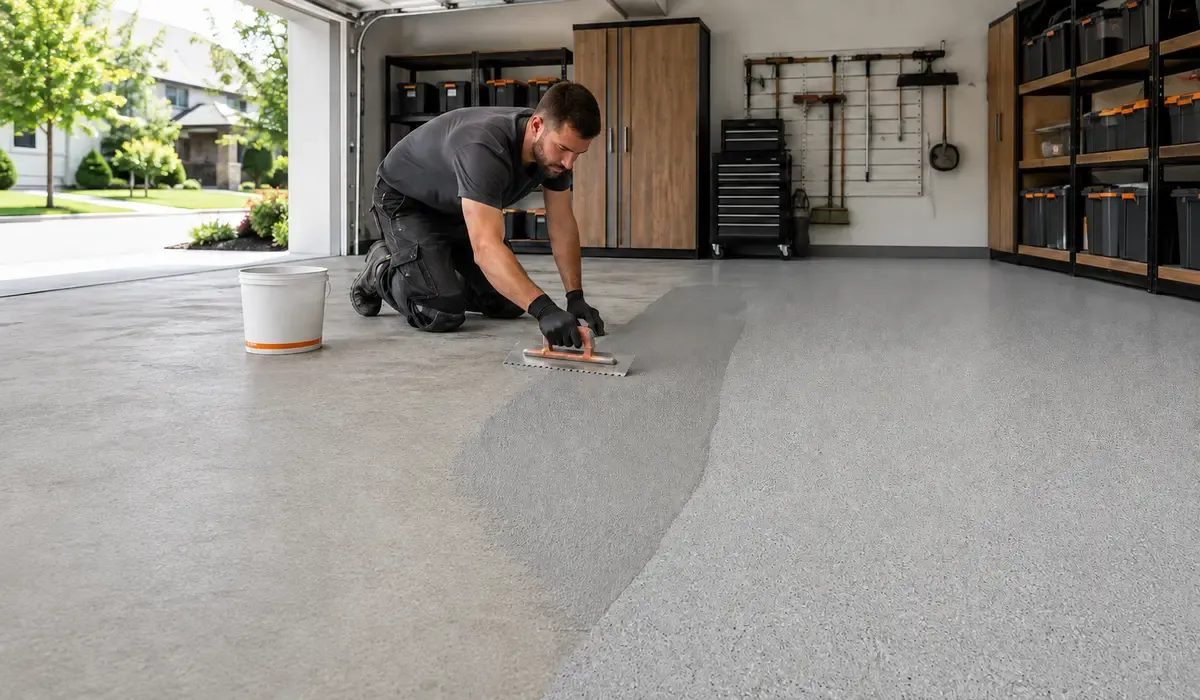
Pour the mixed material onto the prepared concrete floor and spread it evenly.
Application requirements include:
- Use a 3 mm notched trowel
- Spread the material consistently
- Maintain a recommended thickness of approximately 1.0–2.0 mm
- Keep adjacent application areas connected
- Allow the material to self-level
No separate primer is required when the concrete meets the required conditions and has been correctly prepared.
The standard system described in the JUKE TDS also does not require an additional topcoat.
How Much Material Does a Garage Need?
One 24 kg set covers approximately 12 square meters at the recommended thickness.
Use this calculation for an initial estimate:
Garage area ÷ 12㎡ = approximate number of 24 kg sets
For example:
36㎡ ÷ 12㎡ = approximately 3 sets
This is a theoretical estimate. Substrate roughness, unevenness, application thickness, repair areas, and material loss may increase consumption. Allowance should be added after inspecting the floor.
How Long Does the Floor Need to Cure?
After application, protect the floor from dust, water, traffic, and contamination.
According to the JUKE 2026 TDS:
- Surface dry: 4–6 hours
- Hard dry: 24 hours
- Light pedestrian traffic: after 48 hours
- Vehicle traffic: after 72 hours
Actual curing can be affected by temperature, humidity, ventilation, and application conditions.
Do not place a vehicle on the floor before the specified vehicle-traffic curing period has passed.
Performance Requirements for Garage Flooring
Garage flooring must withstand regular traffic, cleaning, equipment, and occasional spills. According to the JUKE 2026 TDS, the system provides:
- Mohs hardness: Level 8
- Compressive strength: ≥80 MPa
- Solid content: approximately 98%
- VOC content: 16 g/L
- Water impermeability: watertight at 0.4 MPa for 2 hours
- Heat resistance: no flowing or bubbling below 80°C
- Low-temperature flexibility: no cracking at −20°C
These are technical performance results and should not be converted into absolute claims such as “scratch-proof” or “resistant to every chemical.”
When Should a Garage Floor Not Be Covered?
Do not apply the system until corrective work has been completed when the concrete has:
- Active structural cracks
- Serious movement or settlement
- Excessive moisture
- Rising damp or water pressure
- Weak or powdering surfaces
- Severe spalling
- Deep, unresolved oil contamination
- Unstable existing coatings
- Large unrepaired height differences
A coating system performs only as well as the substrate beneath it.
Garage Floor Resurfacing FAQ
Does the old concrete need to be removed?
Not when the slab is structurally sound, sufficiently dry, and suitable for repair and preparation.
Is a primer required?
No separate primer is required for the JUKE system when the concrete meets the specified conditions and is properly prepared.
Does the kit include application tools?
The standard set contains the flooring materials—Part A and Part B. Grinding equipment, mixer, notched trowel, cleaning equipment, and other application tools should be prepared separately.
Can the system repair structural cracks?
No. Structural or active cracks must be assessed and repaired before the flooring material is applied.
How soon can a vehicle enter the garage?
The JUKE TDS permits vehicle traffic after 72 hours under suitable curing conditions. Environmental conditions may affect the actual curing time.
Can it be used over garage tiles?
Yes, suitable firmly bonded tiles can also be covered after inspection and correct surface preparation. Read Can You Apply Epoxy Flooring Directly Over Existing Tile? for detailed requirements.
Check Whether Your Garage Floor Is Suitable
Send JUKE Materials photos of the existing floor, the total project area, and information about cracks, moisture, contamination, and current surface condition.
We can help evaluate the application requirements and estimate the required quantity.