
Aug 17, 2026Epoxy Color Sand
How to Choose the Right Epoxy Tile Grout for Wet Areas
Learn how to select epoxy tile grout for bathrooms, kitchens, and commercial tile joints based on moisture exposure, joint condition, color, application, and supplier support.
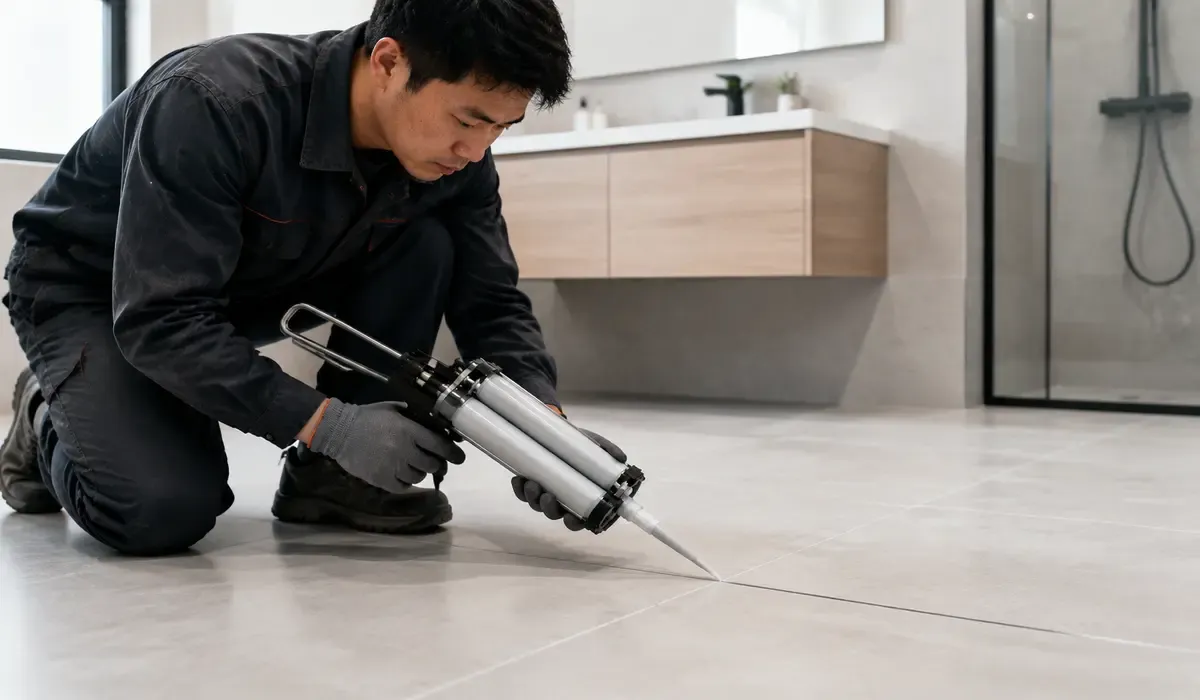
How to Choose the Right Epoxy Tile Grout for Wet Areas
The right epoxy tile grout should match the installation environment, joint condition, tile color, application method, and maintenance requirements.
For bathrooms, kitchens, laundries, retail spaces, and other moisture-prone areas, a two-component epoxy tile grout can provide a denser and more stain-resistant joint than conventional cement-based grout. However, product selection and surface preparation still determine the final result.
What Is Epoxy Tile Grout?
Epoxy tile grout is a two-component material used to fill and seal the joints between tiles. The components are mixed during application and cure to form a dense tile joint.
JUKE Premium Epoxy Tile Grout is supplied in a double-tube format and combines epoxy resin with fine quartz sand. It is intended for tile joints—not for coating an entire floor.
If you need to renovate the complete floor surface, a self-leveling epoxy colored sand flooring system is a different product category.
Where Is Epoxy Tile Grout Commonly Used?
Epoxy tile grout is commonly selected for areas where tile joints are regularly exposed to water, stains, cleaning products, or frequent use, including:
- Bathrooms and shower areas
- Kitchens and backsplashes
- Laundry rooms
- Hotel and apartment interiors
- Restaurants and commercial washrooms
- Retail and public tiled spaces
For swimming pools, permanently submerged joints, food-processing areas, or chemically aggressive environments, confirm the product’s suitability for the specific project conditions before installation.
1. Evaluate Moisture and Stain Exposure
Start by considering what the tile joints will encounter during normal use.
Bathroom joints need resistance to moisture and frequent cleaning. Kitchen joints may be exposed to grease, coffee, sauces, and household cleaners. Commercial spaces may require more frequent maintenance and greater wear resistance.
A dense epoxy grout surface generally absorbs less moisture and staining than porous cement-based grout, making it easier to maintain in demanding areas.
This does not eliminate the need for correct installation, cleaning, ventilation, or movement-joint design.
2. Inspect the Existing Tile Joints
Before applying any grout, check the condition of the tiles and joints.
The joints should be:
- Clean and free from dust
- Dry before application
- Free from loose grout, oil, soap, and contaminants
- Deep enough to accept the new material
- Surrounded by stable, securely bonded tiles
Loose tiles, active cracks, water leakage, or structural movement should be repaired before grouting. Epoxy grout should not be used to conceal an unresolved substrate problem.
3. Confirm the Joint Size
Not every grout is suitable for every joint width and depth.
Check the supplier’s recommended application range before purchasing. Very narrow joints require a material that can be placed cleanly without gaps, while wider or deeper joints may require different application control.
Distributors and contractors should test the product with the tile types and joint dimensions commonly used in their market.
4. Match the Grout Color to the Tile
Grout color has a major influence on the finished appearance.
A color close to the tile creates a more continuous and subtle surface. A contrasting color makes the tile pattern and joint lines more visible.
Before confirming a large order:
- Compare samples under the project’s actual lighting
- Check the color next to the installed tile
- Allow the sample to cure before making the final decision
- Test on natural stone or porous tiles when staining is a concern
Printed color charts and screen images should only be used as initial references because lighting, tile finish, and display settings can change how a color appears.
5. Consider Application and Cleaning
Two-component epoxy grout must be applied according to the supplier’s instructions.
Installers should understand:
- How the two components are dispensed and mixed
- The available working time
- The recommended application tools
- When excess material should be removed
- How the tile surface should be cleaned
- The required curing conditions
Do not assume that all epoxy grouts have identical working times or cleaning procedures. A trial application helps installers confirm handling, color, and finish before starting a large project.
6. Check the Tile Surface
Glossy glazed tiles are generally easier to clean after application than textured, porous, or unsealed surfaces.
Before using epoxy grout on natural stone, matte tiles, textured ceramics, or other absorbent surfaces, complete a small test area. Masking or a suitable protective treatment may be required to prevent surface staining or residue.
7. Choose a Supplier That Supports Your Market
For distributors, tile suppliers, wholesalers, and private-label brands, product performance is only part of the purchasing decision.
A suitable manufacturing partner should also provide:
- Consistent batch quality
- Stable color options
- Clear packaging and application instructions
- Technical and safety documents
- Sample support
- OEM and private-label packaging
- Marketing images and application materials
- Reliable factory-direct supply
JUKE Materials supports international distributors and building-material sellers with factory-direct epoxy tile grout, OEM packaging, product samples, and sales materials.
Epoxy Tile Grout vs. Epoxy Flooring
These products should not be confused.
Epoxy tile grout fills the joints between existing tiles. It preserves the visible tile layout.
A self-leveling epoxy colored sand flooring system covers the full surface and creates a seamless new floor. It may be applied over suitable existing tiles or concrete after the substrate has been inspected and properly prepared.
Choose tile grout when the tiles are in good condition and only the joints need filling or renovation. Choose a full-surface flooring system when the objective is to change the complete floor appearance.
Frequently Asked Questions
Is epoxy tile grout suitable for bathrooms?
It can be suitable for bathroom tile joints because cured epoxy grout provides a dense, moisture-resistant surface. Correct joint preparation, application, curing, and ventilation remain important.
Can epoxy grout be applied over old grout?
Loose, dirty, damaged, or contaminated grout should be removed. The remaining joint must provide sufficient clean depth for the new material to bond and cure correctly.
Is epoxy tile grout completely maintenance-free?
No grout should be described as maintenance-free. Epoxy grout can reduce staining and water absorption compared with conventional cement grout, but it still requires routine cleaning and proper care.
Can epoxy grout repair loose tiles or active cracks?
No. Loose tiles, water leakage, active cracks, and structural movement must be addressed before applying grout.
Is epoxy grout the same as self-leveling epoxy flooring?
No. Epoxy grout is used inside tile joints. Self-leveling epoxy flooring covers the complete floor surface and creates a seamless finish.
Request Samples and Factory-Direct Pricing
Tell JUKE Materials your target market, preferred colors, packaging requirements, and expected order quantity.
We can provide product information, sample support, factory-direct pricing, and OEM packaging options for distributors, wholesalers, tile suppliers, and private-label sellers.